
Healthcare has carried the highest data breach costs of any industry for 13 consecutive years. According to IBM’s 2026 Cost of a Data Breach Report, the average healthcare data breach costs $6.64 million, 33% above the $4.99 million cross-industry average.
The organizations absorbing those costs are not the ones that skipped security. They are mid-market health systems, specialty practices, and multi-location physician groups whose internal IT teams are doing more than they were built to handle.
Managed IT services for healthcare is the model that closes that gap. Not a generic MSP contract with healthcare branding. A service model built around the clinical environment, HIPAA’s Security Rule, and the operational reality of keeping patient care running. This guide covers what that model includes, what HIPAA specifically requires from any IT partner, how to evaluate providers before you grant them access to your clinical environment, and what the right engagement looks like once you do.
In this guide:
- Healthcare cybersecurity trends shaping 2026
- How AI is transforming healthcare cybersecurity threats and defenses
- IT and cybersecurity for orthopedic practices
- IT and cybersecurity for GI practices
- Cybersecurity and 42 CFR Part 2 compliance for behavioral health practices
- What to expect from modern IT services for healthcare
- Cloud, telemedicine, and multi-site network infrastructure
- What healthcare managed security services include
- How healthcare IT risk management works at the frontline
- What the HIPAA compliance checklist requires, and where the proposed Security Rule update stands
- How SRA and risk assessments differ
- How to choose the right SRA partner
- What HIPAA requires from your security partner
- How to choose a HIPAA-compliant MSP
- The 10 must-have managed IT capabilities
- The questions hospitals should ask HIPAA managed IT providers
- The cybersecurity threats hitting healthcare and the regulations they trigger
- Why cybersecurity belongs in the C-suite, and what cyber insurers require
- The strategic security priorities for healthcare IT in 2026
- How to build the healthcare IT budget case
Healthcare Cybersecurity Trends 2026: What IT Leaders Need to Know
The healthcare cybersecurity landscape in 2026 is being shaped by three converging forces: AI-assisted attacks that automate the most resource-intensive parts of a breach, a proposed HIPAA Security Rule overhaul that would make today’s addressable controls mandatory, and the continued growth of connected medical devices that most security stacks are not built to protect. Each of these forces individually would require a security program update. Together, they require a different approach.
According to Sophos’s State of Ransomware in Healthcare 2024, 67% of healthcare organizations were hit by ransomware that year, up from 60% in 2023. Many of those attacks succeeded not because the targets lacked security tools, but because attackers used AI-assisted methods to find the gap those tools missed, moving faster than human analysts could respond. The trend in 2026 is not more attacks. It is more targeted attacks against organizations that have not closed the detection and response gap.
For IT directors and healthcare CIOs, the 2026 trends are not a list of threats to be aware of. They are a benchmark for evaluating whether your managed IT partner’s security capabilities are keeping pace with the environment they are being paid to protect.
Go deeper: The trends reshaping what healthcare IT security programs need to cover in 2026
AI-assisted attacks, the proposed HIPAA control changes, and connected device security: this guide covers the specific trends IT leaders need to understand and what they mean for evaluating your current managed IT partner.
How AI Is Transforming Healthcare Cybersecurity
AI is operating on both sides of the healthcare cybersecurity equation simultaneously. Attackers use large language models to generate phishing messages that mimic clinical communication patterns at scale: lab result notifications formatted to match your EHR, urgent referrals from physicians your staff works with, system alerts that look exactly like the ones your IT team sends. Clinical staff conditioned to respond quickly to patient-related communications are the precise audience these messages are built for.
On the defense side, AI-powered threat detection, specifically UEBA and NDR platforms with machine learning-based anomaly scoring, gives security teams the ability to correlate behavioral signals across a healthcare network at a volume no human analyst team can match. That capability is only as good as the configuration behind it. A UEBA platform deployed without clinical behavioral baselines produces alert fatigue, not detection.
For healthcare organizations that have adopted clinical AI tools, the attack surface extends beyond the network. Model poisoning attacks work by introducing manipulated inputs into a clinical AI’s training pipeline, causing diagnostic tools to produce subtly incorrect outputs over time without triggering a security event. The NIST AI Risk Management Framework introduced GOVERN and MEASURE functions specifically to help organizations identify and monitor AI-specific risks, but operationalizing that coverage in a clinical context remains a challenge most security teams have not yet worked through.
Go deeper: How AI is being used to attack healthcare organizations, and how it is being used to defend them
Automated phishing, synthetic patient identity fraud, model poisoning, and AI-powered detection: this guide covers both sides of the AI-healthcare cybersecurity equation and what HIPAA requires for AI systems processing patient data.
IT and Cybersecurity for Orthopedic Practices
Specialty practices, including orthopedic, urology, and cardiology groups, have become primary ransomware targets. Attackers perceive weaker security controls relative to large health systems, combined with the same high-value patient data and the same HIPAA exposure. The risk profile is the same. The defenses are not.
The five attack vectors hitting specialty practices hardest in 2026 include AI-generated phishing tuned to clinical workflows, unencrypted device exposure from staff using personal devices on clinical networks, credential-based attacks exploiting shared EHR workstations, ransomware variants targeting smaller clinical networks, and vendor-based intrusions through unmonitored BAA relationships.
A managed IT partner serving specialty practices needs to know these attack patterns specifically, not just the general healthcare threat landscape. The security controls that protect a multi-site orthopedic group are different from those that protect a regional hospital, and a provider who cannot describe that difference is not protecting the right target.
Go deeper: The five attack vectors hitting orthopedic and specialty practices hardest in 2026
This guide covers the specific cyber threats targeting orthopedic, urology, and other specialty practices in 2026, including how each attack works in a clinical environment and what a managed IT partner should be doing to address it.
Go deeper: What managed IT for an orthopedic practice has to cover
PACS and imaging workstations, EHR support, and multi-site coverage: this specialty-specific guide covers what an orthopedic practice needs from a managed IT partner.
IT and Cybersecurity for GI Practices
A gastroenterology practice runs more clinical systems than its size suggests: the EHR, an endoscopy reporting system, image capture from the procedure rooms, and pathology interfaces that return results to the chart. Every one of those connections carries protected health information, and every one belongs in the risk analysis.
Detailed procedure histories make GI data a target in its own right. Practices that grow across several sites add a network problem on top: one EHR, one set of compliance obligations, and very different connections at each location.
A managed IT partner for a GI group needs to support the endoscopy environment as a clinical system, not as another workstation, and document HIPAA safeguards across every site the practice runs.
Go deeper: What managed IT for a GI practice has to cover
EHR, endoscopy, and HIPAA in one environment: this guide covers what a GI practice needs from a managed IT partner and where generalist support falls short.
Go deeper: Why attackers go after GI data
This guide covers why gastroenterology practices draw attackers, which threats hit them hardest, and the controls that close the gaps.
Go deeper: What HIPAA requires from a GI practice
Colonoscopy records, PHI, and risk assessments: this guide covers how HIPAA applies to GI workflows and what a GI-specific risk assessment needs to include.
Go deeper: Running IT across multiple GI locations
Networks, EHR access, and compliance across sites: this guide covers what changes when a GI practice grows from one location to several.
Cybersecurity and Compliance for Behavioral Health Practices
Behavioral health records carry a sensitivity most clinical data does not: diagnoses, therapy notes, and substance use history that patients disclose on the assumption it stays private. A breach in this setting costs patient trust in a way a billing data breach does not.
Practices that treat substance use disorders also answer to 42 CFR Part 2, a federal confidentiality rule stricter than HIPAA for those records. The updated Part 2 final rule brought it closer to HIPAA, and compliance has been required since February 16, 2026.
For IT, that means access controls, consent tracking, and disclosure records that hold up under both rule sets, not just one.
Go deeper: Why HIPAA compliance looks different in behavioral health
This guide covers why behavioral health data needs stronger protection than standard clinical records and what that means for your security controls.
Go deeper: What 42 CFR Part 2 means for your network, EHR, and vendors
This guide covers what Part 2 requires from your network, EHR, and vendor stack, and why role-based access alone does not satisfy it.
What to Expect from Modern IT Services for Healthcare
Most healthcare organizations know they need better IT support. Fewer know what that actually looks like in a clinical environment. A generalist MSP can keep email running and reset passwords. A healthcare-ready IT partner supports the EHR, the imaging network, the clinical device infrastructure, and the compliance documentation that regulators ask for when something goes wrong.
The model that fits most mid-market healthcare organizations is co-managed IT: the internal team retains clinical workflow knowledge and institutional context, and the external partner contributes the security depth, 24/7 coverage, and HIPAA compliance expertise that the current environment requires. The internal team’s clinical knowledge is irreplaceable. What most teams are missing is the specialized capability that sits around it.
The difference between a healthcare-ready IT partner and a generalist provider shows up in the first conversation. A provider with genuine clinical experience answers questions about HL7 interface monitoring, clinical-down SLA definitions, and medical device security in operational terms. A generalist answers the same questions in product feature language.
Go deeper: What does a modern healthcare IT engagement actually include?
Co-managed IT, clinical-aware help desk, EHR support, and HIPAA compliance. This guide covers what the model includes, who it fits, and what separates a healthcare-ready partner from a generalist provider.
| Evaluation Criteria | Full Managed IT | Co-Managed IT | Internal-Only |
|---|---|---|---|
| Who it fits | Organizations with no internal IT function or with compliance maturity too low to manage HIPAA obligations internally | Organizations with capable internal IT staff who have reached the limits of their security, compliance, or coverage capacity | Organizations with a full internal IT team that can maintain 24/7 coverage, HIPAA compliance documentation, and clinical system depth independently |
| External partner covers | Full IT stack: help desk, network, security monitoring, HIPAA compliance, EHR support, backup and recovery, strategic advisory | Security depth, 24/7 SOC coverage, HIPAA compliance documentation, specialized clinical system support, and strategic advisory | None: all IT functions managed internally |
| Internal team covers | Nothing: full operational responsibility transferred to the managed IT partner | Clinical workflows, institutional knowledge, day-to-day operational support, and vendor relationships | Everything: help desk, network, security, compliance, EHR support, backup, and strategy |
| HIPAA compliance responsibility | External partner leads compliance program; covered entity retains legal liability under HIPAA regardless | Shared: external partner manages documentation, risk analysis, and audit readiness; internal team manages clinical workflow compliance | Internal team owns all HIPAA compliance obligations; covered entity retains full legal liability |
| 24/7 security coverage | Provided by external partner's SOC with healthcare-specific detection rules and clinical behavioral baselines | Provided by external partner's SOC; internal team handles daytime operational support | Dependent on internal staffing: most mid-market internal IT teams have after-hours coverage gaps |
| Best for | Organizations opening a first location, scaling rapidly, or with no existing IT infrastructure | Multi-site physician groups, regional health systems, and specialty practices with existing IT staff who need security and compliance depth | Large health systems with dedicated internal IT departments, in-house security operations centers, and full-time compliance staff |
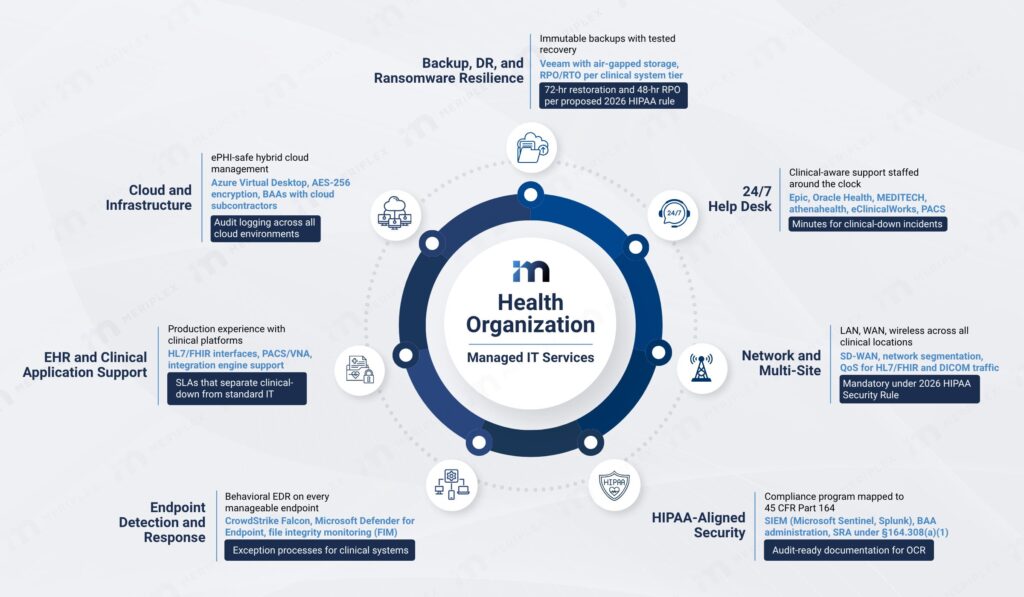
Here is what a complete managed IT services program for healthcare covers across all seven components.
Healthcare IT Infrastructure: Cloud, Telemedicine, and Multi-Site Networks
The services on that map only work as well as the infrastructure beneath them. Cloud platforms host the EHR and the backups, telemedicine runs video visits over the same connections as clinical systems, and multi-site groups depend on a network that keeps every location on the same applications.
Each layer carries its own HIPAA obligation. A cloud provider that stores ePHI is a business associate and needs a signed BAA. A telemedicine platform needs the same encryption and access controls as any other system that handles ePHI. A network that spans several sites needs segmentation that keeps clinical traffic away from guest Wi-Fi and building systems.
Infrastructure is also where performance problems show up first. A video visit that freezes or an EHR that crawls at a satellite clinic is a network design problem before it is a help desk ticket.
Go deeper: How to stay HIPAA compliant in the cloud
BAAs, shared responsibility, and the configuration order that actually works: this guide covers what HIPAA requires when ePHI moves to the cloud.
Go deeper: The IT infrastructure telemedicine depends on
QoS, device segmentation, and a complete BAA chain: this guide covers what to configure before your telemedicine program scales.
Go deeper: What your network needs to handle across sites
This guide covers how SD-WAN prioritizes clinical traffic, keeps multi-site groups connected, and fits into a HIPAA-compliant network design.
Healthcare Managed Security Services: What They Include and Why They Matter
Healthcare managed security services are distinct from general IT support. They are the security-specific layer of a managed IT engagement: continuous monitoring through a dedicated Security Operations Center, Endpoint Detection and Response calibrated for clinical device traffic patterns, SIEM platforms like Microsoft Sentinel or Splunk configured with healthcare-specific detection rules, and the human analysts who make the contextual judgments that automated tools cannot.
The gap between a managed IT provider who includes security services and one who has genuinely built them for healthcare is visible in the detail. A healthcare-built MDR program has UEBA behavioral baselines that distinguish a night-shift nurse accessing records at 2 AM from a compromised credential running the same pattern. A generic security stack flags both and creates the alert fatigue that makes the real event harder to find.
For organizations evaluating whether their current managed IT provider’s security offer is genuinely integrated or bolted on as an afterthought, the questions that surface this are specific: what detection rules are written for HL7 and DICOM traffic, how passive monitoring handles unmanaged medical devices that cannot host endpoint agents, and what the escalation path looks like for a clinical-impact security event at 3 AM on a Sunday.
Go deeper: What a credible healthcare managed security services program includes, and what basic IT support misses
Threat monitoring, endpoint protection, SRA, backup and recovery, and compliance documentation: this guide covers what each component requires in a clinical environment and what separates a healthcare-built security program from a generic one.
Healthcare IT Risk Management: How Your Support Provider Closes Security Gaps
Most healthcare breaches do not start with a sophisticated attack. They start with a basic IT support failure: a departed employee’s credentials that were never revoked, a device that was never encrypted, a patch that was skipped because no one owned the clinical system exception process. The daily IT support decisions your provider makes are where most healthcare security gaps either open or close.
A risk-managing IT provider treats every support interaction as a potential security signal. Access reviews happen on the day of departure, not the following week. Patch management programs have documented timelines and defined exception processes for clinical systems that require vendor coordination before updates. Audit logs are actively monitored, not just collected. EDR runs on every endpoint, not just the ones that are easy to manage.
The operational behaviors that separate a provider who understands risk from one who runs a help desk are specific and verifiable. The question is whether your current IT provider can describe them in operational detail, or whether they respond to the question with a product list.
Go deeper: How your IT provider's daily decisions are creating or closing your security gaps
Access controls, patch management, audit logs, incident response: this guide covers the specific operational behaviors that separate a risk-managing IT provider from a help desk at the frontline level.
HIPAA Compliance Checklist 2026: A Guide for Healthcare Providers
HIPAA’s Security Rule does not assess intentions. It assesses documentation. When the Office for Civil Rights investigates a breach, the first thing they look for is whether the organization can produce a current risk analysis, documented access controls, workforce training records, audit log reviews, and Business Associate Agreements with every vendor that touches protected health information.
The proposed HIPAA Security Rule update would eliminate the addressable flexibility most organizations rely on. Controls that are addressable today, including multi-factor authentication, network segmentation, and encryption at rest, would become required once HHS finalizes the rule, which the federal regulatory agenda now projects for July 2027. Organizations that wait for the final rule to update their compliance programs are building a gap that will show in the next audit.
A managed IT partner’s role in HIPAA compliance is not to claim the work is done. It is to produce the documentation trail that proves it: risk analysis outputs, access review records, training attestations, BAA inventories, and incident response records, organized by safeguard category and ready to produce within 48 hours of a request.
Go deeper: What OCR expects to find when they investigate, and how to make sure it is there
The 2026 HIPAA compliance checklist covers every documentation artifact OCR looks for, organized by administrative, physical, and technical safeguard category, with what a compliant risk analysis needs to contain.
Go deeper: Where the proposed HIPAA Security Rule update actually stands
The proposal, the controls it would make mandatory, and the current timeline: this guide covers what the update means for your practice and what to do before HHS finalizes it.
Healthcare SRA vs. Risk Assessment: What Is the Difference and Why It Matters
The HIPAA Security Risk Analysis is one of the most consistently misunderstood requirements in healthcare compliance. Organizations routinely conflate it with a general IT security review, a vulnerability scan, or a compliance gap assessment. These are not interchangeable. A HIPAA Security Risk Analysis is a specific regulatory requirement under 45 CFR 164.308(a)(1) with a defined methodology, scope, and deliverable that OCR has articulated in guidance and enforcement actions.
In October 2024, OCR launched a formal Risk Analysis Initiative specifically targeting this requirement, stating that failure to conduct a HIPAA Security Risk Analysis leaves healthcare entities vulnerable to cyberattacks. Risk analysis deficiencies remain the most common finding across OCR’s breach investigations, not because organizations skip security entirely, but because they conduct the wrong kind of assessment and believe it satisfies the regulatory requirement.
A managed IT partner who cannot describe the difference between a HIPAA SRA and a general risk assessment in operational terms is not operating at the compliance depth the regulation requires. This is one of the questions that surfaces genuine healthcare expertise fastest in an evaluation conversation.
Go deeper: Why conflating a HIPAA SRA with a general security review is the most common compliance mistake
This guide covers the specific distinction between a HIPAA-required Security Risk Analysis and a general IT risk assessment, including what OCR looks for in the deliverable and why the difference matters for your compliance record.
How to Vet a Healthcare SRA Provider: 5 Criteria That Matter
A HIPAA Security Risk Analysis is only as useful as the partner conducting it. An SRA completed by a provider who does not understand clinical workflows, ePHI data flows through EHR integrations, or the specific risk profile of medical devices on a clinical network will produce a deliverable that satisfies a checkbox without actually mapping the organization’s exposure.
The right SRA partner describes a structured methodology that maps ePHI flows across all systems, including cloud environments, remote access points, and EHR integrations with platforms like Epic, Oracle Health, or MEDITECH. They assign risk levels, produce a remediation roadmap with prioritized findings, and deliver documentation that an OCR investigator would recognize as thorough and current.
Asking to see a sample SRA deliverable from a comparable healthcare client is one of the most effective ways to separate providers who have done this work from those who describe doing it. Providers who have managed real SRAs for clinical organizations produce the documentation without hesitation.
Go deeper: What to require from an SRA partner before they touch your compliance program
Methodology, ePHI flow mapping, clinical system scope, and what the deliverable should contain: this guide covers the selection criteria for choosing an SRA partner who satisfies what OCR actually requires.
MSSP for Healthcare: What HIPAA Requires from Your Security Partner
HIPAA does not reduce your liability because you outsourced the security work. The covered entity remains responsible regardless of who operates the controls. What HIPAA does require is that any vendor accessing, processing, storing, or transmitting protected health information signs a Business Associate Agreement and demonstrates that their operations satisfy the Security Rule’s requirements under 45 CFR Part 164.
The six criteria that a qualified healthcare MSSP must satisfy cover the full scope of what HIPAA demands from a security partner: a signed BAA with defined breach notification obligations, documented risk analysis support, explicit mapping to the four technical safeguard categories in 45 CFR 164.312, a tested incident response plan that includes the four-factor breach determination under 45 CFR 164.402, a defined approach for connected medical devices that cannot be patched, and continuous generation of audit-ready documentation under 45 CFR 164.316.
The HITECH Act extended HIPAA liability directly to business associates, meaning your MSSP can be held independently liable for breaches, not just your organization. Providers who understand this speak to it without prompting. Providers who treat the BAA as a contract checkbox have told you something important about how they will operate once the contract is signed.
Go deeper: The six HIPAA criteria every healthcare MSSP must satisfy, with the questions to verify each one
BAA obligations, risk analysis support, technical safeguard mapping, incident response standards, medical device controls, and audit documentation: this guide covers what HIPAA specifically requires from your security partner and what gaps look like under OCR scrutiny.
HIPAA-Compliant MSP: How to Choose the Right Healthcare IT Partner
Every managed IT provider in this space claims to be HIPAA-compliant. The claim has become so uniform it no longer carries information. A genuinely HIPAA-compliant MSP operates a documented compliance program, employs staff with healthcare-specific expertise, maps their services to specific Security Rule citations, and can demonstrate their compliance posture under scrutiny, not just in a sales conversation.
The selection criteria that determine whether a provider is actually qualified go beyond the standard RFP checklist. A signed BAA is a prerequisite, not a differentiator. What differentiates a qualified provider is their ability to describe how the BAA shapes their operational procedures, how they conduct a HIPAA Security Risk Analysis versus a general security review, and what their incident response process looks like specifically for a healthcare breach determination under 45 CFR 164.402.
Providers who hold SOC 2 Type II certification have had their own security controls independently audited. That is a meaningful signal for organizations that need to verify a partner’s security posture before granting access to clinical systems and ePHI.
Go deeper: The selection criteria that separate a genuinely HIPAA-compliant MSP from one that says it is
BAA obligations, SRA methodology, incident response standards, and subcontractor accountability: this guide covers what to require from any MSP before granting access to your clinical environment.
10 Must-Have Managed IT Capabilities for Healthcare Organizations
Choosing a managed IT partner for a healthcare organization is not a standard IT procurement decision. It is a risk management decision with patient safety and regulatory consequences. The capabilities that determine whether a provider can actually protect a clinical environment go beyond help desk SLAs and uptime guarantees. They include clinical-specific detection rules, EHR production experience, tested ransomware response runbooks, and a documented approach to connected medical devices that cannot be patched on standard timelines.
The 10 capabilities that matter most in a healthcare managed IT evaluation are not weighted equally for every organization. A multi-site physician group will rank unified help desk and multi-site network management higher.
A regional health system preparing for the proposed HIPAA Security Rule update will prioritize HIPAA-aligned compliance documentation and SOC capability. The scorecard is a tool for surfacing where a provider is genuinely strong and where they are hoping you will not ask. Providers who welcome the evaluation questions in this framework have done the work. Providers who generalize, redirect to product demos, or cannot answer in operational specifics have told you what you need to know.
Go deeper: The 10 capabilities to require from any managed IT provider, with the evaluation questions to ask for each
From 24/7 clinical-aware help desk to EHR support, ransomware resilience, and vCIO services: this scorecard covers what to require from a healthcare managed IT partner and how to evaluate responses across all 10 capability areas.
Questions to Ask HIPAA Managed IT Providers: A Hospital Evaluation Guide
Standard hospital RFPs ask managed IT providers to confirm capabilities they already know how to confirm: 24/7 support, BAA signing, prior healthcare experience. None of those answers reveal whether a provider understands the operating reality of a hospital. The questions that surface operational knowledge are the ones that require specific, documented responses rather than a rehearsed pitch.
Twelve questions organized across four risk categories, HIPAA documentation, cybersecurity, ransomware resilience, and subcontractor accountability, give hospital CIOs and procurement teams a framework for evaluating providers in real time rather than in hindsight. The questions are designed to be asked during a vendor conversation, not submitted in an RFP where providers have time to craft the ideal answer.
The dynamic that these questions create is consistent: providers who have done this work answer in operational detail. Providers who have not generalize, deflect, or redirect toward product demonstrations when the questions get specific. That response pattern is itself the most important answer in the evaluation.
Go deeper: 12 specific questions to ask any HIPAA managed IT provider before signing, organized by risk category
HIPAA documentation depth, ransomware response runbooks, subcontractor accountability, and clinical SLA definitions: this guide covers what a strong answer looks like versus a rehearsed one across all four risk categories.
Cybersecurity Threats and Regulatory Consequences in Healthcare
Understanding the threat landscape and the regulatory stack that governs it are two sides of the same problem. Each attack type triggers specific HIPAA provisions. Each regulatory requirement exists because a specific threat exploited a specific gap. The two guides below cover both sides.
Go deeper: What each cybersecurity threat costs operationally and which HIPAA provisions it triggers
Ransomware, phishing, supply chain attacks, IoMT exploits, and credential compromise each produce two simultaneous damage tracks: immediate clinical disruption and a mandatory regulatory event with its own notification deadlines. This guide covers what happens when each threat hits and what your controls need to cover before it does.
Go deeper: The full regulatory stack, what is mandatory, and where OCR is actively enforcing in 2026
Two regulations carry mandatory legal weight. The remaining frameworks are voluntary but activate legal protections during OCR investigations when documented consistently for at least 12 months. This guide covers what is mandatory, what is not, and what the enforcement pattern looks like right now.
Healthcare Cyber Risk Management: Why Cybersecurity Belongs in the C-Suite
Healthcare organizations that treat cybersecurity as an IT department problem recover from incidents more slowly, perform worse in audits, and spend more on remediation than those that treat it as an enterprise risk management function. The difference is not the technology. It is where accountability sits in the organizational structure and how cybersecurity risk is represented in board-level reporting.
When cybersecurity risk sits in the enterprise risk register alongside financial, operational, and patient safety risk, rather than subordinated to IT, the governance decisions that determine how well an organization responds to a breach are made at the right level with the right context. The board understands that a ransomware event affecting clinical systems is not an IT outage. It is a patient safety event with regulatory consequences.
For mid-market healthcare organizations without a dedicated CISO, a managed IT partner with vCIO or fractional CISO capability fills the gap between operational IT support and board-level security accountability. In the current threat and regulatory environment, that function is the difference between a security program that holds up under scrutiny and one that does not.
Go deeper: The governance framework that connects security operations to board-level accountability
This guide covers why cybersecurity belongs in the C-suite in a healthcare organization, how enterprise risk governance changes security outcomes, and what the reporting structure should look like for mid-market health systems.
Go deeper: Why HIPAA compliance doesn't make you insurable
Cyber insurance requirements for medical practices go beyond HIPAA: this guide covers what underwriters ask for and where a compliant practice can still fall short.
Healthcare IT Security in 2026: A Strategic Guide for CIOs and IT Leaders
Healthcare CIOs and IT directors heading into 2026 are managing a security program whose requirements have changed faster than most programs have updated to reflect them. The proposed HIPAA Security Rule update, the continued expansion of connected medical devices, and the emergence of AI-assisted attacks on clinical targets have reshaped the security priorities that actually reduce risk in a clinical environment.
The six priorities that determine whether a healthcare organization’s security program is built for the current environment cover the governance, technical, and operational decisions that separate organizations that recover well from incidents from those that do not. They are not a generic cybersecurity framework applied to healthcare. They are priorities derived from the specific operational reality of clinical environments and the regulatory obligations that govern them.
For organizations aligning their security program to the NIST Cybersecurity Framework (CSF) 2.0, which structures security operations across Identify, Protect, Detect, Respond, and Recover, the strategic layer is where those functions connect to board-level accountability and clinical operations. Without that connection, the framework is a document rather than a program.
Go deeper: The six security priorities healthcare CIOs need to address in 2026
This strategic guide covers the priorities that determine whether a healthcare organization’s security program is built for the current environment or the one from five years ago, including how the proposed HIPAA Security Rule update changes the calculus.
Healthcare IT Budget Planning 2026: What Mid-Market Frameworks Miss
Most healthcare organizations lose the budget argument for managed IT because they are comparing it against the wrong number. The right comparison is not managed IT versus the salary of one IT generalist. It is managed IT versus the fully loaded cost of the current model, including the after-hours incidents, the compliance gaps, and the downtime events that nobody budgeted for because nobody calculated what they cost.
HIPAA compliance costs are almost always underbudgeted because organizations treat them as a single line item. In practice they are three separate categories: maintenance (the ongoing cost of staying compliant), readiness (the periodic work of proving compliance through risk analyses and audit preparation), and remediation (what you spend when a risk analysis reveals gaps). Organizations that collapse all three into one budget line are almost always underfunding prevention and overpaying for remediation.
The number that moves CFOs is not the cost of managed IT. It is the cost of two hours of EHR downtime: lost billable encounters, idle clinical staff, and documentation liability that accumulates before the system comes back online. Put that number in the room and the conversation shifts from ‘why does IT cost this much’ to ‘why haven’t we done this already’.
Go deeper: The three healthcare IT budget categories most organizations undercount, with the benchmarks to fix it
HIPAA compliance split three ways, clinical uptime sized by revenue-at-risk, and security benchmarked at 18-24% of IT spend: this framework covers the cost comparison between managed IT models and the four questions to run before your next budget conversation.
Working with a Managed IT Services Provider for Healthcare
The right managed IT partner for a healthcare organization is not the one with the longest services list. It is the one that can demonstrate clinical-environment experience, map their services to specific HIPAA Security Rule citations, and show you documented proof of how they have performed in a real healthcare incident. Platform-agnostic guidance, defined onboarding processes, and SLAs that distinguish clinical-down events from standard IT outages are the baseline. Everything above that is where the evaluation gets interesting.
Is your IT built for the way healthcare actually runs?
Related Reading
- Healthcare Cybersecurity Trends 2026: What IT Leaders Need to Know
- AI in Healthcare Cybersecurity: What HIPAA Requires When AI Touches ePHI
- Top 5 Cyber Threats Targeting Orthopedic Practices in 2026
- Managed IT for Orthopedic Practices: A Specialty-Specific Guide
- Managed IT for GI Practices: EHR, Endoscopy, and HIPAA in One Environment
- Cybersecurity for Gastroenterology Practices: Why GI Data Is a Target
- HIPAA Compliance for GI Practices: Colonoscopy Records, PHI, and Risk Assessments
- Multi-Location GI Practice IT: Networks, EHR, and Compliance Across Sites
- Cybersecurity in Behavioral Health: Why HIPAA Compliance Looks Different Here
- Cybersecurity & Compliance for Behavioral Health Practices: What 42 CFR Part 2 Means for Your IT
- Co-Managed IT Services for Healthcare: What to Expect from the Right Partner
- Cloud Computing in Healthcare: A Guide to HIPAA Compliance in the Cloud
- How Cloud Can Support Telemedicine and Remote Healthcare Services
- SD-WAN for Healthcare: What Your Network Needs to Handle and Why It Matters Now
- Healthcare Managed Security Services: What They Include and Why They Matter
- Healthcare IT Risk Management: How Your Support Provider Closes Security Gaps
- HIPAA Compliance Checklist 2026: A Guide for Healthcare Providers
- Proposed HIPAA 2025 Security Rule Update: What It Means for Your Practice
- Healthcare SRA vs. Risk Assessment: What Is the Difference and Why It Matters
- How to Vet a Healthcare SRA Provider: 5 Criteria That Matter
- MSSP for Healthcare: What HIPAA Requires from Your Security Partner
- HIPAA-Compliant MSP: How to Choose the Right Healthcare IT Partner
- 10 Must-Have Managed IT Capabilities for Healthcare Organizations: An Evaluation Guide
- Questions to Ask HIPAA Managed IT Providers: A Hospital Evaluation Guide
- Cybersecurity Threats in Healthcare: What Happens When One Hits
- Healthcare Cybersecurity Regulations: What HIPAA Actually Requires
- Healthcare Cyber Risk Management: Why Cybersecurity Belongs in the C-Suite
- Why Being HIPAA Compliant Doesn’t Mean You’re Insurable
- Healthcare IT Security in 2026: A Strategic Guide for CIOs and IT Leaders
- Healthcare IT Budget Planning 2026: What Mid-Market Frameworks Miss