
Why the SRA Requirement Is Non-Negotiable for Healthcare Providers
How do you choose an SRA provider for a healthcare organization?
Choosing an SRA provider for healthcare requires evaluating five criteria: healthcare-specific expertise including familiarity with EHR platforms and clinical workflows, a comprehensive methodology covering HIPAA’s three safeguard categories, clear reporting that produces actionable findings not technical documentation, post-assessment remediation support, and a verifiable track record with healthcare organizations of comparable size and complexity.
For IT leaders and CIOs at mid-sized healthcare practices, the Security Risk Assessment is both a HIPAA requirement and a practical security tool. The problem is not whether to conduct one. The problem is finding a provider SRA partner with the depth and healthcare-specific knowledge to conduct it correctly. Most practices turn to specialized SRA providers to perform the assessment, but the quality of a provider SRA varies significantly based on the assessor’s methodology, healthcare familiarity, and what they deliver after the report is written.
83% of physician practices have already experienced a cyberattack, and OCR’s enforcement data confirms that organizations without a documented, current risk analysis face disproportionate regulatory scrutiny. The right SRA provider does not just identify compliance gaps. They produce a risk management foundation that satisfies auditors, strengthens your cyber insurance position, and gives your IT team a prioritized remediation plan.
The distinction between a provider SRA and a broader organizational risk assessment—what each covers, who it applies to, and when each is required—is the subject of Healthcare SRA vs. Risk Assessment: What Is the Difference and Why It Matters. This guide focuses specifically on how to evaluate and select the right SRA partner for your healthcare environment.
The SRA is one piece of a larger managed IT services program. The complete guide to managed IT services for healthcare shows how the pieces connect.
Not Sure Whether Your Current SRA Provider Has the Healthcare Depth OCR Expects to See?
HIPAA Enforcement Is Active, Not Theoretical
The HIPAA Security Rule’s risk analysis requirement requires covered entities and business associates to perform an accurate and thorough assessment of potential risks and vulnerabilities to the confidentiality, integrity, and availability of ePHI. In one 2024 enforcement action, a physician services organization that had acquired an orthopedic practice paid a $240,000 HIPAA civil monetary penalty following three ransomware attacks on systems containing ePHI, partly because investigators found the organization had not fully implemented required security processes.
A proper provider SRA is your first line of defense against that outcome. It systematically uncovers where your practice is falling short of HIPAA’s safeguards before auditors or attackers find those gaps. The cybersecurity threats most likely to exploit those gaps in a healthcare environment is useful context for understanding what your SRA findings actually need to prioritize. What OCR expects to find documented during an investigation—risk analyses, remediation evidence, and training records—is covered in the HIPAA Compliance Checklist 2026: A Guide for Healthcare Providers.
Cyber Insurance Applications Increasingly Require SRA Evidence
Cyber insurance underwriters now ask specifically about your risk assessment process as part of evaluating applications and renewals. A thorough SRA with a documented remediation plan demonstrates to underwriters that you are taking a structured, proactive approach to cyber risk, which can influence premium negotiations and policy terms. An SRA provider who understands insurance requirements gives you a compliance review and insurance preparation in one engagement.
The Real Cost of Getting It Wrong
Healthcare data breaches carry costs that extend far beyond regulatory fines. According to IBM’s 2026 Cost of a Data Breach Report, the average healthcare data breach costs $6.64 million, the highest of any industry. A well-executed SRA is one of the most cost-effective tools available to prevent these outcomes.
How to Choose the Right SRA Provider for Your Healthcare Practice
1. Healthcare-Specific Expertise
A provider SRA partner must understand healthcare IT without needing to be briefed on it. This means familiarity with EHR platforms including Epic, Oracle Health, and athenahealth, PACS imaging systems, HL7 interfaces, and the privacy regulations governing how ePHI flows through a clinical environment. An assessor who does not understand clinical workflows will produce a risk analysis that looks complete on paper but misses the vulnerabilities that matter in a healthcare setting.
Healthcare has specific technical constraints that generalist IT security firms do not encounter: legacy software on imaging workstations that cannot be updated without vendor coordination, and medical devices with vendor-managed firmware that cannot host security agents. Ask any prospective SRA provider to describe how they have handled these constraints in previous healthcare engagements. A provider with genuine healthcare depth will answer in operational detail without prompting.
2. Comprehensive and Tailored Methodology
The right SRA provider uses a well-rounded framework such as NIST CSF or HIPAA Security Rule guidelines to ensure no aspect of security is overlooked. The assessment must cover all three HIPAA safeguard categories: technical safeguards covering network security, device encryption, and backup processes; administrative policies covering staff training and incident response plans; and physical safeguards covering office security and device access controls.
The assessment should also be scoped and scaled to your specific practice environment. A 20-physician surgical group has materially different risks than a two-location dermatology clinic. Ask the provider how they scope assessments for organizations of your size and complexity, and ask to see the methodology document they use.
3. Clear, Actionable Reporting
The SRA deliverable should give your team a clear picture of what risks exist, what the consequences are if they remain unaddressed, and what to do first. A quality SRA provider delivers an executive summary highlighting key risks and recommended actions, organized by priority so budget and effort go to the vulnerabilities with the highest potential impact.
Ask for a sample report before engaging any provider. If the deliverable is a dense technical document without prioritization or remediation guidance, it will not serve your organization’s actual security needs regardless of how comprehensive the underlying assessment was.
Want to See What a Healthcare SRA Deliverable Should Actually Look Like Before You Commit to a Provider?
4. Post-Assessment Remediation Support
The end goal of a provider SRA is measurable risk reduction, not a report. SRA providers who deliver findings and disengage leave the hardest part of the work to your internal team. Ask any prospective partner whether they offer support after delivery, whether through in-house services or coordination with your existing IT vendor.
The specific questions to ask any managed IT or security provider before granting them access to your clinical environment are covered in Questions Hospitals Should Ask HIPAA Managed IT Providers, including how to evaluate their incident response capabilities and subcontractor accountability.
5. Verifiable Healthcare Track Record
Verify credentials and ask for references from healthcare organizations of comparable size and complexity. Are their assessors certified with credentials relevant to healthcare security such as CISSP, CISA, or HCISPP? Can they share references from orthopedic practices, multi-physician networks, or senior living facilities they have assessed? A provider with genuine healthcare experience will produce specific references without hesitation.
Choose a provider whose communication style is direct and professional. Effective risk assessments require candid conversations with clinical and administrative staff about how systems are actually used. A provider that creates unnecessary anxiety or obscures findings in technical language during the sales process will do the same during the assessment.
How to Select a Cybersecurity Consulting Partner for Hospitals: A Step-by-Step Framework
The selection process for a healthcare SRA provider should be structured. The following framework gives IT leaders and compliance officers a repeatable process for evaluating and selecting a provider SRA partner.
- Document your current state: Before approaching any provider, document your existing risk documentation, last SRA date, current EHR and imaging platforms, number of locations, and any outstanding OCR correspondence.
- Define your primary objective: Are you conducting the SRA primarily for HIPAA compliance documentation, cyber insurance renewal, board reporting, or post-incident urgency? Your objective shapes the deliverable format and level of remediation support you need.
- Request a methodology document: Ask each prospective provider to share their SRA methodology before any proposal. It should reference HIPAA Security Rule requirements explicitly, cover all three safeguard categories, and describe how they handle healthcare-specific constraints.
- Evaluate the sample report: Request a sample SRA report from a comparable healthcare client. Evaluate it for clarity of risk prioritization, specificity of remediation guidance, and whether the executive summary is usable by leadership without an IT translator.
- Check credentials and references: Verify assessor certifications and speak directly to at least one reference from a healthcare client of comparable size. Ask specifically about the quality of remediation guidance and whether findings were accurate to the actual risk environment.
- Clarify post-delivery support: Confirm in writing what support is included after the report is delivered: remediation planning assistance, follow-up questions, and whether a follow-up assessment is included or available at a defined cost.
- Evaluate communication fit: The SRA process requires candid conversations with your staff about how systems are actually used. If the provider’s communication style during the sales process is technical or evasive, that pattern will continue during the assessment.
Use this scorecard to evaluate any SRA provider before you commit.
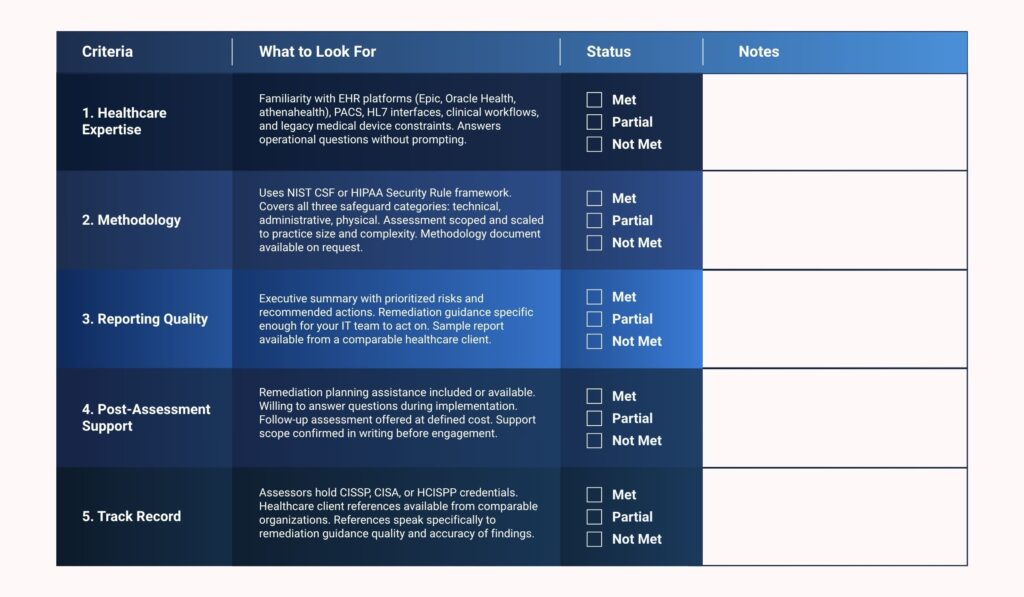
Download the SRA Provider Evaluation Scorecard to bring into your next provider conversation.
Conclusion: The Right SRA Provider Changes the Outcome
A HIPAA Security Risk Assessment conducted by the right provider satisfies the regulatory requirement, produces a credible compliance record for OCR and insurers, and gives your IT team a specific, prioritized roadmap for reducing the risks that matter most in your clinical environment. A generic assessment conducted by a provider without healthcare depth does none of these reliably.
An assessor who understands healthcare IT’s constraints, communicates clearly, and stays engaged through remediation is not a premium offering. It is what an accurate and thorough risk assessment, as HIPAA requires, actually takes. The security partner obligations that belong in your BAA connect directly to your SRA program.
In healthcare, the gap between a compliant SRA and a paper exercise is the gap an attacker or an auditor walks through. What the full healthcare cybersecurity regulatory stack requires in 2026, from mandatory HIPAA provisions to the voluntary frameworks that reduce OCR penalty exposure, gives that gap its legal and financial context.