
What is healthcare cyber risk management?
Healthcare cyber risk management is the practice of treating cybersecurity as an enterprise governance function rather than an IT department responsibility. It requires board-level oversight, C-suite accountability, integration of cyber risk into enterprise risk management frameworks, and alignment of cybersecurity strategy with patient safety and clinical continuity objectives.
When ransomware struck Britain’s National Health Service in 2017, ambulances were diverted and surgeries canceled. The incident was not an IT failure. It was an enterprise governance failure: cybersecurity had not been treated as a patient safety risk, and the organization had no governance structure to respond at the speed and scale the crisis required. For healthcare executives, that incident marked a threshold. Healthcare cyber risk management has since evolved from a back-office IT concern into a critical enterprise risk function that demands board and C-suite ownership.
Cyber threats today do not just threaten data. They threaten the entire functioning of a healthcare organization. A ransomware attack can halt clinical operations for days, jeopardizing patient outcomes and community trust. The cybersecurity threats hitting healthcare organizations hardest in 2026 covers what each attack type costs operationally and which HIPAA provisions it triggers when governance structures are not in place to respond. A breach of protected health information can trigger HIPAA penalties and erode patient confidence. These stakes have elevated healthcare cybersecurity risk management to the boardroom. 70% of US hospital boards now include cybersecurity in their risk management oversight, reflecting recognition that cyber risk is enterprise risk. The governance model that most healthcare organizations still operate under has not kept pace with that recognition.
Is Your Cybersecurity Governance Structure Keeping Pace With the Threat Environment Your Organization Is Operating In?
The Rising Cyber Threat in Healthcare
Why Healthcare Is a Primary Target
Hospitals and health systems hold a trove of sensitive data, from personal identifiers and financial records to medical research, making them prime targets for cyber thieves and nation-states. According to IBM’s 2026 Cost of a Data Breach Report, the average healthcare breach costs $6.64 million, 33% above the cross-industry average. But beyond monetary cost, cyber incidents can put lives on the line directly. When hackers lock up electronic health records or disable networked medical devices, doctors can lose access to critical patient information and tools in the middle of care delivery.
Experts now urge hospitals to view cybersecurity as a patient safety, enterprise risk, and strategic priority woven into the organization’s risk management and continuity frameworks. The US government regards cyber threats to hospitals as a public safety matter, on par with other strategic threats. Healthcare cyber risk management is not a compliance exercise. It is an operational necessity.
Why IT-Led Cybersecurity Falls Short
Traditionally, many healthcare organizations managed cybersecurity through their IT departments, viewing it as a technical problem of protecting systems and data. This IT-centric approach is proving inadequate. A Ponemon Institute study found only about 36% of IT security professionals believed their senior leadership saw cybersecurity as a strategic priority, and roughly 68% of boards were not being briefed on cyber risks or defenses. Treating cyber as an IT issue kept it off the radar of the C-suite and board until a crisis hit.
Siloing cybersecurity under IT creates dangerous blind spots. Cyber risk touches clinical operations, finances, compliance, and reputation simultaneously. As the American Hospital Association’s cybersecurity advisory notes, governance of cyber risk often remains siloed, with risk reports sitting with CIOs rather than Chief Medical Officers, and risk assessments failing to connect cyber controls to patient safety outcomes. IT has much more control over systems than it does over human behavior, whereas the C-suite has the most influence on the behavior and culture of an organization. Many hospitals still treat cybersecurity as a siloed IT issue, leaving critical gaps in preparedness.
From IT Issue to Enterprise Risk Function
Board and C-Suite Accountability
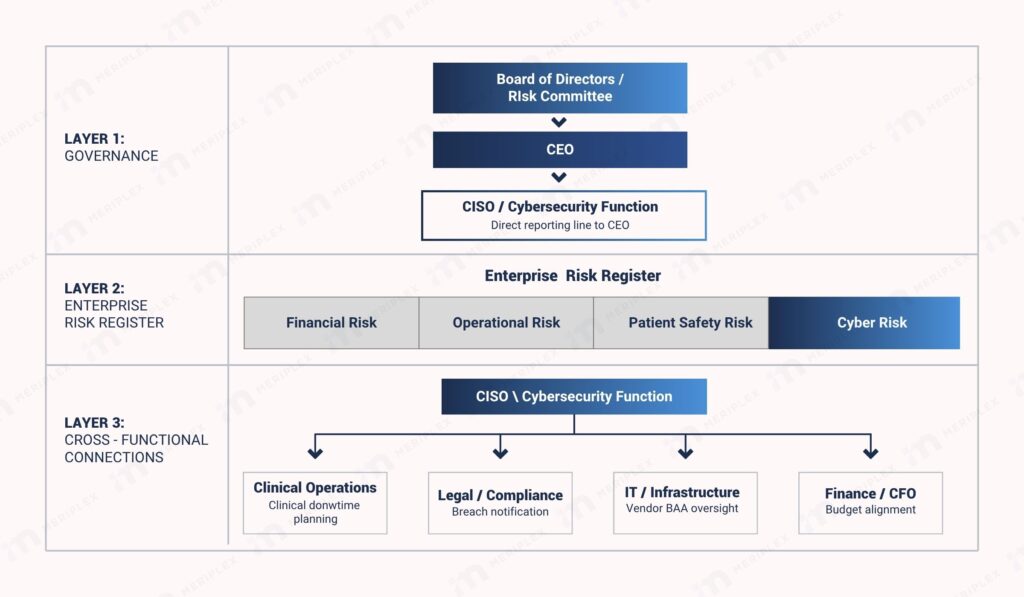
Shifting to a risk-led cybersecurity strategy means elevating cyber risk to the same plane as other major enterprise risks. Healthcare boards and CEOs must treat cyber threats as first and foremost a patient safety and care delivery risk issue. The American Hospital Association recommends that boards elevate cyber risk to an enterprise risk management issue, on par with patient safety and quality of care. This involves establishing a board-level risk or audit committee that includes cybersecurity in its charter and receives regular briefings on the organization’s cyber risk profile and mitigation efforts.
Executive leadership should assign a high-ranking sponsor for healthcare cybersecurity risk management, whether a Chief Information Security Officer with a direct line to the CEO or a Chief Risk Officer who ensures cyber is part of enterprise risk discussions. The reporting structure is critical. If a CISO is buried under a CIO with limited board access, warnings may never reach decision-makers in time. Forward-thinking hospitals are giving security leaders the status, authority, and independence needed to be effective.
Integration Into Enterprise Risk Management
A risk-led approach means integrating healthcare cybersecurity risk management into enterprise frameworks and culture. Cyber risks should be included in the hospital’s enterprise risk register, assessed alongside strategic, financial, and operational risks. This cross-functional integration forces a holistic view: the cybersecurity team must collaborate with clinical operations, finance, legal, and other departments to identify where cyber threats intersect with business processes and patient care.
As one AHA guide notes, effective hospital cybersecurity requires close integration and cooperation among the cybersecurity function and all business, operations, administrative, and clinical functions. The process for onboarding a new medical device or third-party vendor should involve cyber risk evaluation as a governance step, not just a procurement decision made in isolation. The contractual and compliance obligations that govern your security partners under HIPAA’s business associate requirements are the contractual layer that makes this governance framework enforceable.
Not Sure Whether Your Vendor Onboarding Process Includes the Cyber Risk Evaluation OCR Expects to See?
Culture as a Governance Outcome
Viewing cybersecurity as a risk function shifts organizational mindset. Leadership sets the tone that a top-down culture of cybersecurity is as non-negotiable as the culture of patient safety. When executives champion healthcare cyber risk management, employees across the organization are more likely to take ownership of their role in protecting it. The goal is to leverage healthcare’s existing culture of care and extend it to cyber care. Staff should understand that practicing good cyber hygiene is a form of protecting patients, analogous to handwashing and infection control, but for digital systems.
In a risk-led paradigm, success is measured not just by IT metrics like number of patches applied, but by risk outcomes: reduced likelihood of a breach that disrupts care, faster recovery times, and minimized impact on patients if an incident occurs.
Benefits of a Risk-Led Healthcare Cyber Risk Management Strategy
Patient Safety and Clinical Continuity
When cyber risk is managed at the enterprise level, defenses focus on what matters most: keeping patients safe and care uninterrupted. A risk-led strategy prioritizes safeguarding the availability and integrity of critical systems and medical devices so that attackers cannot endanger patients. This directly supports the hospital’s mission of delivering reliable care rather than treating data protection as a separate objective.
Executive Alignment and Informed Decision-Making
With leadership involved, cybersecurity efforts align to business priorities. Executives can weigh cyber risks in terms of impact on strategic goals and allocate resources to the most critical exposures. Regular board reporting on cyber risk ensures accountability and continuous improvement rather than set-it-and-forget-it complacency. This leads to more proactive decisions, for example investing in backup systems or network segmentation where it reduces the greatest organizational risk.
Financial and Regulatory Risk Reduction
Treating cybersecurity as an enterprise risk helps avoid the massive costs of breaches and downtime. Effective healthcare cyber risk management saves money, ensures regulatory compliance, protects reputation, and supports business continuity. In healthcare, avoiding a single large breach or preventing a days-long shutdown can save not only money but lives. A risk-focused approach also keeps the organization ahead of regulators: HIPAA compliance becomes a natural byproduct of robust risk controls rather than a last-minute scramble. What the full healthcare cybersecurity regulatory stack actually requires in 2026, from mandatory HIPAA provisions to the voluntary frameworks that activate OCR penalty protections, is the right context for building that risk-led compliance program.
Organizational Resilience
A risk-led strategy improves the resilience of the hospital when incidents occur. By integrating cyber into enterprise continuity planning, organizations are better prepared to maintain or rapidly restore critical services during a cyber crisis. Leadership that has planned for ransomware scenarios, with offline data backups and documented downtime procedures, can keep the hospital running when attackers strike. This resilience protects the organization’s reputation and builds trust among patients and the community.
The six operational security priorities that give this governance framework its technical teeth are what determine whether those plans actually work under pressure.
How Healthcare Leaders Can Enable the Shift to Risk-Led Cybersecurity
Five Steps to Enterprise Cyber Risk Governance
Moving to a risk-led healthcare cyber risk management model requires deliberate changes championed by leadership. The following five steps operationalize the shift.
- Establish Governance and Oversight: Make cybersecurity a standing item on the board and executive agenda. Form a board-level committee or expand an existing risk committee’s scope to include cybersecurity risk oversight. Ensure the board is regularly briefed on cyber threats, readiness, and incidents, just as it would be for financial or operational risks. This communicates that cybersecurity is a priority and creates accountability for progress.
- Empower a Capable Security Leader: Designate a senior leader to lead the cybersecurity program and position them appropriately in the organizational hierarchy. For true risk alignment, this leader should have sufficient authority and independence, reporting directly to the CEO or another top executive rather than being several layers down. Invest in this role with the budget and staff needed to manage cyber risk effectively. Every healthcare organization should have someone who wakes up every day focused on cyber risk and can speak the language of both technology and business.
- Integrate Cyber into Enterprise Risk Management: Fold cyber risk assessments into the broader ERM process. Identify key cyber scenarios and evaluate their likelihood and impact alongside other enterprise risks. Assign risk owners, mitigation plans, and track progress over time using the same rigor applied to other organizational risks. The distinction between a HIPAA-mandated security risk analysis and a broader enterprise risk assessment is not semantic — it determines which regulatory requirements apply, who conducts the assessment, and what the deliverable needs to contain.
- Align Policies with Patient Safety Objectives: Reframe cybersecurity policies in terms of protecting patients and critical services rather than technical compliance requirements. Develop incident response plans with multidisciplinary input from IT, clinical operations, communications, and legal so that a cyber incident triggers a coordinated organizational response that prioritizes patient safety and continuity of care. The six operational priorities that translate this governance commitment into a working security program are what determine whether that response plan holds under real incident conditions.
- Foster an Enterprise-Wide Security Culture: Use executive influence to drive cultural change. Communicate to all staff that cybersecurity is everyone’s responsibility and directly tied to the mission of care. Incorporate cybersecurity into patient safety rounds, staff training, and internal communications. When employees understand that a phishing click could take down clinical systems, they are far more likely to follow protocols and raise concerns. Leadership’s active engagement is essential to cultivate this culture. Culture does not change without operational reinforcement. The day-to-day IT risk management behaviors that make executive intent visible at the frontline are what close the gap between governance policy and what staff actually do.
The governance framework that connects those five steps to operational security looks like this.
Key Takeaways for Healthcare Executives
- Healthcare cyber risk management is an enterprise responsibility, not an IT problem: Modern cyber threats can shut down hospitals and endanger patients, making cybersecurity a core enterprise risk that demands board and C-suite attention. Treat cyber risk on par with financial, operational, and patient safety risks in governance and strategy.
- Executive oversight and leadership are critical: Establish board oversight through risk committees and assign clear executive ownership for cybersecurity. Regularly review cyber risk reports and preparedness at the leadership level. Leadership involvement secures the resources and cross-department cooperation needed to stay ahead of threats.
- Integrate cybersecurity into enterprise risk management and culture: Break down silos between IT and the rest of the organization. Embed cyber risk management into enterprise processes including risk assessments, business continuity plans, vendor management, and clinical workflows. Drive a security-aware culture where every staff member understands their role in protecting patient data and systems.
- Focus on risk outcomes and resilience: Shift the mindset from compliance to actual risk reduction. Instead of measuring success by checklists or IT metrics, focus on outcomes like reduced downtime, prevented incidents, and quick recovery. Invest in controls and contingencies that mitigate the highest risks.
- Act before a crisis forces the issue: Cyber threats are growing in frequency and sophistication. Waiting for the perfect moment leaves your organization exposed. The time to elevate cybersecurity into your risk function is before the next attack, not after it. For organizations building that program from the ground up, the complete guide to managed IT services for healthcare is the right starting point.