
Healthcare cybersecurity refers to the practices, technologies, and policies that protect patient data, clinical systems, and medical infrastructure from unauthorized access and cyberattacks. As AI enters both the attacker’s toolkit and the defender’s, healthcare cybersecurity now requires protecting not just data in transit and at rest, but the integrity of the AI systems making clinical decisions. For healthcare executives, that means understanding AI as a source of new risk, not just a security solution.
AI in healthcare cybersecurity describes the use of machine learning and large language models on both sides of the security equation: by attackers automating and scaling threat campaigns against clinical targets, and by defenders using behavioral analytics and AI-powered detection to identify threats faster than human analysts can at volume. For healthcare organizations operating under HIPAA, that dual dynamic has direct implications for compliance posture, clinical operations, and the security infrastructure required to defend against both.
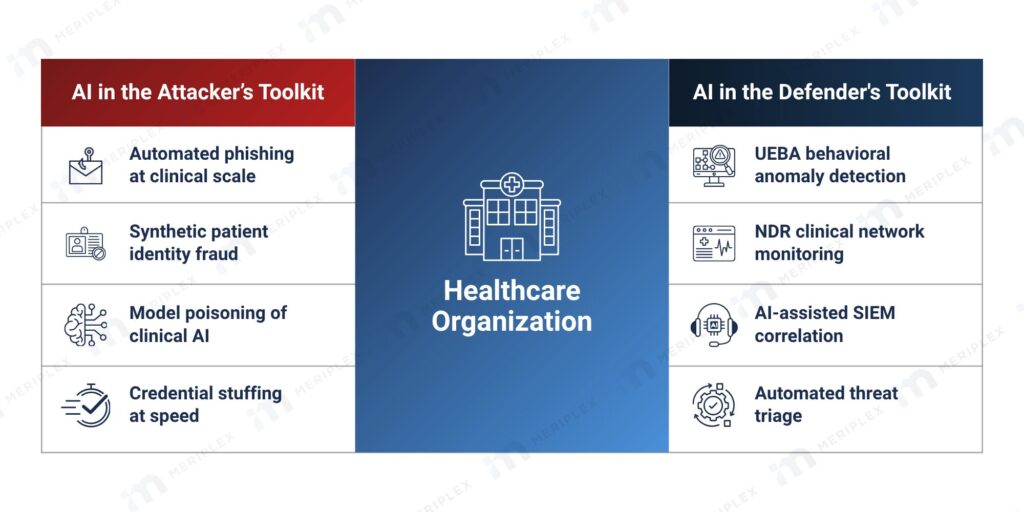
The split is clearer when you see both sides at once.
Want to Know Whether Your Current Security Program Is Keeping Pace With AI-Driven Threats?
Your attackers have access to AI. The question is whether your defenses do too, and whether you understand what AI is doing to the threat itself. According to IBM’s 2026 Cost of a Data Breach Report, the average healthcare data breach costs $6.64 million, 33% above the $4.99 million cross-industry average, and the highest figure of any sector for the 13th consecutive year.
AI did not create that gap. It gave the people responsible for it better tools, faster execution, and attack capacity that previously required a much larger criminal operation.
The defensive promise of AI is real. So is the attack surface it opens. Healthcare executives who understand both sides of that equation will make better decisions than those running on optimism or fear alone.
AI did not make healthcare a target. It made attacking healthcare organizations faster, cheaper, and harder to defend against with the security infrastructure most of them currently have.
Has AI Made Healthcare Cybersecurity Harder to Manage?
Yes, significantly. AI has automated the most resource-intensive parts of a cyberattack, including reconnaissance, social engineering, and credential phishing, reducing the skill and time required to breach a healthcare network. At the same time, AI-powered defenses require expert configuration and continuous tuning to function effectively. For most mid-market healthcare organizations, that expertise gap is the central problem.
Healthcare cybersecurity has always been an asymmetric fight. Defenders have to get everything right, every time. Attackers only have to find one gap.
AI has widened that gap. Threat actors now automate the most labor-intensive parts of an attack: reconnaissance, social engineering, credential phishing, payload delivery, and evasion. Campaigns that used to require skilled operators working over several weeks now run faster, cheaper, and against more targets simultaneously.
According to Sophos’s State of Ransomware in Healthcare 2024, 67% of healthcare organizations were hit by ransomware attacks that year, up from 60% in 2023. Many of those attacks succeeded not because the targets lacked security tools, but because attackers used AI-assisted methods to find the seam those tools missed, moving faster than human analysts could respond.
For healthcare organizations with lean IT teams and clinically stretched staff, that operational shift has direct consequences: more sophisticated attacks arriving more frequently, against the same number of people responsible for stopping them.
What AI-Driven Threats Are Healthcare Organizations Not Prepared For?
The four highest-impact AI-driven threats in healthcare are AI-generated phishing tuned to clinical workflows, synthetic patient identity fraud, model poisoning attacks on clinical AI systems, and misconfigured AI threat detection that produces alert fatigue rather than actual coverage. Each exploits a gap that traditional security frameworks were not designed to address.
How Does Automated Phishing Target Healthcare Workers Specifically?
AI-generated phishing in healthcare works by mimicking the specific communication patterns clinical staff expect, including lab result notifications, urgent referrals, and EHR system alerts, using language models trained on publicly available healthcare data. Because clinical staff are conditioned to respond quickly to patient-related communications, these messages achieve significantly higher engagement rates than generic phishing attempts.
Generic phishing is easy to catch. AI-generated phishing targets the specific way healthcare workers think and act under pressure.
Attackers now use large language models to produce personalized messages at scale, drawing on publicly available data about staff roles, organizational hierarchy, and clinical workflows. The output looks like a lab result notification formatted to match your EHR system, or an urgent referral from a physician your staff actually works with. Clinical staff trained to respond quickly to anything patient-related are the precise audience these messages are built for. The cybersecurity threats hitting healthcare organizations hardest in 2026 covers the full phishing and social engineering pattern, including TOAD campaigns and spam bomb techniques Health-ISAC identified as active against healthcare delivery organizations in 2024.
When the credential theft that follows opens access to your network, the phishing message is rarely what anyone investigates first. By then it has done its job.
What Is Deepfake Patient Data and Why Does It Matter?
Deepfake patient data refers to AI-generated synthetic patient identities constructed from real data fragments and model-generated fill, used to commit insurance fraud, obtain controlled substances, or corrupt clinical records. Unlike financial fraud, manipulated medical records carry patient safety consequences: treatment decisions made from corrupted data can cause direct clinical harm.
AI-generated synthetic patient identities are an active and emerging vector for insurance fraud, controlled substance diversion, and clinical record manipulation. Financial services has tracked this attack pattern extensively. Synthetic identity fraud exceeded $35 billion in losses in 2023 per Federal Reserve data, and those same methods are now being applied to medical records and insurance systems. Healthcare-specific deployment data at scale is still being systematically quantified and should be framed as a documented emerging risk rather than a fully characterized one.
The threat extends beyond financial exposure. When fabricated records enter a patient’s clinical history, treatment decisions follow from corrupted information. Once falsified data is integrated into a health system, it is difficult to correct. Data integrity in healthcare is a patient safety issue with direct clinical consequences.
Model Poisoning: The Slow Attack on Clinical AI
As healthcare organizations adopt AI tools for diagnostic imaging analysis, sepsis prediction, triage support, and clinical decision-making, they inherit an attack surface that most current security frameworks are only beginning to formally address. The NIST AI Risk Management Framework (AI RMF, 2023) introduced the GOVERN and MEASURE functions specifically to help organizations identify, assess, and monitor AI-specific risks including model integrity threats. NIST CSF 2.0, released in 2024, extended its IDENTIFY and PROTECT functions to cover AI system dependencies, but operationalizing that coverage in a clinical AI context remains a practitioner-level challenge most healthcare security teams have not yet worked through.
Model poisoning, specifically data poisoning and backdoor injection attacks, works by introducing manipulated inputs into a model’s training pipeline, causing the system to produce subtly incorrect outputs over time. A diagnostic classifier whose error rate drifts incrementally. A risk-stratification model whose outputs skew in a direction no alert ever flags. The attack does not trigger a security event. It degrades trust in a clinical system gradually enough that the connection between the attack and the outcome may never be formally established.
A model poisoning attack does not announce itself. It degrades a clinical AI system slowly enough that by the time the outputs are wrong enough to notice, the question of when it started and why is nearly impossible to answer without purpose-built monitoring.
AI Threat Detection in Healthcare: What Works and What Doesn't
AI-powered threat detection, specifically User and Entity Behavior Analytics (UEBA) and Network Detection and Response (NDR) platforms with machine learning-based anomaly scoring, gives security teams the ability to correlate behavioral signals across a healthcare network at a volume no human analyst team can match. That capability is real and worth the investment. But the capability is only as good as the configuration behind it.
A UEBA or NDR platform deployed in a healthcare environment without clinical behavioral baselines produces one of two failure modes: alert fatigue from false positives that analysts deprioritize over time, or missed detections because the model never learned what normal looks like in your specific environment. A night-shift nurse accessing records at 2 AM is normal. A traveling physician authenticating from three different states in a week is normal. A third-party medical device vendor running a remote session during a scheduled maintenance window is normal. A model trained on generic enterprise traffic flags all three.
Effective AI threat detection in healthcare requires three things the platform itself does not provide: expert deployment against clinical-specific behavioral baselines, ongoing tuning as workflows and staffing patterns change, and human analysts to make the contextual judgments the algorithm cannot. Organizations that deploy the platform without that surrounding operational capability get the licensing cost without the protection.
Deployed AI Threat Detection Tools But Not Sure Whether They Are Configured for Your Clinical Environment?
Security Information and Event Management (SIEM) platforms, Extended Detection and Response (XDR) solutions, and Zero Trust Network Access (ZTNA) frameworks are increasingly deployed alongside UEBA and NDR in healthcare environments. Each requires the same clinical contextualization to function effectively, and each represents an additional configuration surface that a managed security services program maintains on an ongoing basis rather than a one-time deployment.
The broader threat landscape driving investment in these detection capabilities, including the ransomware trends and attack vectors most commonly targeting healthcare organizations in 2026, is covered in the 2026 healthcare cybersecurity trends guide.
What Does HIPAA Require for AI Systems Processing Patient Data?
HIPAA’s Security Rule, under 45 CFR § 164.312, requires healthcare organizations to implement technical safeguards including access controls, audit controls, integrity controls, and transmission security for any system that creates, receives, maintains, or transmits electronic protected health information. AI and machine learning systems that process ePHI fall within these requirements even though HHS has not yet issued AI-specific implementation guidance.
HHS has not issued comprehensive guidance on how HIPAA’s Security Rule applies to AI and machine learning systems that process electronic protected health information. Healthcare organizations adopting clinical AI tools are making compliance decisions in a regulatory environment where the standards are trailing the technology by several years.
That ambiguity does not suspend your obligations. If an AI tool in your organization ingests, analyzes, or learns from ePHI, the access control, audit control, integrity, and transmission security requirements under 45 CFR § 164.312 apply to that system. How to document that compliance, how to conduct a vendor risk assessment when the model architecture is proprietary, and how to satisfy HIPAA’s breach notification requirements under 45 CFR § 164.400 when an AI system is the compromised component are all questions regulators will expect you to have answered when enforcement eventually formalizes.
HIPAA AI compliance requires more deliberate vendor assessment, tighter data governance documentation, and cleaner risk records now, not after HHS publishes formal AI-specific guidance.
The HHS Office for Civil Rights (OCR), which enforces HIPAA, has signaled increasing focus on AI-adjacent data practices through its existing enforcement actions. Healthcare organizations that treat AI tool adoption as outside the scope of their existing HIPAA risk analysis under 45 CFR § 164.308(a)(1) are building a compliance gap that will be difficult to close retroactively. What the full healthcare cybersecurity regulatory stack requires in 2026 maps those risk analysis obligations to the specific 45 CFR provisions OCR enforces and the voluntary frameworks that reduce penalty exposure when documented consistently.
Why Do Mid-Market Healthcare Organizations Carry the Most AI Security Exposure?
Mid-market healthcare organizations carry disproportionate AI security exposure because they face the same threat landscape and regulatory obligations as large health systems, but without dedicated security operations centers, internal compliance functions, or the compensation structures needed to attract specialized cybersecurity talent. The result is a growing gap between the sophistication of attacks and the capacity to defend against them.
Large health systems run dedicated security operations centers with internal compliance functions and the budget to retain specialized expertise on demand. That infrastructure exists because the regulatory and threat environment requires it.
Regional hospitals, multi-site specialty networks, and independent physician groups face an identical threat environment with a fraction of those resources. Their patient data carries the same market value to attackers. Their regulatory obligations under HIPAA are identical. Their clinical staff are equally susceptible to an AI-crafted phishing message. According to ISC2’s 2025 Cybersecurity Workforce Study, 59% of security teams report critical or significant skills gaps, and healthcare competes for that talent against financial services, technology, and defense sectors that typically offer higher compensation.
The instinct in resource-constrained environments is to solve this with more technology. In practice, adding security tools without the expertise to configure, monitor, and respond to what they surface creates operational overhead, not operational security.
The Solution: What Managed Security Actually Delivers in a Healthcare Environment
In a typical security assessment engagement with a regional health system, the first thing we find is not a missing tool. It is a monitoring gap. The organization has endpoint protection, a next-generation firewall, and often an EDR platform already deployed. What is missing is the continuous, contextualized human analysis of what those tools are surfacing. Alerts are being generated. Nobody with the right expertise is reviewing them at 11 p.m. on a Tuesday when a compromised credential starts moving laterally through the network.
That is the gap managed security services for healthcare close, not by replacing your internal team, but by providing the continuous coverage and specialized expertise that clinical environments require and that most mid-market organizations cannot realistically staff internally. The strategic security priorities that connect those services to enterprise governance, board oversight, and CIO-level decision-making are covered in the healthcare IT security strategic guide for 2026.
Continuous monitoring with clinical behavioral context. A managed detection and response program that uses UEBA baselines built against your specific environment distinguishes between a clinician accessing patient records during an off-hours emergency and a compromised credential running the same query pattern for a different reason. MDR for healthcare means analysts with healthcare-specific operational knowledge making those calls around the clock.
HIPAA compliance support that tracks the technology. As AI tools enter your clinical and operational workflows, the risk analysis documentation required under 45 CFR § 164.308(a)(1), vendor Business Associate Agreements (BAAs), and technical safeguard reviews need to reflect what you are actually deploying. A managed security partner actively monitoring the regulatory intersection with AI is more useful here than an annual compliance audit that looks backward.
Incident response designed around clinical dependencies. When clinical systems go offline, the operational consequences differ materially from a breach in manufacturing or financial services. Notification obligations, recovery sequencing, and operational continuity priorities in healthcare all reflect patient care dependencies. An MDR program built for healthcare accounts for them before an incident occurs, not during one.
AI vendor risk assessment using the NIST AI RMF. Before an AI tool touches ePHI in your environment, its security architecture, training data practices, model governance documentation, and breach history require independent scrutiny. Meriplex conducts that assessment using the NIST AI RMF GOVERN and MEASURE functions as a structured evaluation framework, which provides a documented, defensible basis for the compliance record your organization needs to build now.
The security gap in most mid-market healthcare organizations is not a missing tool. It is the absence of continuous, expert human analysis of what the existing tools are already surfacing, and the expertise to act on it at 11 p.m. when it matters.
Where This Leaves Healthcare Executives
The AI tools entering healthcare this decade will improve clinical outcomes, reduce administrative overhead, and make security operations meaningfully faster. They will also give attackers more convincing phishing campaigns, a new attack surface inside your clinical AI systems, and a compliance environment where the regulations are still being written while your liability is already accumulating.
Healthcare organizations that adopt AI without accounting for its security implications take on risk they have not priced. Those that avoid AI to sidestep that complexity cede operational and clinical ground to competitors who will use it more effectively. The organizations that navigate this well treat AI security as a specific operational problem requiring specific expertise. The governance framework that determines how that expertise is owned and resourced at the organizational level is the subject of healthcare cyber risk management: why cybersecurity belongs in the C-suite.
AI security is one layer of a complete managed IT services program for healthcare. The complete guide to managed IT services for healthcare is where that program starts.