
What are the top cyber threats facing orthopedic practices?
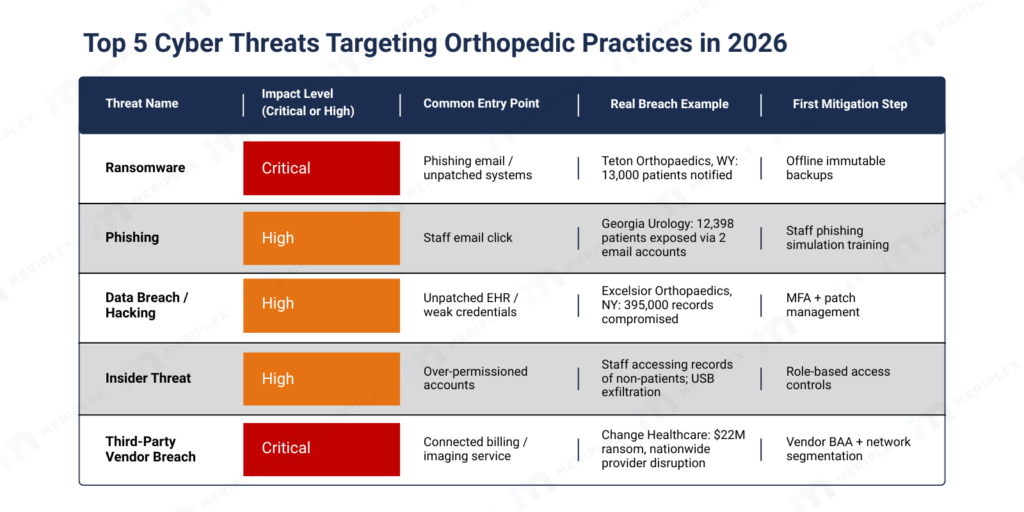
The top five cyber threats targeting orthopedic practices are: ransomware attacks that encrypt patient records and halt operations, phishing emails that compromise staff credentials, direct hacking and data breaches targeting EHR systems, insider threats from staff or vendor misuse, and third-party vendor breaches through connected billing and imaging services. Orthopedic practices are high-value targets because they hold imaging data, surgical records, and insurance information on large patient volumes.
Specialty clinics including orthopedic practices have become primary targets for cyberattacks. These practices manage highly sensitive patient information including imaging archives, surgical records, and insurance data, making them attractive to attackers who know that stolen medical records command significantly higher prices than financial data. By some estimates, protected health information is nearly 50 times more valuable than credit card details on the black market.
The scale of the problem is growing. In 2023 alone, over 133 million individual health records were exposed in breaches, more than double the previous year’s count. Healthcare organizations faced a 45% spike in cyberattacks between late 2020 and early 2021, nearly twice the rate seen in other industries. For orthopedic practices specifically, the risk is compounded by large patient volumes, imaging data that is expensive to recreate, and IT environments that often lack dedicated security teams.
The five threats below are the ones Meriplex sees most frequently in orthopedic environments. Each includes named breach examples with specific figures, because the abstract risk becomes real when you recognize the practice.
Not sure how exposed your orthopedic practice actually is?
1. Ransomware Attacks on Orthopedic Practices
Why Orthopedic Practices Are High-Value Ransomware Targets
Ransomware is the most operationally destructive threat facing orthopedic practices today. CISA defines ransomware as malware designed to encrypt files and render systems unusable until a ransom is paid. For an orthopedic practice, that means patient charts, imaging archives, surgical notes, and billing systems become inaccessible simultaneously. You cannot treat patients or generate revenue until the issue is resolved, with no guarantee that paying the ransom actually restores your data.
Orthopedic practices are attractive ransomware targets for three specific reasons. First, imaging archives are large, expensive to recreate, and immediately necessary for surgical planning. Second, the combination of EHR data, insurance records, and diagnostic imaging means a single practice holds high-value data across multiple categories. Third, the clinical urgency of orthopedic care, where delayed access to imaging can directly affect patient outcomes, creates pressure to pay quickly rather than restore from backups.
Named Breach: Teton Orthopaedics, Wyoming 2024
In 2024, a Wyoming orthopedic practice was struck by a ransomware attack that encrypted its files. Teton Orthopaedics was forced to notify over 13,000 patients that their data may have been compromised. The breach investigation took several months, during which time the practice operated under significant operational constraints. This was not an isolated incident. In 2023, 46 hospital systems fell victim to ransomware, up from 25 the previous year, and smaller specialty clinics are increasingly in the crosshairs.
Protecting Your Orthopedic Practice Against Ransomware
- Maintain offline, immutable backups: Air-gapped or logically isolated backups that ransomware cannot reach; test restoration quarterly against documented RTOs
- Network segmentation: Isolate imaging systems and EHR servers from general workstations so a single infected endpoint cannot spread laterally to clinical systems
- Patch management: Ransomware groups actively exploit known vulnerabilities in unpatched EHR platforms and remote access tools; documented patch cycles with clinical system exceptions are required
- Incident response plan: A rehearsed downtime procedure that allows your practice to continue operating on paper while systems are isolated and restored
2. Phishing and Email Scams in Orthopedic Settings
How Phishing Works in a Clinical Environment
Phishing is the most common entry point for cyberattacks across all healthcare settings, including orthopedic practices. In a phishing attack, criminals send fraudulent emails that impersonate legitimate contacts to trick staff into revealing credentials or installing malware. For orthopedic practices, where front desk staff, billing coordinators, and clinical assistants frequently receive vendor communications, the attack surface is broad and the IT training is often minimal.
One click is all it takes. A phishing email that convinces a staff member to download a file or enter credentials into a fake portal can silently install ransomware, compromise an entire email account, or grant attackers persistent access to your network. Phishing is also the most common trigger for the larger attacks covered in this article.
Named Breach: Georgia Urology 2024
Georgia Urology, the largest urology practice in Atlanta, discovered in late 2024 that two employees’ email accounts had been compromised by attackers, exposing the personal and health information of approximately 12,398 patients. The breach was limited to email contents, but it illustrates how a single successful phishing attack can generate a HIPAA reportable incident affecting thousands of patients. Beyond the regulatory exposure, the practice faced patient notification costs, investigation expenses, and reputational damage from a breach that originated with two compromised accounts.
Protecting Against Phishing in Orthopedic Practices
- Regular phishing simulations: Unannounced simulated attacks that train staff to recognize the specific patterns used against medical offices, not generic corporate phishing templates
- Email security filters: Layered filtering that blocks malicious links and attachments before they reach staff inboxes
- Clear verification policies: Documented procedures requiring phone verification for any unusual payment requests, credential changes, or vendor communications
- Offboarding access revocation: Immediate deactivation of email accounts and credentials when staff leave; a compromised former employee account is an insider threat and a phishing entry point simultaneously
3. Data Breaches and Hacking of Patient Records
The Scale of Orthopedic Data Breach Risk
Orthopedic practices hold data on large patient volumes: names, Social Security numbers, insurance details, imaging archives, and complete surgical histories. Under HIPAA, any unauthorized access to this data triggers notification requirements. In 2023, the number of compromised healthcare records increased by 156% compared to the prior year, reaching over 133 million records. The average healthcare breach now costs $6.64 million per incident according to IBM’s 2026 Cost of a Data Breach Report, the highest of any industry for the 13th year running, factoring in forensic investigation, patient notification, legal fees, and lost business.
Named Breach: Excelsior Orthopaedics, New York 2024
In 2024, Excelsior Orthopaedics in New York discovered that attackers had accessed and copied data from its systems, compromising the records of nearly 395,000 patients and employees. Combined with the related Teton Orthopaedics incident, the total affected across the two breaches exceeded 408,000 individuals. Excelsior Orthopaedics is not a hospital system. It is a specialty practice. The breach demonstrates that orthopedic clinics can hold data on hundreds of thousands of people, making them targets whose value is comparable to much larger organizations.
How Orthopedic EHR Systems Are Compromised
Most orthopedic EHR breaches do not involve sophisticated exploits. The most common entry points are unpatched software vulnerabilities in EHR platforms or remote access tools, weak or reused passwords on administrative accounts, improperly configured cloud storage or backup repositories, and remote access portals that lack multi-factor authentication. Attackers use automated scanning tools to identify practices running outdated EHR versions and target them specifically. A practice running an unpatched version of a widely used orthopedic EHR platform is not a harder target than a hospital. It is an easier one.
- MFA on all remote access: Every EHR login, VPN, and remote access portal requires multi-factor authentication with no exceptions for physician convenience
- Vulnerability scanning: Regular scanning of all systems including imaging workstations and scheduling platforms for known vulnerabilities
- Encryption: All patient data encrypted at rest and in transit so that stolen files cannot be read without decryption keys
- Intrusion detection: Network monitoring that alerts on anomalous access patterns before an attacker can exfiltrate data at scale
Wondering if your EHR and imaging systems would actually hold up to a breach attempt?
4. Insider Threats in Orthopedic Practices
Why Insider Threats Are Harder to Detect Than External Attacks
Not all threats come from external attackers. Insider threats are risks posed by individuals who already have authorized access to your systems: staff members, physicians, IT contractors, and third-party service personnel. Insider threats can be deliberate, such as a disgruntled employee exfiltrating patient records, or accidental, such as a staff member emailing a file containing PHI to the wrong recipient.
Traditional security measures are designed to stop unauthorized outsiders. An insider already has legitimate access, which means their activity can appear routine until significant damage has occurred. In orthopedic practices, where staff frequently access imaging systems, surgical notes, and insurance data as part of normal workflows, the patterns that indicate misuse are harder to distinguish from normal activity.
Protecting Against Insider Threats
- Least privilege access: Each user account accesses only the systems and data required for their specific role; a front desk coordinator does not need access to surgical notes
- Unique user accounts: No shared logins; every action traceable to an individual account for audit purposes
- Behavioral monitoring: Alerts for unusual data downloads, after-hours access, or large file transfers from clinical systems
- Background checks: Screening for staff and contractors who will have access to PHI before credentials are provisioned
- Offboarding procedures: Immediate credential revocation for departing staff and contractors; access should end on the last day, not when IT gets around to it
5. Third-Party Vendor Breaches in Orthopedic Settings
How Third-Party Connections Create Risk for Orthopedic Practices
Orthopedic practices rely on a connected ecosystem of external providers: EHR software vendors, billing clearinghouses, radiology and imaging services, and managed IT providers. Each of these relationships requires some level of access to patient data or clinical systems. Your cybersecurity posture is only as strong as the weakest link in that network. Nearly 60% of healthcare data breaches can be traced to a compromised third-party vendor or business associate.
The risk is twofold. First, a breach at a vendor that stores your patient data exposes that data even though your own systems were never compromised. Second, a disruption at a critical service provider can take your clinical operations offline even if your practice did nothing wrong.
Named Breach: Change Healthcare 2024
In early 2024, a ransomware attack on Change Healthcare, which processes payment and radiology transactions for providers nationwide, brought its systems offline for several weeks. The disruption prevented many healthcare providers from accessing billing and scheduling tools during that period. The parent company ultimately paid a $22 million ransom to resolve the incident. For orthopedic practices that relied on Change Healthcare’s clearinghouse services, the disruption was direct and immediate despite no fault on their part. The incident confirmed that a single vendor compromise can cascade across thousands of connected practices simultaneously.
Protecting Against Third-Party Vendor Breaches
- Business Associate Agreements: Signed BAAs with every vendor that handles PHI before any data access is granted, with specific breach notification timelines and subcontractor coverage requirements
- Vendor security due diligence: Ask about breach history, SOC 2 Type II certification, and HIPAA compliance documentation before signing contracts
- Network segmentation: Vendor access isolated to the specific systems they need so a compromised vendor cannot move through your entire network
- Minimum necessary data sharing: Share only the data each vendor requires to perform their service; limit PHI exposure at the contractual level
- Contingency planning: Documented procedures for continuing operations if a critical vendor goes offline; the Change Healthcare incident showed that vendor downtime can last weeks
What HIPAA specifically requires your security partners to demonstrate in a signed BAA is covered in detail in MSSP for Healthcare: What HIPAA Requires from Your Security Partner.
Data Protection for Orthopedic Practices: What the Risk Actually Looks Like
Data protection for orthopedic practices is not hospital cybersecurity applied at smaller scale. It is a distinct challenge shaped by the specific data types orthopedic practices hold, the vendor relationships they depend on, and the clinical realities of their operating environment.
What Makes Orthopedic Data Protection Different
Orthopedic practices hold three categories of data that create specific protection requirements. Imaging archives, including X-rays, MRIs, and CT scans, are large, expensive to recreate, and immediately necessary for surgical planning. Surgical records contain the kind of detailed personal and medical history that makes PHI valuable to identity thieves and insurance fraudsters. Insurance and billing data connects to financial systems that are attractive to attackers running payment fraud schemes alongside data theft.
The combination of these three data types means an orthopedic practice breach is rarely limited to a single category of harm. A single compromised system can expose imaging data, surgical history, and financial records simultaneously, which is why orthopedic breaches tend to have high patient counts relative to practice size.
IT Risk Assessments for Orthopedic Providers
An IT risk assessment for an orthopedic practice needs to account for the specific vulnerabilities in that environment: imaging workstations running legacy software, PACS systems with vendor-managed access, surgical scheduling platforms connected to hospital networks, and billing clearinghouses with broad data access. A generic IT risk assessment does not cover these adequately.
OCR expects covered entities to conduct documented risk assessments that map ePHI flows across all systems including imaging archives, remote access points, and third-party integrations. For orthopedic practices, that mapping is more complex than a standard clinic because of the volume and variety of connected systems.
For guidance on how a formal SRA differs from a general IT review and how to choose the right SRA partner for a specialty practice environment, see Healthcare SRA vs. Risk Assessment: What Is the Difference and Why It Matters and How to Vet a Healthcare SRA Provider: 5 Criteria That Matter.
The Compliance Layer: HIPAA in an Orthopedic Context
HIPAA requirements apply to orthopedic practices in the same way they apply to hospitals, with the same financial penalties for violations. The difference is that orthopedic practices typically have fewer dedicated compliance resources, which makes the documentation gap that OCR finds most commonly, a missing or outdated risk analysis, more likely to exist.
The HIPAA Compliance Checklist 2026 for Healthcare Providers covers what OCR auditors look for and what your documentation needs to contain. For the broader picture of what a specialty-aware IT partner covers beyond threats and compliance, managed IT for orthopedic practices breaks down the full infrastructure picture.
Safeguarding Your Orthopedic Practice: Where to Start
Cyber threats facing orthopedic practices are not theoretical. The breach cases in this article are real, the financial figures are documented, and the regulatory consequences are ongoing. The practices that recover fastest are not the ones with the most advanced technology. They are the ones that had a plan before the incident occurred.
Five Immediate Actions for Orthopedic Practices
- Train staff on orthopedic-specific phishing patterns: Simulations using the actual types of vendor impersonation and credential theft attacks targeting medical offices, not generic corporate phishing templates
- Enforce role-based access controls: Every user account accesses only what their role requires; shared logins are a HIPAA violation and an insider threat waiting to happen
- Test your backups before you need them: A backup that has not been tested for restoration is not a backup; verify quarterly against your documented recovery time objectives
- Audit your vendor BAAs: Confirm every vendor with PHI access has a current, signed BAA with breach notification timelines and subcontractor accountability clauses
- Get a formal IT risk assessment: Not a general IT review but a documented HIPAA Security Risk Analysis that maps your ePHI flows, identifies specific vulnerabilities in your imaging and EHR environment, and produces a prioritized remediation plan
How your IT provider should be approaching risk management across your entire clinical environment, not just cybersecurity, is the subject of Healthcare IT Risk Management: How Your Support Provider Closes Security Gaps.
For orthopedic practices ready to evaluate the full managed IT services model, the complete guide to managed IT services for healthcare covers what that looks like in a clinical environment.