
What are healthcare managed security services?
Healthcare managed security services are specialized cybersecurity and IT protection services designed for healthcare organizations to protect electronic protected health information (ePHI), ensure HIPAA and HITECH compliance, and reduce operational risk from ransomware, phishing, and data breaches. They combine continuous threat monitoring, endpoint protection, security risk assessments, backup and recovery, and compliance documentation into a layered, ongoing program.
Healthcare organizations operate in one of the most targeted and regulated industries in the United States. Ransomware attacks, HIPAA enforcement, and cyber insurance scrutiny have fundamentally changed what IT support means in a clinical environment. A firewall and antivirus software are no longer sufficient. What healthcare organizations need are healthcare managed security services that combine technical controls, compliance documentation, and risk management into a program designed specifically for medical environments.
According to the IBM Cost of a Data Breach Report 2024, the average healthcare data breach now costs $9.8 million, the highest of any industry for the thirteenth consecutive year. That figure does not include the regulatory penalties, patient notification costs, or operational disruption that accompany a breach. For mid-market health systems, specialty practices, and long-term care organizations, that exposure is not theoretical. It is the direct consequence of an underfunded or poorly structured security program.
For organizations that have not recently evaluated where their gaps are, a Security Risk Assessment maps exactly that exposure before an incident or an auditor does it for you.
Not Sure Whether Your Current Security Program Covers All Six Components a Healthcare Environment Actually Requires?
This guide explains what healthcare managed security services include, what separates a credible provider from one that deploys tools without compliance alignment, and why the category exists as a distinct discipline from general IT security. For how managed security services fit within a complete managed IT services program for healthcare, the complete guide to managed IT services for healthcare is the right starting point.
What Are Healthcare Managed Security Services?
Healthcare managed security services are not general cybersecurity services applied to a medical setting. They are a distinct discipline that integrates technical controls, compliance documentation, and risk management frameworks tailored to the specific constraints of clinical environments: legacy systems that cannot be patched on standard timelines, medical devices that cannot host endpoint agents, EHR platforms with complex access patterns, and regulatory requirements that mandate not just security controls but documented evidence of those controls.
Unlike general cybersecurity services, healthcare managed security services must account for the intersection of patient safety and data security. A system outage in a retail environment costs revenue. A system outage in a hospital can delay procedures, divert ambulances, and create direct patient safety consequences. That operational reality shapes everything from how monitoring thresholds are set to how incident response is escalated.
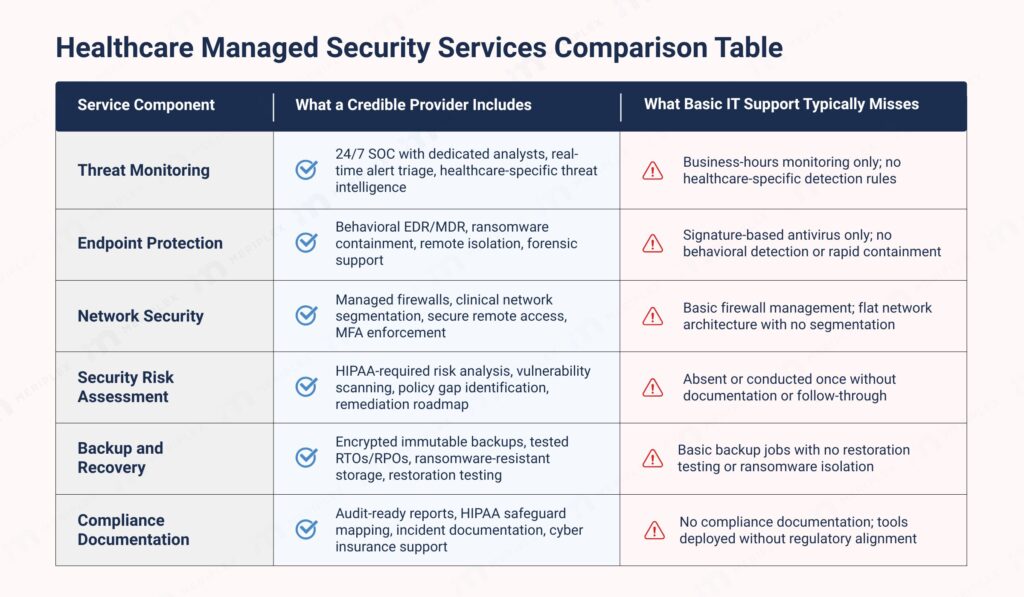
The six components of a credible healthcare managed security services program are continuous threat monitoring, endpoint detection and response, infrastructure and network security, security risk assessments, backup and disaster recovery, and compliance documentation. The strategic security priorities that connect these components to enterprise governance are what determine whether a healthcare managed security services program actually reduces risk or simply adds tools without direction.
What a credible program includes versus what basic IT support typically delivers comes down to six components.
What Does a Managed Security Service Provider Do for Healthcare Organizations?
A managed security service provider for healthcare runs the same six-component program covered below, but every piece of it is built around clinical reality instead of a generic office network. In practice, that looks like:
- Monitoring EHR access patterns and clinical device traffic specifically, since abnormal behavior reads differently in a hospital than it does in a law firm
- Mapping every control back to HIPAA’s technical, administrative, and physical safeguards, so documentation holds up under an OCR audit rather than a generic compliance checklist
- Building incident response playbooks around clinical downtime procedures, because containing a threat mid-surgical-schedule requires a different sequence than containing one in a back office
- Applying compensating controls to legacy systems and medical devices that can’t run standard endpoint agents, instead of assuming every asset can simply be patched
- Producing compliance documentation built for OCR investigators and cyber insurance underwriters, not a generic security report
That’s the real distinction when evaluating providers: a general IT firm can bolt security onto a healthcare account, but a managed security service provider built for healthcare designs the entire program around clinical constraints from day one. For the broader picture of what that role covers across any industry, that breakdown goes deeper on the core services themselves.
What Healthcare Cybersecurity Services Include: The Six Components
1. Continuous Threat Monitoring
Continuous threat monitoring ensures that your healthcare environment is observed by trained analysts at all times. Cyber threats do not operate on a schedule, and in healthcare, even a few hours of delayed response can affect patient care, revenue cycle operations, and compliance standing.
A credible monitoring program runs on a Security Operations Center staffed with dedicated analysts who triage alerts in real time, separate genuine threats from noise, and follow defined escalation protocols for healthcare-specific incident types. Healthcare organizations cannot operate on next-business-day response models when clinical systems are involved. Speed is operational protection, not a premium service tier.
2. Endpoint Detection and Response
Endpoint detection and response (EDR), often delivered as Managed Detection and Response (MDR), protects the devices that power day-to-day clinical operations: physician workstations, nursing stations, billing computers, and in some cases internet-connected medical devices. These systems are frequent entry points for ransomware and credential-based attacks.
The critical distinction between EDR and legacy antivirus is behavioral detection. EDR monitors what devices are doing, not just what files they contain. That distinction matters in healthcare because ransomware variants frequently evade signature-based detection while exhibiting detectable behavioral patterns: unusual file encryption activity, lateral movement across network segments, or anomalous outbound data transfers. A properly implemented EDR solution also provides remote device isolation, which is essential for containing a compromise before it spreads across a clinical network. Whether MDR is justified for your specific environment depends on staffing, threat exposure, and the gap between your current detection capability and what 24/7 behavioral monitoring would close.
3. Infrastructure and Network Security
Infrastructure and network security form the backbone of a healthcare organization’s defensive posture. While endpoints are common entry points, poorly secured networks are what allow threats to spread. In medical environments where clinical systems, billing platforms, imaging equipment, and administrative networks coexist, network architecture directly impacts breach severity.
The most consequential network security decision in healthcare is segmentation. Flat networks, where a compromised front-desk workstation can reach clinical systems and imaging archives, dramatically increase lateral movement risk. Proper segmentation isolates clinical devices, medical device networks, and administrative workstations into separate zones with controlled traffic between them. This is a technical control requirement under HIPAA’s technical safeguards and a practical defense against ransomware propagation.
- Managed firewalls: Control inbound and outbound traffic and enforce policy at network boundaries
- Network segmentation: Isolate clinical systems, medical devices, and administrative networks from each other
- Secure remote access: MFA-enforced access with least-privilege permissions for remote staff and vendors
4. Security Risk Assessments
A Security Risk Assessment is not optional in healthcare. It is a required component of HIPAA’s Security Rule and serves as the foundation for any defensible compliance program. An SRA evaluates how ePHI is stored, accessed, and transmitted and identifies where risk exists across administrative, physical, and technical safeguards.
Without a documented SRA, compliance posture is indefensible. In the event of an audit or breach investigation, the absence of a current risk analysis is one of the first things regulators identify. OCR’s enforcement initiative in 2024 and 2025 resulted in nearly $900,000 in settlements across eight healthcare organizations that had failed to conduct compliant risk analyses. The SRA is not a box to check. It is the evidence base that demonstrates your security program is managed, not merely installed.
What OCR expects to find documented, what the remediation roadmap needs to contain, and how a formal SRA differs from a general IT risk review are the three questions How SRA and Risk Assessments Differ answers directly.
5. Backup and Disaster Recovery
Backup and disaster recovery planning ensures that healthcare organizations can restore operations after a cyber incident, system failure, or natural disaster. In environments where access to patient records, imaging systems, and scheduling platforms is mission-critical, recovery time directly affects both clinical continuity and revenue.
The critical distinction in healthcare backup strategy is immutability. Standard backups that are connected to the same network as production systems can be encrypted by ransomware alongside the primary data, eliminating the recovery option entirely. Immutable backup storage, isolated from the production environment and tested regularly against documented recovery time objectives, is the operational difference between a ransomware event that lasts hours and one that lasts weeks.
According to research published in the JAMA Health Forum, only 20% of ransomware-attacked healthcare organizations successfully recovered from their own backups. The technology to recover was present in most cases. The failure was in backup architecture, isolation, and restoration testing.
6. Compliance Reporting and Documentation
In healthcare, security controls must be documented, mapped, and defensible. Tools alone do not satisfy regulatory expectations. Providers need evidence that safeguards are implemented, monitored, and continuously improved, especially when responding to audits, breach investigations, or cyber insurance renewals.
A common failure point occurs when organizations deploy basic security tools such as antivirus or a firewall and assume this equates to compliance. Technology alone does not satisfy regulatory scrutiny. Compliance requires documented risk assessments, continuous monitoring, evidence that identified vulnerabilities are remediated, and appropriate oversight at the leadership level. When security tools are deployed without compliance alignment, organizations create exposure that does not become visible until an audit or a breach surfaces it.
The HIPAA obligations that govern what your security partner must document, maintain, and deliver as a business associate are not optional addendums to your contract. They are the contractual layer that makes your compliance program enforceable, and they belong in your BAA before access is granted.
Why Healthcare Security Is Different from General IT Security
The Value and Persistence of Protected Health Information
Protected health information is one of the most valuable data types targeted by criminal groups. Unlike payment card data, which can be canceled and reissued, medical records contain persistent identity and clinical information that cannot be changed. A single patient record contains full identity data, clinical history, prescription records, and billing details across multiple healthcare encounters. That combination makes it valuable for identity fraud, extortion, and targeted phishing over extended time horizons.
Criminal groups understand that the combination of high data value and operational urgency in healthcare increases the likelihood of ransom payment. The cybersecurity threats hitting healthcare organizations hardest in 2026 covers what each attack type costs operationally and which HIPAA provisions it triggers when managed security controls are not in place to contain it. Healthcare data breach frequency has increased for the third consecutive year, with small and midsize organizations accounting for over 60% of reported incidents. The targeting is not random. It reflects a calculated assessment that smaller healthcare organizations are high-value and lower-resistance targets.
Operational Sensitivity
Healthcare organizations operate under a level of operational sensitivity that most industries do not face. A retail company can close for a day and recover lost revenue over time. A medical practice, surgical center, or hospital cannot pause operations without direct patient consequences. When ransomware or system outages occur, the impact extends beyond IT inconvenience to patient safety, appointment volume, surgical scheduling, and revenue cycle operations simultaneously.
Downtime in healthcare compounds quickly. What starts as a technical disruption can escalate into financial loss, regulatory exposure, and reputational damage within hours. The five cybersecurity threats most commonly targeting healthcare organizations in 2026 and the specific operational disruption patterns each one creates in clinical environments are documented from Meriplex’s direct client experience in the healthcare cybersecurity trends guide.
Legacy Systems and Medical Device Constraints
Healthcare environments are rarely built on clean, modern infrastructure. Many organizations rely on legacy clinical applications, vendor-supported equipment, and imaging platforms that cannot be easily upgraded or replaced. Outdated EMR integrations, unsupported operating systems tied to clinical applications, and internet-connected medical devices such as imaging equipment and monitoring tools often cannot be patched or hardened using standard IT security approaches.
Security strategies in healthcare must account for these constraints by implementing compensating controls, network segmentation, and continuous monitoring designed around clinical realities rather than idealized infrastructure models. This is one of the primary reasons healthcare managed security services exist as a distinct category from general enterprise security.
Running Legacy Clinical Systems or Medical Devices That Standard Security Tools Cannot Protect?
Layered Regulatory Oversight
Healthcare organizations operate under layered regulatory oversight that directly influences how security programs must be structured and documented. HIPAA enforcement actions for insufficient safeguards, OCR audits following reported breaches, FTC scrutiny for healthcare-adjacent entities subject to the Safeguards Rule, and state privacy laws each impose specific documentation and control requirements that shape security program design.
Security strategy in healthcare cannot exist separately from compliance obligations. Controls must be implemented, documented, and defensible under regulatory review. The security partner obligations under those same regulations are the contractual layer that connects your governance program to your vendor relationships.
Managed Security Services for Healthcare: When Outsourcing Makes Strategic Sense
Most mid-market healthcare organizations reach a point where internal IT capacity and security program maturity diverge. The internal team is capable and committed but stretched across infrastructure projects, user support, cloud migrations, and compliance documentation simultaneously. Monitoring becomes reactive. After-hours coverage is inconsistent. Leadership gains visibility only when something breaks.
Managed security services for healthcare address this gap by providing structured monitoring, documented controls, and around-the-clock response capabilities that match today’s threat environment. This is not about replacing internal IT. It is about reinforcing it with the specialized depth that healthcare security requires but most internal teams cannot maintain at scale.
The indicators that managed security services for healthcare have become strategically necessary are consistent across organizations: the internal team operates primarily in reactive mode, 24/7 coverage is inconsistent, compliance documentation is incomplete, and security responsibilities compete with infrastructure and clinical support priorities. These are not signs of failure. They are indicators that risk exposure has outgrown existing capacity.
What separates a credible managed security services provider for healthcare from a general IT firm offering security add-ons is the depth of healthcare-specific capability: detection rules calibrated for EHR access patterns and clinical device traffic, incident response playbooks that account for clinical downtime procedures, and compliance documentation that satisfies OCR and cyber insurance underwriters rather than just producing a report.
Final Thoughts: Healthcare Security Services as Organizational Infrastructure
Healthcare managed security services are no longer a discretionary investment. They are a core component of organizational resilience for any healthcare organization that handles ePHI, operates clinical systems, or faces regulatory scrutiny. A single incident can disrupt patient care, trigger regulatory penalties, and materially impact revenue. The stakes extend well beyond IT.
The question is no longer whether healthcare organizations need structured security services. It is whether their current model is mature enough to withstand today’s regulatory pressure, cyber insurance requirements, and threat landscape. The answer, for most mid-market healthcare organizations, is that the gap between what they have and what they need is larger than their internal team can close alone.
The Managed Security Services program provides the layered monitoring, documentation, and response capabilities that healthcare organizations need to operate with confidence in that environment.