
Healthcare cybersecurity has crossed a threshold. The sector is no longer facing a growing threat: it is operating inside one. Hospitals, clinics, and their business associates are experiencing more frequent attacks and larger data breaches than at any point in the past decade, and the trajectory shows no sign of reversing.
At Meriplex, our healthcare security team works directly with mid-market health systems, orthopedic groups, and long-term care organizations across the country. What we see consistently is a gap between the threat environment these organizations are operating in and the security infrastructure they have built to defend against it. This report is our attempt to close that gap, not with vendor marketing, but with the specific data, regulatory context, and operational insight that IT leaders actually need to make decisions in 2026.
The five trends below are not predictions. They are already in motion.
Are the Five Trends Below Already Creating Gaps in Your Healthcare Security Program?
Each one has a direct impact on clinical operations, HIPAA compliance posture, and the bottom line. By the end of this guide, you will know where your organization is most exposed and what to prioritize first.
For organizations evaluating how these trends affect their managed IT program, the complete guide to managed IT services for healthcare covers the full security and compliance stack.
The 5 Cybersecurity Trends Reshaping Healthcare in 2026
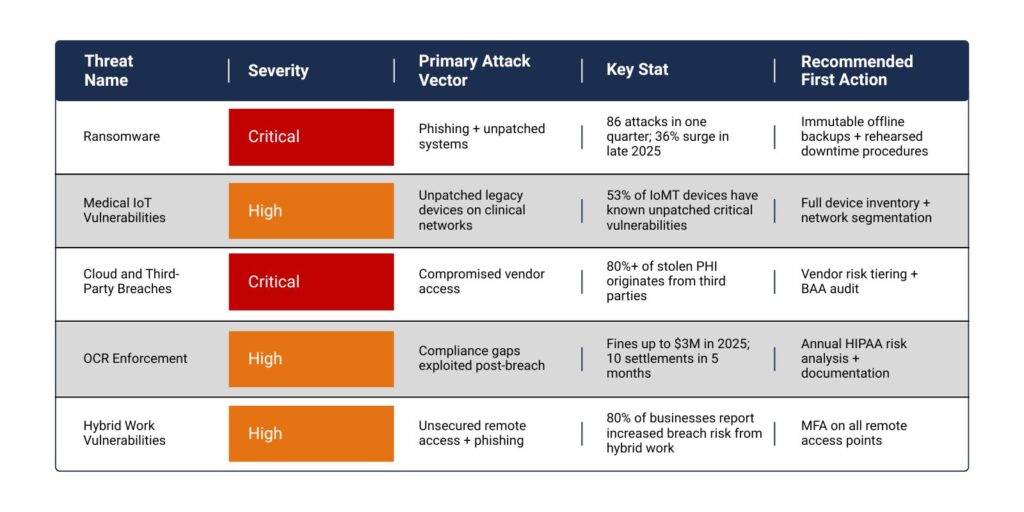
Here are the top five cybersecurity threats and challenges dominating the healthcare sector in 2026:
- Ransomware and Double-Extortion Attacks: Ransomware remains the number one cyber threat to healthcare, with attacks growing in frequency and severity. Criminal groups increasingly steal sensitive data before encrypting it to extort payments, putting patient information at high risk of exposure.
- Vulnerabilities in Medical IoT Devices: The Internet of Medical Things (IoMT), from infusion pumps to patient monitors, is expanding rapidly. These connected devices widen the attack surface and often run outdated software, making them prime targets for attackers if not properly secured.
- Cloud Breaches and Third-Party Vendor Risks: Healthcare’s reliance on cloud services and third-party vendors such as EHR hosts and billing processors means a single breach at a business associate can cascade across dozens of healthcare providers.
- OCR Enforcement and Regulatory Pressure: Regulators are cracking down on cybersecurity compliance. The HHS Office for Civil Rights has made HIPAA Security Rule enforcement a priority, with proposed updates raising the bar for 2026.
- Hybrid Work and Remote Access Vulnerabilities: The rise of remote and hybrid work in healthcare introduces new security gaps that attackers are actively exploiting through unsecured remote access points and targeted phishing.
Here is how each threat stacks up across severity, attack vectors, and recommended first actions.
Ransomware: Healthcare's Number One Cyber Threat
Why Healthcare Is the Primary Target
Ransomware continues to be the most dangerous and disruptive cyber threat facing healthcare. Criminal ransomware gangs know that hospitals and clinics are highly sensitive to downtime and may restore operations quickly by paying. Recent data shows ransomware attacks surged by 36% in late 2025 compared to the previous year, with the healthcare sector accounting for over one-third of all reported attacks. In one analysis, healthcare suffered 86 ransomware attacks in a single three-month period, representing 32% of all known ransomware incidents, more than twice as many as the next most-targeted industry.
The Double-Extortion Model
Modern ransomware attacks also steal data as leverage. An estimated 96% of ransomware incidents targeting healthcare now involve data exfiltration, the double extortion model. Attackers exfiltrate patient records and other sensitive files before encrypting systems, then threaten to publish the data if the ransom is not paid. This puts millions of patients at risk of identity theft and privacy violations.
The impact on patient care from ransomware can be severe. A February 2024 ransomware attack on a major healthcare IT vendor halted payment and claims processing systems for approximately two months, leaving hospitals unable to verify insurance or process prescriptions. The incident affected nearly 190 million Americans’ health records, making it the largest healthcare data breach on record. These scenarios confirm that ransomware is not an IT problem. It is a direct threat to patient safety and healthcare operations.
What Meriplex Is Seeing in 2026
Across our healthcare client base, the most common ransomware entry point we have seen in the past 12 months is not a zero-day exploit. It is a phishing email that bypassed an undertrained staff member, combined with a network that was not segmented to limit lateral movement. The specific cybersecurity threats hitting mid-market healthcare organizations hardest right now covers each attack type alongside the HIPAA provision it triggers when it succeeds. Organizations that had invested in immutable, air-gapped backups and had rehearsed their downtime procedures recovered in hours. Those that had not recovered in weeks. The technical gap between those two outcomes was smaller than most IT leaders expect. The operational discipline gap was not.
Key takeaway for 2026: The organizations that recover from ransomware in hours rather than weeks are not necessarily better funded. They rehearsed before it happened.
Medical IoT Under Siege: Securing the Internet of Medical Things
The Scale of the IoMT Security Problem
The proliferation of connected medical devices is a double-edged sword for healthcare. Networked devices like smart infusion pumps, wireless patient monitors, and IoT-enabled imaging systems deliver real clinical benefits. They allow real-time monitoring, remote adjustment, and seamless data flow into electronic records. Each connected device is also a potential cyber entry point, and many have not been built with strong security in mind.
Industry research predicts that by 2026, smart hospitals will deploy over 7 million IoMT devices, more than double the number in 2021. A 2022 FBI report found 53% of connected medical devices had at least one known critical vulnerability that remained unpatched. Roughly 1 in 5 connected medical devices run on unsupported operating system platforms that no longer receive security updates.
Regulatory Response: FDA PATCH Act and Device Security Requirements
Regulators have responded to the IoMT security challenge. The FDA rolled out new requirements under the PATCH Act and related guidances between 2023 and 2025, treating medical device cybersecurity as part of device safety. As of 2025, any cyber device seeking FDA approval must include a cybersecurity plan in its premarket submission. Manufacturers must ensure devices can be updated and patched, provide a software bill of materials (SBOM), and design security controls into the product.
Key takeaway for 2026: You cannot secure what you have not inventoried. Start with a full IoMT asset map, segment clinical device traffic from general IT, and make security a procurement requirement before the next device ships.
Not Sure What IoMT Devices Are on Your Network or Whether They Are Segmented?
Cloud Breaches and Third-Party Risks on the Rise
The Scale of Supply Chain Exposure in Healthcare
Modern healthcare relies on a multitude of third-party vendors and cloud-based services to deliver care. Electronic health records may be hosted by cloud providers. Revenue cycle management and billing are often outsourced. Radiology images are stored in cloud PACS systems. This digital supply chain brings efficiency, but it also concentrates risk: a single breach at a major service provider can expose data from dozens or hundreds of covered entities at once.
In 2024, a ransomware attack on a health IT clearinghouse compromised the health records of over 190 million Americans across client organizations. By the end of 2024, the total number of individuals whose healthcare data had been hacked reached 259 million, an all-time high and roughly 75% of the US population. In 2023, approximately 138 million individuals’ records were hacked largely due to exploitation of a popular file-transfer software used by many organizations.
According to the American Hospital Association’s cyber analysts, over 80% of all stolen patient records in recent years have been taken from third-party vendors, business associates, and other non-hospital providers. Over 90% of hacked records were stored outside of core electronic health record systems, often in cloud file shares, email accounts, or backup repositories.
Third-Party Risk Management: What Healthcare CIOs Should Require
Third-party risk management is not a compliance checkbox. It is an operational requirement. Maintain an inventory of all vendors with access to PHI and regularly assess their security controls. Require cybersecurity questionnaires or audits. Insist on cybersecurity clauses in contracts covering MFA, encryption, timely patching, and cyber insurance. Assign each vendor a risk tier and apply stricter controls or more frequent reviews for high-risk partners.
Key takeaway for 2026: Your security posture is only as strong as your least-scrutinized vendor. Build the governance program before you need it, because after a breach is the wrong time to find out a business associate was not meeting their BAA obligations.
OCR Enforcement and Regulatory Focus on Cybersecurity
What OCR Has Been Penalizing in 2025
Healthcare entities must answer to regulators as well as attackers. In 2026, the HHS Office for Civil Rights will maintain a strong focus on cybersecurity compliance and will impose penalties for significant security lapses. In the first five months of 2025 alone, OCR announced 10 settlements with healthcare organizations over data breaches, with fines reaching into the millions.
Despite the varied nature of those breaches, OCR found a common theme in each case: the organization had failed to conduct an enterprise-wide security risk analysis. Fines in 2025 cases ranged from $25,000 to $3,000,000, and almost all required corrective action plans mandating a comprehensive risk analysis and security improvements. OCR stated that a thorough risk analysis is one of the simplest and most effective tools to prevent breaches, and that failing to conduct one will draw regulatory scrutiny.
Proposed HIPAA Security Rule Updates for 2026
HHS has proposed significant updates to the HIPAA Security Rule for the first time in years, aimed at strengthening ePHI protections in light of today’s cyber landscape. The proposed changes, unveiled in late 2024, include mandatory multi-factor authentication for administrative and critical system access, stricter access controls, improved audit logging, and updated definitions to cover new technologies. Final action is now projected for July 2027, and the final rule would raise the compliance bar for all covered entities and their business associates.
Broader government initiatives are also reshaping the landscape. The White House National Cybersecurity Strategy and HHS 405(d) task force publications are pushing the sector toward zero trust principles and secure-by-design practices.
Key takeaway for 2026: OCR is not waiting for the final rule to enforce the existing one. If you do not have a documented, current risk analysis, that is the gap regulators find first. What HIPAA actually requires across mandatory and voluntary frameworks in 2026 maps the full regulatory stack and where enforcement pressure is concentrated right now.
Hybrid Work Expands the Attack Surface
Four Ways Remote Work Creates Security Gaps in Healthcare
The COVID-19 pandemic permanently changed how healthcare works, accelerating trends toward remote and hybrid work. Clinical staff now frequently conduct telehealth sessions from home. Administrative, billing, and IT personnel have shifted to fully remote or hybrid schedules. This flexibility introduces specific cybersecurity vulnerabilities:
Home and Public Networks
When a billing coordinator logs into your practice management system from a coffee shop, your network perimeter does not extend to protect them. Personal routers are rarely hardened, home networks are routinely compromised, and the credentials captured there are the same ones used to access clinical systems on Monday morning. More than 80% of businesses report that hybrid working has increased their risk of data breaches.
Personal Devices and Shadow IT
Remote workers frequently use personal laptops, tablets, or phones to access work applications when managed devices are not available. Those devices do not have the endpoint controls your IT team configured, and they are leaving your network every time someone closes their laptop at the end of the day. Approximately 23% of business leaders cite hybrid work as their top breach threat, and the device problem is a significant part of why. When a thumb drive, a personal phone, or an unmanaged laptop walks out of the building with PHI on it, the perimeter did not fail. It was never there to begin with.
Remote Access Infrastructure
VPNs, remote desktop portals, and cloud collaboration tools are now mission-critical, and attackers know it. The largest healthcare breach on record originated through a compromised remote access server that lacked multi-factor authentication. Attackers found a vulnerable Citrix remote access service and, without MFA in place, used it to enter the network.
Phishing and Social Engineering
A nurse working a telehealth shift from home cannot turn to a colleague and ask whether that IT support email looks legitimate. That friction removal is exactly what attackers count on. Phishing remains the top digital fraud threat globally, and the shift to remote work has made the confirmation gap attackers exploit wider than ever.
How to Extend Security Beyond the Clinic Walls
Healthcare organizations must adapt their security perimeter to wherever employees are working. Require multi-factor authentication for all remote logins. Use virtual desktop infrastructure or secure gateways so that data is not stored on home machines. Enforce endpoint protection on any device used for work. Implement Zero Trust Network Access principles, which treat every login regardless of location as potentially untrusted until verified.
Key takeaway for 2026: The security perimeter is wherever your staff are working today. If your controls only apply inside the building, you have already left the door open.
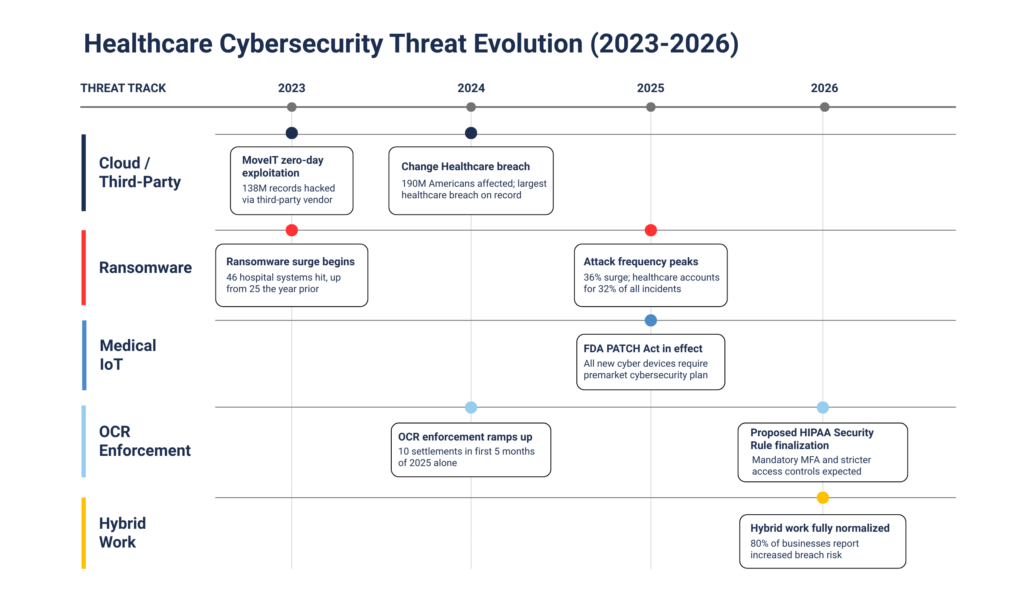
The timeline below shows how these five threats have evolved and converged over the past three years.
Preparing for 2026: Strengthening Healthcare Cyber Defenses
Six Actions Healthcare IT Leaders Should Take Now
Given these five trends, what should healthcare IT leaders prioritize in 2026?
- Double down on fundamentals: Up-to-date software patching, strong access controls with MFA everywhere feasible, network segmentation separating clinical device networks from general IT, and reliable data backups. Many breaches exploit unforced errors like outdated software or poor network hygiene.
- Conduct a fresh risk analysis: Perform or update your enterprise-wide security risk assessment as required by HIPAA. Identify where all ePHI resides, including with third parties. Do not neglect legacy data stores in acquired clinics or old servers.
- Align with established frameworks: HHS Cybersecurity Performance Goals lay out high-impact practices for defeating common attack tactics. The HICP guidance outlines the top five threats and corresponding best practices. NIST Cybersecurity Framework 2.0 provides a comprehensive risk management roadmap.
- Strengthen third-party oversight: Require cybersecurity questionnaires or audits from vendors. Insist on cybersecurity clauses in contracts. Establish an inventory of vendors handling PHI and assign each a risk tier.
- Invest in detection and response: Consider a Security Operations Center or managed detection and response service if you do not have one. Regularly drill your incident response plan by simulating a ransomware event and testing backup restoration.
- Foster a security culture: Technology alone is not enough. Educate your workforce on how to recognize phishing, the importance of not reusing passwords, and how to report lost devices or unusual behavior. Leadership must set the tone by treating cybersecurity as essential to patient trust and care quality.