
What are the top healthcare IT security priorities for 2026?
The six healthcare IT security priorities for 2026 are: strengthening identity and access management, implementing Zero Trust in clinical settings, modernizing endpoint protection, planning for ransomware incidents, aligning with HIPAA and 405(d) frameworks, and securing cloud and hybrid infrastructure. Each addresses a distinct attack vector that healthcare organizations face today.
Healthcare CIOs entering 2026 face a convergence of cybersecurity challenges unlike any previous year. Crafting a healthcare IT security roadmap is no longer optional. In 2024, over 275 million healthcare records were compromised and OCR issued 10 settlements in five months alone. Regulators and attackers are moving faster than most healthcare IT security programs were built to handle. This playbook outlines the high-stakes security landscape and six strategic priorities that should anchor any 2026 healthcare IT security strategy.
Why Healthcare Cybersecurity Plays by Different Rules
Most industries treat a data breach as a financial and reputational problem. Healthcare treats it as a patient safety problem, because that’s what it actually is. When a retailer’s systems go down, customers get annoyed. When a hospital’s systems go down, a nurse can’t pull up a medication record mid-shift. That gap is the whole reason cybersecurity for healthcare organizations gets regulated, audited, and scrutinized in ways most sectors never experience.
Three things make healthcare a harder problem to secure than almost any other industry.
The data is worth more to attackers. A medical record bundles identity, financial, and clinical history into one file, which is exactly why it sells for more on the black market than a stolen credit card number ever will.
The environment is genuinely messy. Most healthcare organizations are running legacy on-prem systems, cloud-hosted EHR platforms, a fleet of connected medical devices, and a long list of third-party vendors, all stitched together. Every connection point is a door, and somebody has to keep track of all of them.
Downtime isn’t an inconvenience, it’s a clinical event. A manufacturer that loses its systems for a day loses money. A hospital that loses its systems for a day risks delaying surgeries and putting patients in danger. Ransomware groups know this, which is part of why they target healthcare so aggressively in the first place.
None of this means healthcare needs more security theater. It needs HIPAA-aligned controls that actually hold up under audit, an understanding of how clinical workflows function in practice, and a partner who treats every security decision as something with a downstream effect on patient care, not just an IT ticket. The six priorities below are what that looks like when you put it into action for 2026.
Is Your 2026 Healthcare IT Security Program Built Around the Threats Actually Hitting the Sector?
The 2026 Healthcare IT Security Landscape
The Threat Environment Healthcare CIOs Are Operating In
The healthcare sector heads into 2026 with a target on its back. Cyberattacks on hospitals and providers have reached record levels, with data breaches impacting an unprecedented number of patients. Ransomware and hacking incidents now dominate: roughly 80% or more of healthcare breaches are caused by external hacking and IT incidents, according to HHS breach reporting data. In 2024 alone, over 275 million healthcare records were compromised, affecting about 82% of the US population, largely due to vendor breaches including the 190-million record Change Healthcare attack. One analysis found nearly 30% of breaches stem from compromised login credentials, underscoring how often attackers simply log in with stolen accounts.
At the same time, the connected medical device landscape has expanded the healthcare attack surface. Claroty’s 2025 State of CPS Security report analyzed over 2.25 million IoMT devices across 351 healthcare organizations and found known exploited vulnerabilities inside 99% of them. Imaging systems including CT scanners, MRI machines, and X-ray equipment are the highest-risk device category. These are not theoretical vulnerabilities. They are actively used by ransomware groups today.
Regulatory Pressure Is Intensifying
HIPAA and the HITECH Act remain foundational, but new requirements are adding complexity. HHS has proposed updates to the HIPAA Security Rule in 2025 to strengthen cyber safeguards, including more explicit requirements for access controls and audit logs. The voluntary 405(d) program providing the HHS Health Industry Cybersecurity Practices (HICP) framework has gained prominence as a de facto industry standard. Even state governments are acting: New York rolled out state-level hospital cybersecurity regulations requiring breaches to be reported to state health authorities within 72 hours. The result is a more complex patchwork of rules that healthcare CIOs must navigate to stay compliant.
Despite this daunting landscape, 2026 can be a turning point. The six strategic priorities below focus on practical, high-impact measures to fortify your organization’s healthcare IT security posture.
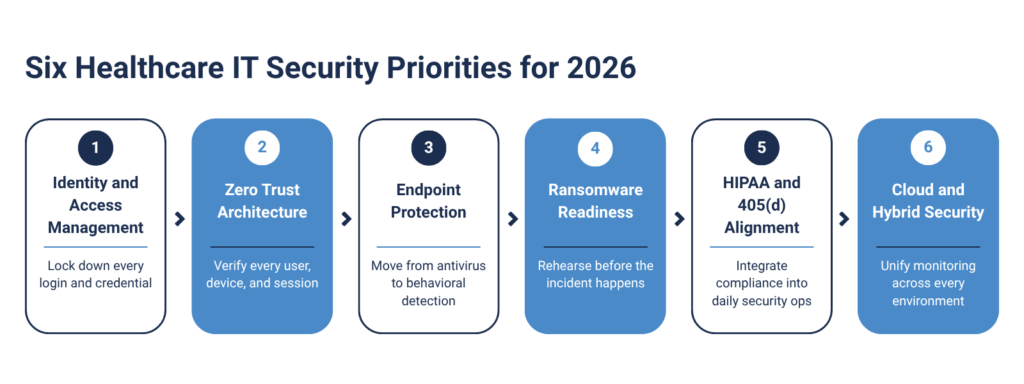
Six Healthcare IT Security Priorities for 2026
These six priorities are not abstract ideals. They are practical, actionable steps designed for resource-constrained healthcare IT teams. Each one addresses a specific attack vector that is active in the 2026 threat environment
Priority 1: Strengthen Identity and Access Management
In healthcare breaches, identity is the new perimeter. Most attacks succeed not because of sophisticated exploits but because someone’s credentials were stolen. Enforcing multi-factor authentication across every EHR login, VPN, and privileged account is the single highest-return security investment a healthcare organization can make in 2026. Pair that with role-based access controls, strict vendor IAM policies, and regular account hygiene, and you eliminate the entry point used in the majority of healthcare breaches including the 2024 Change Healthcare incident, which originated through a login portal with no MFA in place.
The governance model behind your IAM program matters as much as the technology. When cybersecurity ownership sits below the IT department, IAM gaps go unaddressed until after a breach. Modern IAM tools can also evaluate context such as device health, location, and user behavior before granting access, adding adaptive risk-based checks that static credential systems cannot provide.
Priority 2: Implement Practical Zero Trust in a Clinical Setting
Zero Trust is not a product. It is a security architecture built on one principle: never trust, always verify. Start with network segmentation of critical systems, isolating EHR servers and clinical workstations from IoMT devices and general internet traffic. Then move to Zero Trust Network Access to replace legacy VPNs for remote clinicians and vendors. Every step toward Zero Trust materially reduces the risk of lateral movement after an initial compromise, which is how most healthcare ransomware events escalate from a single endpoint to a network-wide outage.
Priority 3: Modernize Endpoint Protection Without Overhead
Traditional antivirus cannot keep pace with fileless malware, ransomware variants, or AI-assisted attacks that adapt faster than signature databases update. Healthcare organizations in 2026 need endpoint detection and response (EDR) tools that continuously monitor behavior rather than signatures, paired with a managed detection and response service that provides 24/7 human oversight. For healthcare IT teams that are already stretched, MDR is not an upsell. It is the practical solution to the coverage gap that attackers exploit at 2 AM on a Sunday. Nearly half of healthcare providers report significant portions of their IT estate run on legacy technology, which cannot host modern security agents and requires compensating controls.
Running Legacy Systems That Can't Support Modern Security Agents?
Priority 4: Plan for Ransomware Incidents Before They Happen
In healthcare, a ransomware attack is a patient safety emergency, not just a data security incident. According to HHS ASPR data, ransomware attacks on healthcare increased 42% in a single year and the trend has worsened since. Every healthcare organization must operate under the assumption that a ransomware incident will happen and prepare accordingly before it strikes. The organizations that recover in hours rather than weeks are not better funded. They rehearsed before it happened. Immutable offline backups, tested recovery time objectives, and practiced downtime procedures are the difference. For the full threat landscape context including ransomware frequency data and double-extortion trends, see 2026 Healthcare Cybersecurity Trends: What IT Leaders Need to Know.
Priority 5: Align With HIPAA and 405(d) Without Getting Buried in Paperwork
Compliance and security are not separate programs. They are the same program viewed from different angles. The HHS 405(d) HICP framework provides a practical roadmap scaled by organization size. Under a 2021 law amending HITECH, regulators must consider whether a breached entity had recognized cybersecurity practices in place for the prior 12 months, and may mitigate fines accordingly. Adopting and documenting HICP is both a security improvement and a regulatory credit that OCR will weigh in your favor if an incident occurs.
Priority 6: Secure Cloud Workloads and Hybrid Infrastructure
Healthcare IT environments in 2026 are a hybrid mix of on-premises servers, cloud-hosted applications, and SaaS services with sensitive data moving between them constantly. A misconfigured cloud storage bucket or an unsanctioned SaaS application can become an open door for attackers just as quickly as an unpatched on-premises server. The Change Healthcare breach demonstrated that a single vendor compromise can cascade across an entire ecosystem, exposing every connected organization regardless of their own security posture.
Why Growing Healthcare Organizations Need a Cybersecurity Partner
The Staffing and Coverage Reality
53% of healthcare organizations reported lacking in-house cybersecurity expertise and nearly half reported insufficient IT staffing to handle security needs. The cybersecurity talent shortage is real, budgets are constrained, and the threat environment operates 24 hours a day. A managed security partner provides round-the-clock monitoring and response. If ransomware begins spreading at 2 AM, an MDR team can isolate infected devices immediately. Without that coverage, your IT team may not notice until 7 AM, by which time containment is significantly more complex and costly.
What to Look for in a Healthcare IT Security Partner
Not all IT security providers understand healthcare. When evaluating partners, insist on all of the following:
- Healthcare expertise and HIPAA knowledge: They should speak fluently about EHR platforms, ePHI handling, PACS systems, and HICP alignment without needing to be educated.
- Comprehensive security capabilities: Managed EDR/XDR, network security monitoring, cloud security, IAM support, vulnerability management, incident response, and compliance support under one roof.
- True 24/7 SOC with proven incident response: Verify staffing across all shifts. Ask how they handled a recent healthcare incident. A partner that cannot give you a specific example has not been tested.
- Hybrid infrastructure coverage: They must cover on-premises, cloud, IoMT, and mobile environments. Partial coverage means blind spots.
- Strong internal security posture: They become a business associate the moment they touch your data. Require SOC 2 Type II certification and a signed BAA before access is granted.
Choosing a security partner is a risk management decision with legal consequences, not a procurement decision with vendor preferences
Healthcare IT Security Is a Journey, Not a Destination
Achieving strong healthcare IT security is a continuous process. Threats will keep evolving whether it is new AI-driven attacks, vulnerabilities in tomorrow’s medical devices, or tactics that do not exist yet. Your security program must be dynamic, regularly reassessed, and always improving.
By implementing the six strategic priorities outlined here, from IAM and Zero Trust to endpoint modernization, ransomware planning, compliance alignment, and cloud security, you will materially strengthen your organization’s posture. Each element reinforces the others, creating layered defense in depth.
In healthcare, every security gap you close is a patient you did not put at risk. The complete guide to managed IT services for healthcare is where these six priorities connect to the full managed IT services model.