
What makes an MSP HIPAA-compliant?
A HIPAA-compliant MSP meets the technical, administrative, and physical safeguard requirements of the HIPAA Security Rule for all ePHI they handle, signs a Business Associate Agreement before accessing patient data, and can demonstrate compliance through documented policies, audit logs, and third-party certifications like SOC 2 Type II.
Healthcare organizations handle extremely sensitive patient data and must comply with HIPAA’s strict privacy and security regulations. Outsourcing IT to a HIPAA-compliant MSP does not remove this responsibility. It raises the bar. A single compliance lapse can lead to hefty fines and cause reputational damage that erodes patient trust. According to StrongDM’s HIPAA violation penalty data, violations can incur penalties ranging from a few hundred dollars to over $2 million per violation per year. The right MSP allows your organization to focus on delivering quality care while they handle the complexities of compliance, cybersecurity, and IT infrastructure.
Not Sure Whether Your Current MSP Actually Meets HIPAA's Security Rule Requirements?
What Makes an MSP HIPAA-Compliant?
To be HIPAA-compliant, an MSP must meet specific requirements of the HIPAA Security Rule in three key categories of safeguards: technical, administrative, and physical. They need to mirror the protections a covered entity would implement for all ePHI they handle. Below we break down each category and what to look for.
Technical Safeguards: Protecting Data and Systems
Technical safeguards are the foundation of HIPAA compliance. In healthcare, every digital vulnerability is a patient safety risk.
Encryption is non-negotiable. Your MSP should use robust encryption protocols for all data whether stored in a cloud backup or moving between systems. HIPAA requires automatic logoffs, encrypted storage, and secure transfer protocols to keep ePHI protected across your digital environment. If a device is lost or data is intercepted in transit, encryption ensures it remains unreadable to unauthorized eyes.
Access controls are the next critical layer. HIPAA mandates that only authorized individuals can view or modify patient data. A compliant MSP enforces unique user logins with no shared accounts, multi-factor authentication, and the minimum necessary principle: staff can only access the data they need to do their job. Every interaction with ePHI should be logged and actively monitored through SIEM platforms that watch for unusual access patterns or signs of a breach.
When something goes wrong, and in today’s threat landscape something eventually will, you need an MSP with a tested incident response and recovery plan. The cybersecurity threats hitting healthcare organizations hardest in 2026 covers what each attack type costs operationally and which HIPAA provisions it triggers, so you know what your MSP’s incident response plan actually needs to cover. A compliant provider will detect issues quickly, isolate them, and begin remediation immediately. They will have encrypted, tested backups and a disaster recovery playbook that ensures clinical operations can continue without catastrophic downtime.
Administrative Safeguards: Policies, Training, and Processes
Administrative safeguards make up more than half of the HIPAA Security Rule requirements. This is where policies get implemented, people get trained, and processes either protect you or quietly expose you to risk.
Every MSP employee who might interact with ePHI must be trained on security policies, threat awareness, and HIPAA-specific obligations. This is an ongoing requirement under the Security Rule, not a one-time onboarding checkbox. Ask your MSP candidates how often they refresh training and whether they run phishing simulations internally. How they answer tells you more about their breach risk than any spec sheet.
A serious MSP maintains documented HIPAA security policies, conducts internal risk assessments, and has a named compliance officer accountable for keeping their team aligned. They support user provisioning and deprovisioning, enforce least privilege, and regularly audit who has access to what.
The Business Associate Agreement (BAA) is non-negotiable. If an MSP handles ePHI on your behalf, the BAA must be signed before any data changes hands. It outlines their obligations, defines breach notification responsibilities, and puts legal weight behind their security commitments. An MSP that hesitates on a BAA is telling you something important about how they view their accountability.
Physical Safeguards: Securing Facilities and Hardware
Physical safeguards are the most commonly overlooked category in HIPAA compliance evaluations. Any HIPAA-compliant MSP managing your infrastructure should be hosting data in secure, access-controlled environments with locked cages, biometric access, 24/7 surveillance, and strict visitor logs. Look for certifications like SOC 2 Type II, ISO 27001, or HITRUST CSF, which include physical security controls and demonstrate a baseline of compliance maturity.
Physical safeguards extend to every device the MSP uses to access your systems. MSP employees working with your environment should use encrypted devices, automatic screen locks, and regularly updated endpoint protection. There should be documented procedures for what happens when a device goes missing, including remote wipe capability.
HIPAA also requires that data remain available during a crisis. A forward-thinking healthcare MSP builds redundancy into their infrastructure: geographically distributed data centers, backup generators, and clustered servers that maintain continuity when hardware fails. Healthcare organizations cannot afford hours of downtime, and your MSP’s architecture should reflect that reality.
What Do HIPAA Managed Services Actually Include?
HIPAA managed services is not a product category. It is a set of ongoing operational responsibilities that a qualified MSP takes on behalf of a covered entity. Understanding what is included, and what is not, is the first step in evaluating whether a provider is genuinely equipped to support your compliance program.
A HIPAA managed services engagement typically covers:
- Continuous security monitoring: 24/7 SIEM monitoring of systems containing ePHI, with active alerting for anomalous access patterns, unauthorized login attempts, and data exfiltration signals.
- Endpoint detection and response: EDR tools deployed across all in-scope endpoints, actively monitoring behavior rather than relying on signature-based antivirus.
- Patch management: Regular, documented patching of operating systems and applications that handle ePHI, with exception processes for clinical systems that require vendor coordination before updates.
- Access control management: User provisioning, deprovisioning, MFA enforcement, and periodic access reviews aligned to HIPAA’s minimum necessary principle.
- Backup and disaster recovery: Immutable, encrypted backups with documented and tested RTOs and RPOs for each critical clinical system.
- Incident response: A documented and rehearsed incident response plan covering detection, containment, notification timelines, and breach determination under HIPAA’s four-factor test.
- HIPAA risk analysis support: Annual or more frequent security risk assessments that meet OCR’s requirements under 45 CFR 164.308(a)(1), with documented findings and remediation plans.
- Compliance documentation: Audit-ready records of policies, procedures, training attestations, and BAA registers that OCR expects to see during an investigation.
What HIPAA managed services does not cover is the covered entity’s own compliance obligations. The BAA defines the boundary. Your MSP takes operational responsibility for the controls they manage. You remain accountable for everything else. For a detailed breakdown of what HIPAA specifically requires from your security partner and how to verify their obligations in a BAA, see MSSP for Healthcare: What HIPAA Requires from Your Security Partner.
How to Classify Whether an MSP Is Genuinely HIPAA-Compliant
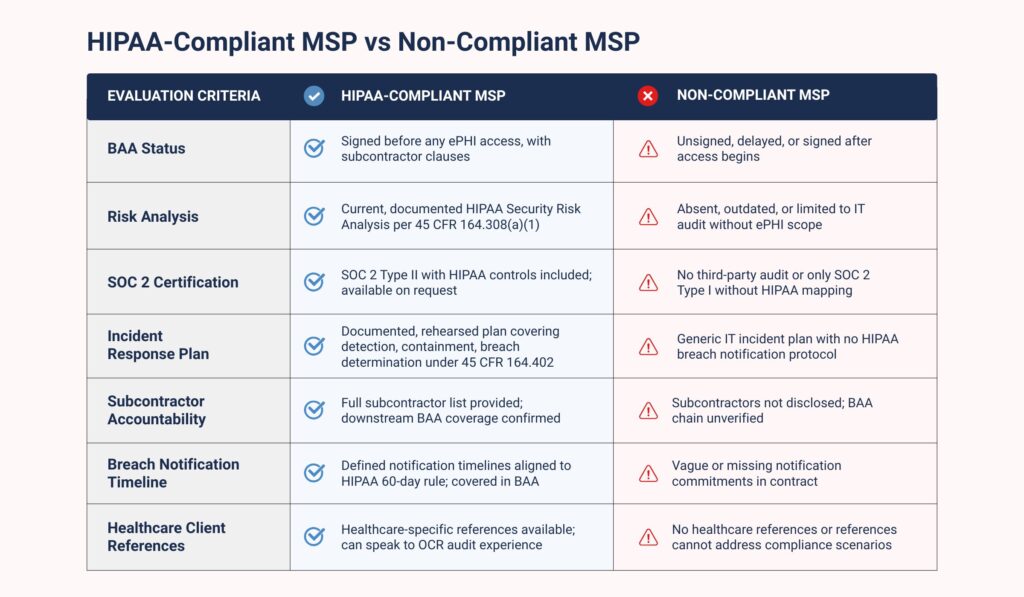
Not every MSP that claims HIPAA compliance actually meets the standard. The gap between claiming compliance and demonstrating it is where most healthcare organizations get burned. Use the following classification criteria to evaluate any provider before you sign a BAA.
A genuinely HIPAA-compliant MSP can demonstrate all of the following:
- A signed BAA ready before any ePHI is accessed, with specific breach notification timelines and subcontractor accountability clauses
- A current, documented HIPAA Security Risk Analysis that maps their services to your ePHI environment
- SOC 2 Type II certification or equivalent third-party audit covering their internal controls
- Named compliance officer or security lead with verifiable HIPAA-specific credentials
- Documented incident response plan that includes the four-factor breach determination required under 45 CFR 164.402
- Healthcare client references who can speak to the MSP’s compliance performance under audit conditions
- Subcontractor list with confirmation that downstream vendors handling ePHI are also bound by equivalent BAA obligations
An MSP that cannot demonstrate these should not be handling ePHI on your behalf regardless of what their marketing says.
Want to Run a Prospective MSP Through These Seven Criteria Before You Sign?
The specific questions that surface whether a provider has genuine HIPAA depth or a rehearsed pitch, and what strong answers look like versus weak ones, are in Questions Hospitals Should Ask HIPAA Managed IT Providers. The 2026 HIPAA Compliance Checklist maps every documentation artifact OCR expects to find, organized by safeguard category.
The gap between a compliant MSP and one that claims to be is visible across seven criteria.
Key Criteria for Selecting a HIPAA-Compliant MSP
Being HIPAA-compliant on paper is necessary but not sufficient. Beyond the compliance baseline, healthcare organizations need a partner who understands clinical environments, scales with their operations, responds at 3 AM, and brings genuine cybersecurity depth. The criteria below are the minimum bar.
Healthcare and Regulatory Expertise
A HIPAA-compliant MSP must speak fluently about EHR platforms, HL7 interfaces, PACS imaging systems, and clinical workflows without needing to be educated. They should carry credentials like HITRUST CSF certification or SOC 2 Type II with HIPAA mapping and be able to provide healthcare client references without hesitation. Compliance is not a box they check once a year. It is how they operate every day.
Scalability and 24/7 Coverage
Healthcare does not keep business hours and neither should your MSP. True 24/7 coverage means a staffed NOC or SOC with defined escalation paths, not an answering service. SLAs should specify response times for clinical-down incidents in minutes, not hours, and uptime commitments for systems containing ePHI should meet or exceed 99.9%.
Cybersecurity Maturity
A HIPAA-compliant MSP with genuine cybersecurity depth runs managed detection and response, aligns with the NIST Cybersecurity Framework or HITRUST CSF, and conducts regular vulnerability assessments and penetration tests. They can show you anonymized examples of how they have helped healthcare clients close security gaps or navigate OCR audits. Generic answers about multilayered security are a red flag. Specific answers with documented evidence are not.
For a comprehensive capability evaluation framework covering all ten must-have managed IT capabilities for healthcare organizations, see 10 Must-Have Managed IT Capabilities for Healthcare.
Strategic Partnership and vCIO Guidance
The right HIPAA-compliant MSP does not wait for things to break. They offer technology roadmaps, conduct regular business reviews, and provide vCIO guidance that aligns IT investment with clinical and compliance priorities. They track regulatory changes so you do not have to, and they raise issues before auditors do.
Common Mistakes to Avoid When Choosing a HIPAA-Compliant MSP
The most costly mistakes in MSP selection are not about choosing the wrong technology stack. They are about skipping the verification steps that distinguish a genuinely compliant partner from one that uses compliance as a marketing term.
- Accepting verbal HIPAA compliance claims without documentation: Ask for the BAA, the SOC 2 report, and the risk analysis methodology. If a provider cannot produce these, they are not ready to handle your ePHI.
- Skipping the BAA: OCR has issued multimillion-dollar fines to organizations that failed to execute a BAA with a vendor even when no breach occurred. No BAA, no access. This is not negotiable.
- Choosing on price alone: An MSP that significantly underbids competitors is almost certainly cutting corners somewhere in their compliance or security program. The cost of a breach dwarfs the savings on a cheaper contract.
- Assuming subcontractors are covered: Your MSP may be compliant. Their data center provider, cloud platform, or NOC partner may not be. Require a full subcontractor list and confirm downstream BAA coverage.
For the full set of questions to ask during evaluation and how to interpret the answers, see Questions Hospitals Should Ask HIPAA Managed IT Providers.
Conclusion: Finding a HIPAA-Compliant MSP That Actually Delivers
Selecting a HIPAA-compliant MSP is a risk management decision with legal consequences. The right partner will not only keep you compliant through strong technical, administrative, and physical safeguards, but will also function as a genuine extension of your team: proactive, transparent, and accountable.
Use the safeguard categories and classification criteria in this guide as your evaluation baseline. If a prospective MSP cannot speak confidently to any of them, that is the information you need before you sign. It is far better to ask hard questions now than to discover compliance gaps after a breach or an OCR investigation. What the full healthcare cybersecurity regulatory stack requires in 2026, from mandatory HIPAA provisions to voluntary frameworks that activate the HITECH safe harbor, is the right context for evaluating whether any MSP’s compliance program actually holds up.
In healthcare, your MSP’s compliance program is part of your compliance program. Choose accordingly. The complete guide to managed IT services for healthcare is where MSP selection fits within the full managed IT services model.