A vCISO (virtual Chief Information Security Officer) is a senior cybersecurity executive who manages your organization’s security program on a part-time or fractional basis. They own the same responsibilities as a full-time CISO: security strategy, risk management, compliance oversight, incident response planning, and board reporting. The difference is the engagement model: you get C-suite security leadership at roughly 30 to 40 percent of a full-time hire’s cost, with no lengthy onboarding and no permanent headcount.
Most mid-market organizations know they have a security leadership gap. They just can’t justify a $250,000 salary to fill it. A vCISO solves that problem directly: an experienced security executive who builds and runs your security program on a fractional basis, without the overhead of a permanent C-suite hire.
The role isn’t a watered-down alternative to a real CISO. A vCISO designs your security strategy, owns your risk management program, drives your compliance certifications, and reports to your board: the same work a full-time CISO would do, scoped to what your organization actually needs right now.
What Is a vCISO? (Definition and Role Overview)
A vCISO, sometimes called a fractional CISO or CISO-as-a-Service, is an outsourced security executive engaged on a part-time, retainer, or project basis. They provide the same strategic oversight as an in-house CISO: security program governance, risk assessment, compliance strategy, vendor risk management, and executive reporting. What changes is the employment structure, not the caliber of the work.
According to ISACA’s State of Cybersecurity 2024 report, 57 percent of organizations report their cybersecurity team is understaffed, and 64 percent have open cybersecurity positions at various levels. The vCISO model exists specifically to bridge that gap, giving organizations access to a seasoned security executive without competing in a constrained talent market or committing to a permanent salary.
Is a vCISO the same as a fractional CISO?
Yes. The terms vCISO, virtual CISO, fractional CISO, and CISO-as-a-Service all describe the same engagement model: an experienced security executive who works with your organization part-time. Some providers use “fractional” to emphasize the cost-sharing model; others use “virtual” to signal the remote-first nature of the engagement. The role, responsibilities, and outcomes are the same regardless of the label.
What Does a vCISO Do Day-to-Day?
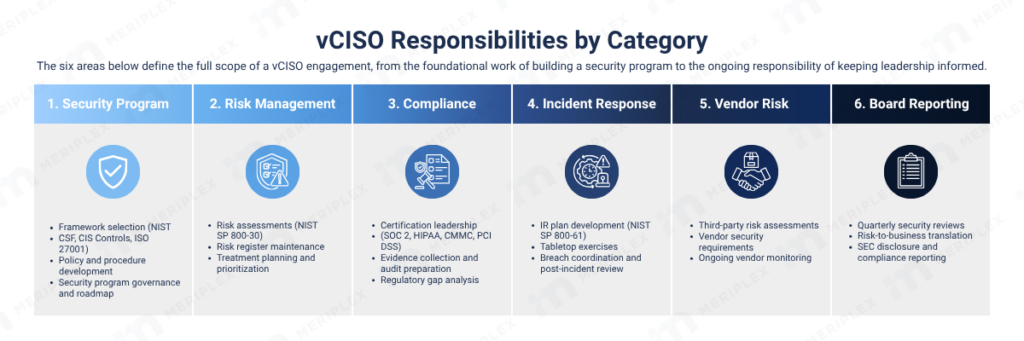
In practice, a vCISO’s work falls into six core areas. The mix shifts depending on your organization’s maturity and immediate priorities. A company in the early stages of building a security program will lean heavily on strategy and policy work, while a more mature organization might focus the vCISO’s time on compliance readiness or board reporting.
Security Program Development and Governance
The vCISO designs and owns your security program from the ground up. That means selecting the right framework for your industry and risk profile. NIST CSF, CIS Controls, and ISO 27001 are the most common starting points. The vCISO then builds the policies, procedures, and controls that map to it. In a first engagement, this phase typically runs six to twelve weeks and produces a documented security program, a prioritized gap analysis, and a 12-month roadmap.
Risk Assessment and Management
A vCISO runs structured risk assessments using frameworks like NIST SP 800-30 or ISO 27005 to identify, quantify, and prioritize your organization’s exposure. The output isn’t a list of findings. It is a risk register with business-contextualized severity ratings and a treatment plan. Leadership gets a clear picture of where the biggest threats live and what it costs to address them versus accepting them.
On a recurring basis, the vCISO monitors your risk posture as your environment changes: new vendors, new infrastructure, acquisitions. The vCISO updates the risk register accordingly.
Compliance and Audit Readiness
Whether you’re pursuing SOC 2 Type II, HIPAA, CMMC Level 2, or PCI DSS, a vCISO runs the compliance program. They translate the framework controls into specific tasks, assign ownership across your internal teams, and manage the evidence collection process ahead of the audit. For organizations going through their first SOC 2 or CMMC certification, this is often where the vCISO delivers the most immediate value. The process is complex, the timeline is unforgiving, and the cost of a failed audit is significant.
Incident Response Planning and Tabletop Exercises
A vCISO builds your incident response plan: the documented playbook that defines who does what when a breach, ransomware event, or data loss occurs. The plan covers detection, containment, eradication, recovery, and post-incident review, aligned to NIST SP 800-61. Equally important, the vCISO runs tabletop exercises that test the plan before an actual incident. Organizations that practice incident response recover faster and with less damage than those that encounter their first real test during a live event.
In a typical first engagement, the most common gap we find is not a technology gap. It is a documentation gap. Organizations often have reasonable security tools in place but no written incident response plan, no formal risk register, and no documented asset inventory. A vCISO spends the first 30 to 60 days closing those foundational gaps, because no amount of technology compensates for an organization that does not know what it is protecting or how it will respond when something goes wrong.
Vendor and Third-Party Risk Management
Every vendor with access to your systems or data is a potential entry point. A vCISO builds and runs a vendor risk management program that evaluates third parties before onboarding, tracks their security posture on an ongoing basis, and ensures your contracts include appropriate security and data handling requirements. For organizations subject to HIPAA, CMMC, or SOC 2, third-party risk management is not optional. It is an audit requirement with specific evidence standards.
Security Architecture and Technology Oversight
A vCISO evaluates and guides your security technology stack: which tools you need, which you can consolidate, and how your current architecture holds up against your actual threat profile. This includes reviewing your SIEM configuration, endpoint detection and response (EDR) coverage, identity and access management controls, and network segmentation. The vCISO does not operate these tools day-to-day, but they define the architecture requirements and hold your operational team or MSSP accountable for implementation.
Board and Executive Reporting
Security reporting to boards and executive teams is a discipline in itself. A vCISO translates technical risk into business language, framing security investments in terms of risk reduction, regulatory exposure, and operational impact rather than CVE counts and patch rates. They present quarterly security reviews, communicate material risk changes, and provide the board with the information it needs to fulfill its oversight responsibility under frameworks like NIST CSF 2.0 and SEC cybersecurity disclosure rules.
The six areas below define the full scope of a vCISO engagement, from the foundational work of building a security program to the ongoing responsibility of keeping leadership informed.
What a vCISO Does Not Do
Scope clarity matters as much as scope coverage. A vCISO is a strategic leader, not an operational resource. They do not monitor your SIEM, manage your firewall rules, respond to individual security alerts, or handle your patch management queue. Those are operational security functions that belong to your internal IT team or your managed security service provider (MSSP).
The distinction is important because confusing the two sets up an engagement for failure. A vCISO who spends their time running operational tasks is an expensive way to fill an analyst role, and it leaves the strategic work undone. Their value is in the architecture and governance layer: deciding what to monitor, which tools to deploy, how to structure your security operations, and whether your MSSP is actually delivering on its commitments.
vCISO vs. Full-Time CISO: How Do the Two Compare?
The comparison comes down to scale, budget, and the depth of security leadership your organization genuinely needs right now.
A full-time CISO makes sense for large organizations (typically 1,000 or more employees) with complex, mature security programs that require dedicated daily leadership. They’re embedded in your organization, available immediately in a crisis, and own the security function as their sole responsibility.
A vCISO is the right fit when your organization needs executive-level security strategy but the program does not yet demand a full-time salary. For most mid-market companies, a vCISO working 20 to 40 hours per month delivers the strategic outcomes they need: a mature security program, audit-ready compliance, and board-level reporting, at a fraction of the cost of a full-time hire. For a detailed cost breakdown and side-by-side comparison, the vCISO vs. Full-Time CISO guide covers the full analysis.
For a detailed cost and value breakdown, including when a full-time CISO becomes the better investment, the Fractional CIO and vCISO Services complete guide covers both roles, how they compare, and how mid-market organizations use them together.
How Does a vCISO Differ from an MSSP?
A Managed Security Service Provider handles the operational layer of your security program: monitoring your environment, managing security tools, responding to alerts, and keeping your defenses current. A vCISO works at the strategic layer above that: deciding which tools you need, what your security policies should require, and whether your MSSP is actually closing your risk gaps.
The two roles are complementary, not interchangeable. An MSSP without a vCISO gives you operational coverage with no strategic direction. A vCISO without operational support gives you a sound strategy with nobody executing it. Organizations that get the most from a vCISO engagement typically have an MSSP or internal security team handling the day-to-day, with the vCISO providing oversight, governance, and the strategic direction that operational teams need.
That independence matters structurally. A vCISO audits and evaluates your security stack, including your MSSP’s performance, without a commercial interest in the outcome. Asking your MSSP to assess its own work is a different thing entirely.
How a vCISO Engages with Your Organization
A vCISO engagement typically starts with a discovery phase: an assessment of your current security posture, a gap analysis against your target framework, and a prioritized 12-month roadmap. That work takes four to eight weeks and produces the foundational documents most organizations lack when they start.
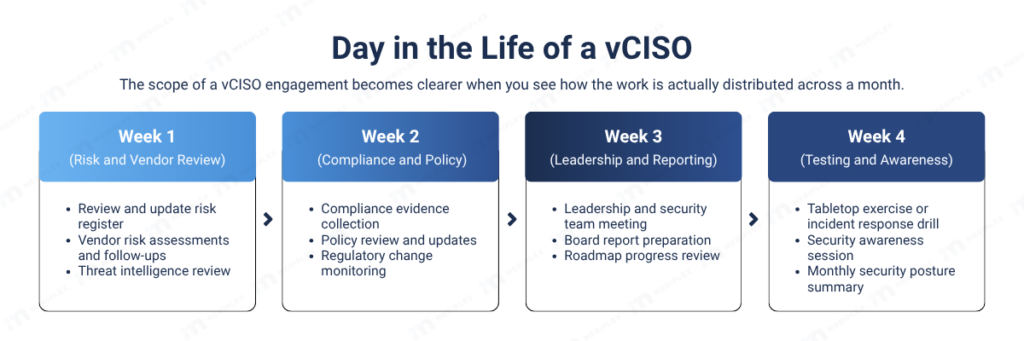
From there, the ongoing engagement follows a monthly rhythm. The vCISO joins your leadership and security meetings, owns the security program calendar, tracks progress against the roadmap, and escalates risks that require executive attention. Deliverables are scheduled: quarterly board reports, annual risk assessments, compliance evidence packages ahead of audits, and updated incident response plans after any significant change in your environment.
The reporting line matters. A vCISO reports directly to your CEO, COO, or board, not to your IT director. That positioning gives them the authority to drive security decisions across the organization, not just within the IT function. Organizations that structure the engagement correctly get a security leader with real influence. Those that treat it as an advisory-only role get a consultant with limited reach.
Which engagement model is right for your organization?
Most organizations with an ongoing security program benefit most from a monthly retainer model: a defined number of hours per month, typically 20 to 40, that gives the vCISO enough continuity to manage your security program actively. Project-based engagements work well for specific, time-bounded needs: a SOC 2 readiness assessment, an incident response plan build, or a one-time risk assessment ahead of a major initiative.
Retainer engagements are structured as flat monthly fees, which makes budgeting predictable. The vCISO joins your regular security and leadership meetings, owns the security program calendar, and is available for ad hoc questions within the agreed scope. Organizations that start with a project-based engagement often extend into a retainer once they see how much foundational work a vCISO surfaces.
Project-based engagements have a defined scope and end date. The vCISO delivers a specific outcome, such as a documented risk assessment, a compliance gap analysis, or a completed incident response plan, and the engagement closes. The limitation is continuity: a project vCISO hands you a plan but isn’t there to execute it or adapt it as your environment changes.
Does Your Organization Need a vCISO?
The clearest signals that a vCISO engagement makes sense:
- You are pursuing a compliance certification (SOC 2, HIPAA, CMMC, or PCI DSS) and have no internal expertise to lead the process
- Your board or executive team is asking security questions that your IT team can’t answer in business terms
- You’ve experienced a security incident, or a near miss, and have no formal incident response plan
- Your organization is growing quickly, collecting more sensitive data, and attracting more attention than your current security posture can handle
- You have an IT director who handles security tactically but no one who owns security strategy, risk management, or governance
- You’re preparing for an M&A transaction and need a credible security program to satisfy due diligence
According to the 2024 Verizon Data Breach Investigations Report, 68 percent of breaches involved a human element: phishing, credential misuse, or social engineering. Those breaches succeed not because organizations lack security tools, but because they lack the governance structure and program discipline that a vCISO puts in place.
If you have decided a vCISO is the right fit and want to know how to vet candidates and providers, the questions to ask when hiring a vCISO covers the evaluation criteria and red flags that separate strong engagements from weak ones.
The scope of a vCISO engagement becomes clearer when you see how the work is actually distributed across a month.