Most IT budgets are built backwards: calibrated to last year’s actuals rather than next year’s demands. The result is a spending plan that reflects history rather than risk—and in a threat environment that evolves faster than annual planning cycles, that gap has real consequences. Too little budget in the right areas leaves organizations exposed to breaches, compliance failures, and the drag of outdated infrastructure. Too much in the wrong ones crowds out strategic investment. Without IT budget benchmarks to compare against, most organizations are optimizing in the dark.
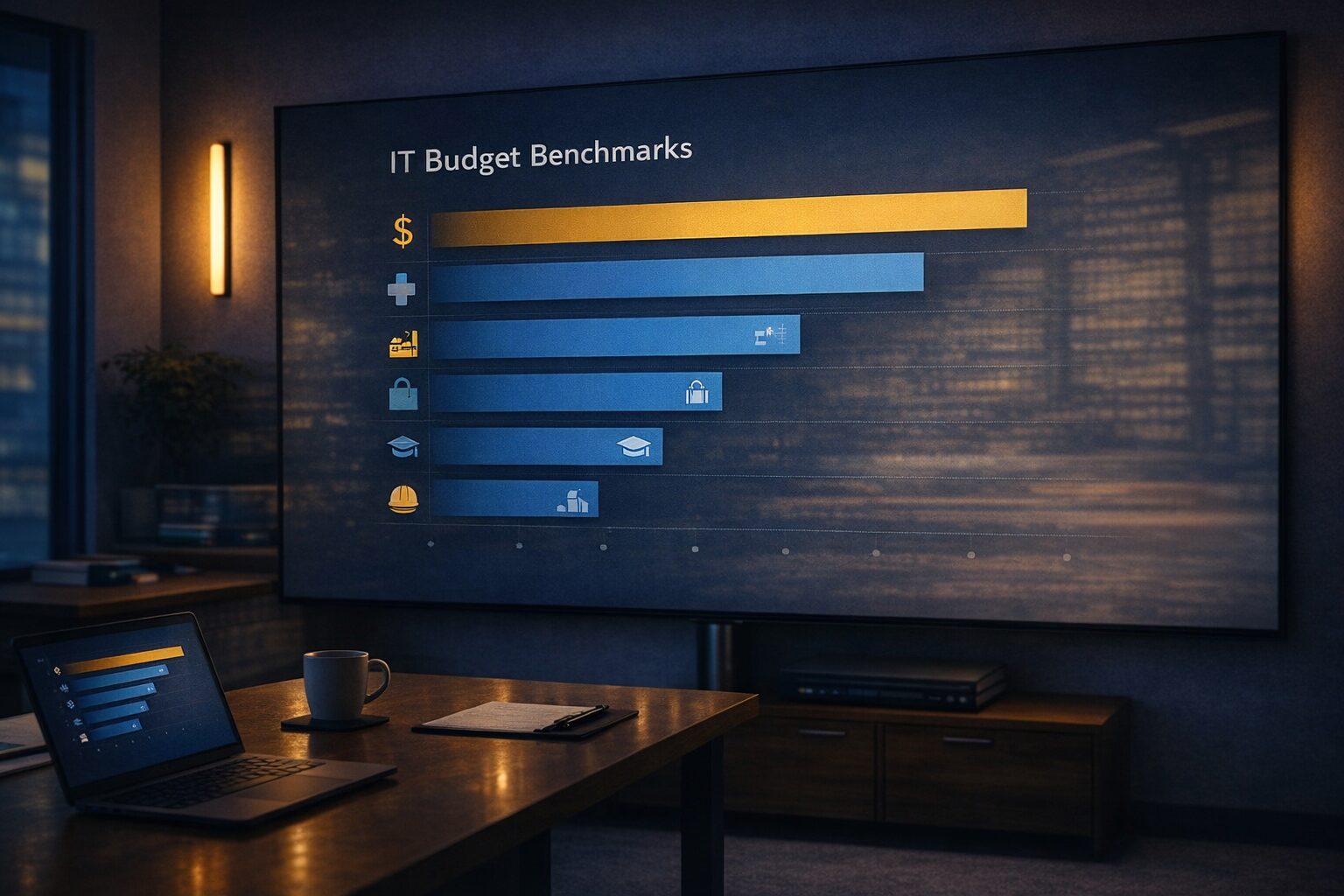
IT budget benchmarks by industry describe the percentage of revenue organizations in a given sector typically allocate to technology.
For healthcare, that figure runs 3% to 5% of operating revenue; banking and financial services firms spend 7% to 10%; manufacturers invest 1% to 3%; and government agencies range from 1% to 5% depending on agency level and mission. What follows is a breakdown of what organizations in each sector are actually spending and why.
In nearly every IT budget assessment we conduct, we find the same gap: organizations believe they’re allocating around 4% of revenue to technology, but when we account for shadow IT, unmanaged SaaS subscriptions, and break-fix costs that bypass the formal IT budget, the actual figure is often 1 to 2 percentage points higher and concentrated in reactive spending rather than strategic investment.
IT spending by industry varies far more than most people expect. A regional bank operates under entirely different technology pressures than a urology practice or a county government. The risks are different, the regulations are different, and the cost of getting it wrong is different. This guide breaks down IT budget benchmarks across the sectors we most commonly serve—Healthcare (including Orthopaedics, Gastroenterology, and Urology), Senior Living & Long-Term Care, Banking & Financial Services, Government, and Manufacturing—so you can see where your organization fits and what it means for your planning.
Before diving into the numbers, keep this in mind: the dollar amount is only part of the equation. Visit our resource on how to align your IT budget with business goals to understand the strategic framework that should sit behind every number in your plan.
Is Your IT Budget Built for What’s Ahead?
How Much Do Healthcare Organizations Spend on IT?
Healthcare organizations typically spend 3% to 5% of operating revenue on IT—the highest benchmark of any service sector. In healthcare, IT is not optional infrastructure: it is the backbone of compliance, care delivery, and patient safety.
According to IBM’s 2023 Cost of a Data Breach Report, healthcare suffered the highest average breach cost of any industry at $10.9 million—a record it has held for 13 consecutive years—which is why technology investment remains non-negotiable even during budget pressure.
HIMSS research consistently places healthcare IT investment in this 3–5% range, driven by electronic health records (EHRs), telehealth infrastructure, HIPAA Security Rule and HITECH Act compliance mandates, and an escalating threat landscape targeting patient data. The precise benchmark shifts meaningfully depending on specialty and digital maturity—which is why the sub-sector breakdown below matters.
Orthopaedics
Orthopaedic practices typically run IT budgets in the 3% to 5% of revenue range, directing significant spend toward Picture Archiving and Communication Systems (PACS), EHR platforms, and patient scheduling solutions. Practices that invest in digital imaging integration and automated patient communication tend to see measurable reductions in administrative overhead. Beyond clinical tools, back-office automation—from insurance verification to revenue cycle management—is increasingly where ortho practices find their most tangible productivity gains. Cybersecurity demands growing attention as orthopaedic practices exchange patient data with hospital networks and insurance payers: a breach in a specialty practice carries the same HIPAA penalties, litigation exposure, and reputational risk as one in a large health system.
Gastroenterology
GI practices face a distinctive IT challenge: managing procedure-heavy workflows alongside the documentation demands of a busy outpatient setting. IT spending in gastroenterology typically ranges from 3% to 4.5% of revenue, with practices routing the largest share toward endoscopy management systems, integrated billing platforms, and clinical documentation tools. GI groups operating ambulatory surgery centers (ASCs) often see technology costs trend toward the higher end of that range, given the added regulatory complexity. Patient communication platforms, secure messaging, and pre-procedure prep workflows are increasingly core IT investments as groups target lower no-show rates and tighter care coordination.
Urology
Urology practices mirror the broader healthcare benchmark, with IT budgets generally in the 3% to 5% range. What distinguishes urology is the specialty’s rapid adoption of telemedicine and remote patient monitoring—particularly for post-procedural follow-ups, chronic condition management, and medication adherence support. These investments demand a reliable foundation: HIPAA-compliant video platforms, patient portals that integrate cleanly with EHRs, and sufficient network bandwidth for consistent virtual care delivery. Urology groups that have deferred their telehealth infrastructure typically face reactive spending when systems underperform during a compliance audit or when a security incident surfaces long-ignored vulnerabilities.
Senior Living & Long-Term Care IT Budget Benchmarks
Senior Living and Long-Term Care organizations historically invested less in IT than acute care facilities—typically 2% to 3% of revenue—but that gap is narrowing quickly. The pandemic dramatically accelerated adoption of telehealth, remote monitoring platforms, and family communication tools, and operators who deferred those investments are now in active catch-up mode. CMS requirements, including Minimum Data Set (MDS) reporting and Emergency Preparedness Rule compliance, drive investment in clinical documentation and quality reporting infrastructure. Back-office demands are equally significant: staff scheduling software, EHR integration with referring hospitals and pharmacy partners, and cybersecurity protections for a population with limited ability to advocate for itself if its data is compromised.
For most Senior Living operators, the question is no longer whether to invest in IT—it’s whether their current spend is reaching the right priorities.
Your IT Complexity Is Growing—Is Your Support Model Keeping Up?
How Much Do Banks and Financial Services Firms Spend on IT?
Banks, credit unions, and financial advisory firms typically allocate 7% to 10% of revenue to IT—more than twice the benchmark of most other industries. According to IBM’s 2023 Cost of a Data Breach Report, the average breach in financial services cost $5.9 million, nearly 33% above the cross-industry average of $4.45 million.
Financial services firms don’t spend 7% to 10% of revenue on IT by choice—they do it because the cost of underspending is measured in regulatory penalties, lost customer trust, and breach expenses that dwarf any technology investment they would have made.
The compliance requirements driving this spending level are specific: SOX, GLBA, and PCI-DSS mandates, alongside a constant threat of financial fraud and sophisticated cyberattacks. Competitive pressure from fintech disruptors is also forcing traditional institutions to accelerate digital transformation timelines, often requiring significant infrastructure investment before revenue gains materialize. Core banking system modernization remains a top priority for community banks and credit unions, many of which are running legacy infrastructure that creates both performance constraints and exploitable attack surfaces.
Government IT Budget Benchmarks
Government agencies at every level face a compounding pressure: modernize aging infrastructure while defending against threats that have specifically targeted public sector systems. Federal agencies typically allocate 3% to 5% of budget to IT; state and local governments generally spend 1% to 3%, though that figure is rising as ransomware incidents against municipalities, school districts, and utility providers demonstrate the cost of underinvestment. CISA’s Cybersecurity Performance Goals (CPGs) and the NIST Cybersecurity Framework (CSF) now serve as the standard benchmarks agencies use to prioritize IT investment, and zero-trust architecture has shifted from an aspirational goal to a compliance expectation across federal contracts and grant programs. Talent retention compounds the challenge: government agencies cannot match private-sector compensation for qualified IT professionals, making co-managed and outsourced IT models an increasingly practical solution at the municipal level.
How Much Do Manufacturers Spend on IT?
Manufacturers typically invest 1% to 3% of revenue in IT—historically the lowest benchmark of any sector. That figure is shifting as IIoT-connected equipment, predictive maintenance platforms, automated quality control systems, and cloud-based ERP solutions move from emerging capabilities to baseline operational requirements under Industry 4.0 frameworks.
Cybersecurity is the most urgent driver of increased manufacturing IT investment. According to IBM’s 2024 X-Force Threat Intelligence Index, manufacturing ranked as the most attacked industry globally for the third consecutive year, with IT and operational technology (OT) network convergence creating attack surfaces that most manufacturers have never had to secure before. Manufacturers who have historically kept IT and OT siloed are now navigating the complexity of securing both environments simultaneously, often for the first time. Cyber insurance underwriters are responding: many now require demonstrable controls—including EDR deployment, network segmentation between IT and OT environments, and documented incident response plans—as conditions of coverage.
How Much Do Manufacturers Spend on IT?
Manufacturers typically invest 1% to 3% of revenue in IT—historically the lowest benchmark of any sector. That figure is shifting as IIoT-connected equipment, predictive maintenance platforms, automated quality control systems, and cloud-based ERP solutions move from emerging capabilities to baseline operational requirements under Industry 4.0 frameworks.
Cybersecurity is the most urgent driver of increased manufacturing IT investment. According to IBM’s 2024 X-Force Threat Intelligence Index, manufacturing ranked as the most attacked industry globally for the third consecutive year, with IT and operational technology (OT) network convergence creating attack surfaces that most manufacturers have never had to secure before. Manufacturers who have historically kept IT and OT siloed are now navigating the complexity of securing both environments simultaneously, often for the first time. Cyber insurance underwriters are responding: many now require demonstrable controls—including EDR deployment, network segmentation between IT and OT environments, and documented incident response plans—as conditions of coverage.
See How Your IT Spend Compares—and Where to Go From Here.
What the Numbers Mean for You
The figures above give you a reference point—they don’t make the decision for you. The percentages reflect widely reported industry patterns; your organization’s right number depends on your growth trajectory, risk tolerance, regulatory environment, and current infrastructure maturity.
The real question for most organizations isn’t whether to increase IT spending—it’s whether their current allocation is reaching the right priorities. What separates effective IT investment from wasted spend is intention: a budget tied to defined outcomes rather than historical habit.
If you’re ready to move beyond benchmarking and build a technology strategy that actively drives your business forward, explore how Meriplex’s managed IT services can give you the expertise, strategic guidance, and hands-on support to optimize your investment—whether you’re right-sizing your IT budget for the first time or evolving a program that’s outgrown its current model.