IT roadmap planning is the process of building a multi-year technology strategy that aligns IT investments with business goals. A well-built IT roadmap covers infrastructure decisions, cybersecurity posture, software strategy, vendor management, and budget allocation—typically across a 3-year planning horizon. For mid-market companies without a dedicated CIO, a structured IT roadmap is the difference between technology that drives growth and technology that quietly creates risk.
Most IT Problems Start the Same Way
Your IT spending is already a roadmap—just not one anyone designed.
A VP of Operations walks into a budget review and learns the company is paying for three overlapping project management platforms. No one has a good answer for why. Six months later, a ransomware attack exploits a system that should have been patched two years ago.
This isn’t bad luck. It’s what happens without a plan.
IT roadmap planning is one of the most consequential things a mid-market company can do—and one of the most consistently skipped. Not because IT leaders don’t understand its value, but because building a credible, actionable IT strategic plan requires time, expertise, and dedicated capacity that most organizations simply don’t have available. And if there’s no CIO in the org chart? That plan rarely gets built at all.
This guide walks through exactly how to build a 3-year IT roadmap—including how to approach budgeting, set priorities, evaluate vendors, and integrate cybersecurity from the start—whether you have an internal IT team driving it or not.
What Is an IT Roadmap—and What Does It Actually Do?
An IT roadmap is a structured, multi-year plan that aligns technology investments with business objectives. It answers three questions: Where are we now? Where do we need to be? How do we get there—and by when?
What it isn’t: a wish list, a vendor contract, or a static document that lives in a shared drive until someone asks about it at the next budget cycle.
A well-built IT roadmap covers:
- Infrastructure and systems: What you have, what needs to be replaced or upgraded, and when
- Cybersecurity posture: Current risk exposure, compliance gaps, and the investments needed to close them
- Application and software strategy: What to consolidate, retire, or invest in
- Vendor and contract management: Who you’re committed to and whether those commitments still make sense
- Budget alignment: Year-by-year capital and operational IT spending, tied to business milestones
The “strategic” part of an IT strategic plan isn’t about vision statements. It’s about making sure that when the business decides to open a new location, acquire a company, or double its headcount, IT is ready—not scrambling.
See What a 3-Year IT Roadmap Looks Like for Your Organization
Why Not Having a Plan Costs More Than Building One
Most mid-market companies don’t lack IT investment. They lack IT coordination. The result is a pattern that shows up across industries: overlapping tools, reactive spending, and security gaps that only become visible after something goes wrong.
When IT planning waits for the CIO hire that never comes, the roadmap that gets built is built by default — one emergency at a time.
Without a documented IT roadmap, a few predictable things happen:
Decisions get made in isolation. The sales team buys a new CRM. Finance implements a reporting tool. Operations selects a field service platform. None of these teams consulted each other—and now IT manages integrations no one planned for.
Budgets disappear into emergencies: Without long-range planning, there’s no proactive capital allocation. Hardware refreshes get pushed until failure, security investments wait until after an incident, and every budget cycle turns into a negotiation between urgent and important.
Security posture falls behind: According to IBM’s 2024 Cost of a Data Breach Report, the average data breach now costs organizations $4.88 million—a figure that doesn’t account for reputational damage or operational disruption. Cyber insurance requirements are growing more prescriptive alongside that number: insurers increasingly require documented evidence of specific controls, including multi-factor authentication (MFA), endpoint detection and response (EDR), and a formal incident response plan. Organizations that discover these gaps at renewal time or after a breach have already paid twice.
Vendor sprawl accumulates unchecked: Without a structured vendor evaluation process, contracts renew by default, tools multiply, and the stack grows expensive and difficult to support.
A 3-year IT plan doesn't prevent every technology problem—it determines whether those problems find you first, or you find them.
How to Build a 3-Year IT Strategic Plan
Building an IT roadmap doesn’t require a 40-person IT department. It requires the right structure. Here’s how to approach it.
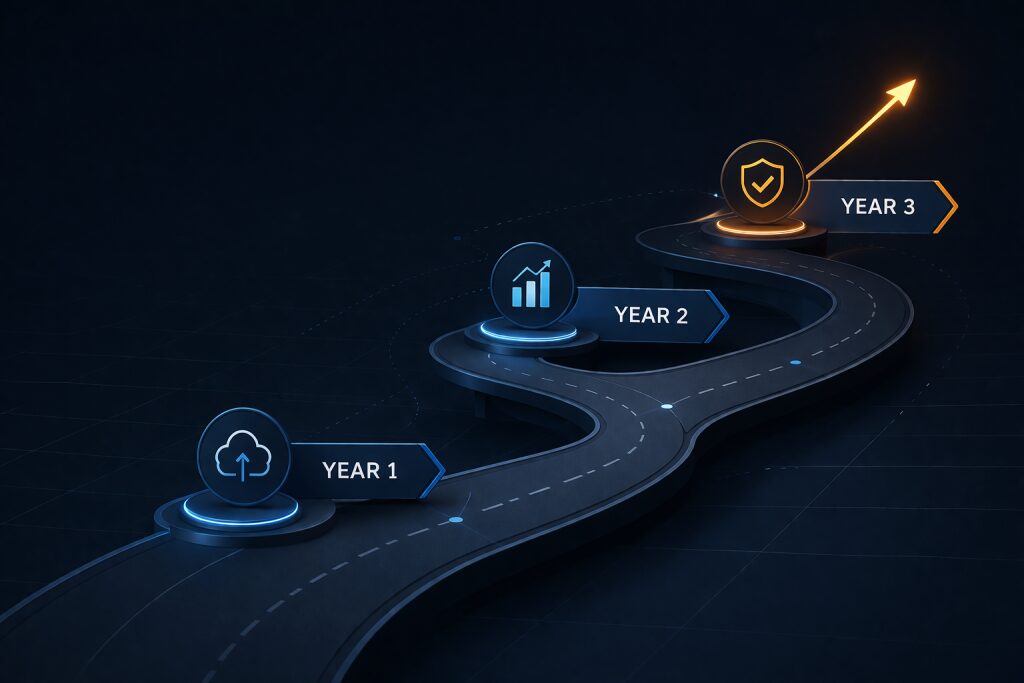
Year 1: Stabilize and Secure the Foundation
Before you plan where you’re going, you need an honest picture of where you are. Year 1 of any IT roadmap should anchor in assessment and stabilization.
Start with a full inventory of your current state: systems, infrastructure, applications, contracts, and security controls. This isn’t glamorous work, but it’s foundational. You can’t prioritize what you haven’t documented.
In a typical IT assessment engagement, the first thing we find is that a company runs three to five redundant security tools with overlapping coverage—paying for duplicate capability while leaving actual gaps elsewhere. An inventory almost always surfaces at least one end-of-life system still processing production data.
Layer in a security baseline assessment using an established framework.
The NIST Cybersecurity Framework (CSF) and CIS Controls are the most widely adopted starting points for mid-market companies—they map directly to the controls cyber insurers require, and they give you a language for prioritizing remediation by risk level rather than urgency.
Year 1 priorities typically include:
- Hardware refresh for end-of-life equipment
- Closure of critical security vulnerabilities identified in the baseline assessment
- Identity and access management improvements: MFA deployment across all users and privileged access management (PAM) controls
- Vendor and contract audit to eliminate redundant tools
- Documentation of key systems, dependencies, and escalation procedures
Year 2: Optimize Spending and Align Technology to Business Goals
With the foundation stabilized, Year 2 locks IT planning in step with business strategy—making sure the technology stack serves the business rather than running alongside it.
This is where budget discipline matters most. Review every technology contract for ROI. Are there tools no one uses? Vendors you could consolidate without losing capability? The goal isn’t cutting IT investment—it’s redirecting it toward tools and systems that move the business forward.
Year 2 is also when IT planning connects directly to business growth plans. If the company plans to grow headcount by 30% over the next 18 months, IT needs a plan for scaling infrastructure, onboarding tooling, and communication systems to match. If a merger or acquisition is on the horizon, IT needs a seat at the table before due diligence closes—not after.
Key Year 2 focus areas:
- Application rationalization and vendor consolidation
- Cloud strategy refinement (what stays on-premise, what migrates, and the cost model for each)
- IT budget modeling tied to business growth projections
- Security maturity improvements: EDR deployment, SIEM implementation, security awareness training program
- Defined SLAs and support models for critical business systems
Year 3: Scale With Intention
Year 3 is where the roadmap pays off. With a stable foundation and an optimized stack, the organization can make technology investments that create competitive advantage—not just maintain operations.
The companies that get the most out of Year 3 aren't the ones with the biggest IT budgets. They're the ones that spent Years 1 and 2 building the foundation those investments actually need.
This might mean deploying automation to reduce manual work, implementing analytics that improve decision-making, or adopting platforms that enable new business models. Whatever those investments are, business priorities drive them—and the groundwork from Years 1 and 2 makes them viable.
Year 3 is also when you start building the next roadmap. A 3-year IT plan is a living discipline, not a one-time deliverable. By Year 3, the business has changed, the technology landscape has shifted, and new priorities have surfaced. The organizations that benefit most from IT roadmap planning treat it as an ongoing function, not a project with an end date.
Not Sure If You Need a Fractional CIO or a Managed IT Partner?
Does Cybersecurity Belong in the IT Roadmap?
Yes—and not as a chapter at the end. For any mid-market company, cybersecurity is inseparable from infrastructure planning, budget decisions, and vendor selection.
An effective IT roadmap treats security as infrastructure. Every infrastructure decision—cloud provider selection, endpoint management, remote access configuration—carries security implications. Evaluate those implications as part of the decision, not as an afterthought.
For mid-market companies specifically, embed security into the roadmap this way:
- Map roadmap milestones to cyber insurance requirements year by year (MFA in Year 1, EDR in Year 2, formal IR testing in Year 3)
- Include security tooling investments in capital planning alongside hardware and software—not as a separate budget that competes for allocation
- Build incident response (IR) planning into Year 1. The NIST CSF’s “Respond” and “Recover” functions provide a structured starting point
- Evaluate every new vendor and application for security posture, data handling practices, and SOC 2 Type II or ISO 27001 certification before contract signature
Zero Trust architecture—the principle of “never trust, always verify” for every user and device requesting network access—is increasingly the recommended posture for mid-market companies. It’s not a single product; it’s an architecture that shapes how you design identity, access, and network segmentation across the entire roadmap.
When the roadmap treats security as a first-order requirement from the start, organizations spend less on reactive remediation and make more defensible decisions when it counts.
Budgeting and Vendor Evaluation: The Part Most Plans Skip
A roadmap without a budget model is a strategy document. The two have to travel together.
Break IT spending into two categories for each year: capital expenditures (hardware, infrastructure investments, major software implementations) and operational expenditures (licensing, support contracts, managed services). Understanding that split helps finance and IT align expectations and prevents mid-year surprises.
Vendor evaluation should follow a structured process, not a series of demos. When assessing any vendor or platform, cover:
- Total cost of ownership: Licensing is the entry price. Add implementation, training, internal support burden, and integration costs to get the real number
- Strategic fit: Does this vendor’s product roadmap align with where your business is heading over the next three years?
- Security posture: What certifications does the vendor hold (SOC 2 Type II, ISO 27001)? How do they handle your data? What is their incident notification timeline?
- Exit costs: How difficult is it to migrate off this platform if the relationship doesn’t work out?
Vendor consolidation is often the highest-ROI move in a Year 1 or Year 2 roadmap. Companies running sprawling stacks frequently find they can reduce vendor count significantly without losing capability — and redirect those savings toward strategic investments with measurable business impact.
Who Builds the Roadmap When There’s No CIO?
This is the question most IT roadmap guides skip entirely.
All of the above assumes someone with the strategic experience and available bandwidth to build and own a multi-year IT plan. For many mid-market organizations, that person doesn’t exist on the org chart.
Hiring a full-time CIO is one option. For organizations above a certain size and complexity threshold, it’s the right one. But a qualified CIO commands a base salary typically ranging from $200,000 to $350,000-plus for mid-market companies — and many organizations don’t need full-time strategic IT leadership. They need the right expertise applied consistently over time.
That’s where the Fractional CIO model solves a real problem. A fractional CIO brings senior-level IT leadership to organizations that need strategic direction without the overhead of a full-time executive hire. They lead roadmap development, own vendor relationships, guide security planning, and serve as a standing resource for the leadership team.
Meriplex’s Fractional CIO and CISO services are designed for exactly this scenario: senior leaders facing technology decisions that will shape company direction for years, without the internal bench to navigate them. Not a junior consultant with a framework—an experienced IT executive embedded in the business and accountable for outcomes.
What Does a Managed IT Partner Add to IT Roadmap Planning?
More than most companies expect.
A managed IT services partner can do more than keep systems operational. When you structure the partnership correctly, roadmap planning becomes a core deliverable—not an optional add-on.
At Meriplex, technology roadmap planning is built into the managed services model. Clients receive day-to-day IT support alongside structured planning sessions, budgeting guidance, vendor advisory, and a long-term roadmap that gets reviewed and updated as the business evolves. The team functions as an extension of internal IT—not a break-fix vendor waiting for something to fail.
For mid-market organizations running IT with a lean internal team or no dedicated IT staff at all, this model fundamentally changes the math. You don’t hire for every gap. You get planning, operations, and security expertise as an integrated service—with senior leaders who know your environment and translate business goals into technology decisions.
Your IT Roadmap Starts With One Conversation
Building a 3-year IT roadmap is not a small undertaking. But running without one—reactive spending, unmanaged risk, technology that can’t keep pace with the business—costs more over time than any planning investment.
The organizations that get the most value from IT roadmap planning are the ones that don’t try to build it alone. Whether that means a fractional CIO who owns the process, a managed IT partner who builds planning into the engagement, or both—the right structure makes the difference between a document that gets filed away and a plan that actually drives decisions.