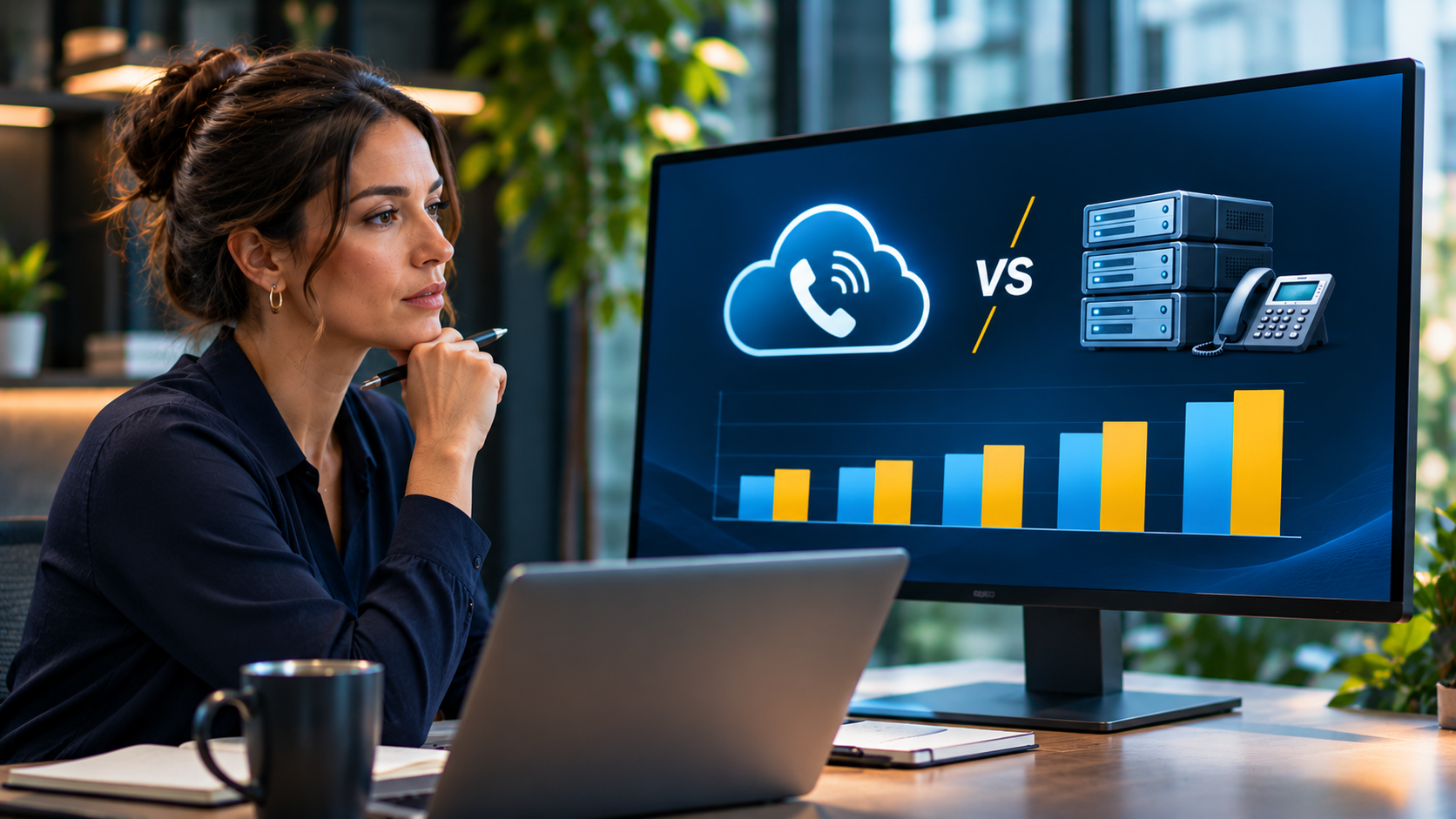
Over five years, the maintenance contract on an on-premise phone system can cost as much as the hardware did. That line never appears on the quote, and neither do the trunk bill, the technician visits, or the hours your own team spends adding extensions. Those four costs sit in four different budgets, which is why almost nobody adds them up.
UCaaS vs on-premise PBX cost is the comparison between a per-user monthly subscription and a capital hardware purchase carrying maintenance, trunk and labor costs behind it. Over five years, UCaaS typically costs $20 to $74 per user per month, and a newly purchased on-premise PBX costs $25 to $67 per user per month. Those ranges overlap, so the deciding factor is usually where you sit in your hardware refresh cycle rather than the headline price.
Treat every figure here as a directional estimate for a mid-market company, not a quote.
Not Sure Which Column You Land In?
What Does an On-Premise PBX Cost Over Five Years?
A replacement on-premise PBX for a 250-user company typically costs $372,000 to $1,008,000 over five years, or $25 to $67 per user per month. The hardware is usually the smallest part of that. Maintenance contracts, SIP trunking or PRI charges, technician visits and internal IT time make up the rest, and they sit in budgets nobody thinks to compare against a cloud quote.
An on-premise system is a capital expense, which is why the purchase is the part everyone budgets for. Published cost guides put hardware, licenses, handsets and installation at $500 to $2,000 per user, with mid-market volume landing in the lower half. For 250 users, roughly $125,000 to $300,000. Everything after that recurs, and that is where the five-year total comes from:
- Maintenance contracts. Annual support runs 10 to 20 percent of hardware value per year. Across five years, that one line can match what you paid for the system.
- Trunk charges. PRI or SIP trunking bills monthly whether anyone calls or not. The right channel count comes from an Erlang B calculation against your busy-hour volume, but most companies inherit a number from a build years ago and never revisit it, even when the rest of their business connectivity gets renegotiated.
- Moves, adds and changes. If adding a new hire means a technician visit, every hire carries a labor charge. Published figures put this at $500 to $1,500 a year for a typical office.
- Internal IT time. A quarter to half of one person’s week goes to telephony in most mid-market environments. It never appears on an invoice, which is why most comparisons leave it out.
- End-of-life exposure. Aging Avaya, Cisco and Mitel estates bite hardest here. Past end of manufacturer support, pricing rises and the pool of technicians who still know the platform shrinks.
What Does UCaaS Cost Over Five Years?
UCaaS for the same 250-user company typically costs $305,000 to $1,105,000 over five years, or $20 to $74 per user per month. The per-user license is roughly three quarters of that. Regulatory fees, E911 compliance work, implementation, handsets and network readiness make up the balance, and none of them show up on the per-seat price you were quoted.
UCaaS is an operating expense built on VoIP, the same technology behind hosted PBX and cloud PBX services. One license covers call control, calling, video, messaging and the maintenance that used to be its own contract. Your spend now tracks headcount instead of hardware, which helps when you shrink and hurts when you grow.
Published US list pricing runs $15 to $50 per user per month by tier. The rest sits underneath it:
- Regulatory fees and E911 work. Your provider passes the FCC Universal Service Fund contribution, state taxes and 911 surcharges through on top of list, commonly adding 15 to 30 percent, so a $30 seat is not a $30 seat. Separately, Kari’s Law and RAY BAUM’S Act require direct 911 dialing and a dispatchable location for every station, which is labor rather than a fee: someone maps users to floors and addresses before go-live, then again every time people move desks.
- Implementation and handsets. A one-time professional services charge scaled to users and sites, plus desk phones at $50 to $300 each. Phones are increasingly optional. Conference room hardware is not.
- Network readiness. Someone applies QoS policy, typically DSCP EF marking for voice, and confirms the 802.3at PoE budget on each switch before the first phone goes live. NIST Special Publication 800-58, the federal guidance on VoIP security, also calls for voice to run on its own network segment. On a flat network, that segmentation is a project in itself. Where the circuit is the constraint, you have the same problem as anyone trying to cut connectivity costs with SD-WAN.
- Add-ons. AI transcription, meeting summaries and agent assist carry their own charges, often $12 to $39 per user per month, and contact center seats price separately again. Companies already paying for Microsoft 365 weigh Teams Phone against a full platform here, and that turns on call routing complexity rather than seat price.
- Contract terms. Renewal escalators and true-down rights set what years four and five cost, and both are settled at signature. Model year five at the escalated rate, not the introductory one.
How Do UCaaS and On-Premise PBX Costs Compare Over Five Years?
Over five years the two totals overlap almost completely: $25 to $67 per user per month on-premise against $20 to $74 for UCaaS. That overlap is the finding. Published averages only pick a winner by hiding the assumptions underneath them. Total cost of ownership turns on your refresh date and your labor cost, not on which platform you choose.
We model 250 users deliberately. According to Mordor Intelligence’s hosted PBX market analysis, companies in the 51 to 250 seat band accounted for 61.1 percent of hosted PBX revenue in 2025, putting the mid-market at the center of this decision.
Five-year cost comparison, 250 users (directional estimates)
| Cost category | On-premise PBX | UCaaS | Notes |
|---|---|---|---|
| System and installation | $125,000 to $300,000 | $0 | $500 to $1,200 per user, capital, depreciated |
| Licenses or maintenance | $62,500 to $300,000 | $225,000 to $750,000 | 10 to 20 percent of hardware value per year, vs $15 to $50 per user per month |
| Trunks and connectivity | $72,000 to $108,000 | Included | Modeled at one channel per three to four users |
| Regulatory and tax | Varies by carrier | $34,000 to $225,000 | USF, state tax and 911 surcharges, 15 to 30 percent on top of list |
| Implementation and handsets | Included above | $21,000 to $70,000 | One-time, scaled to sites and phone take-up |
| Internal IT time | $112,500 to $300,000 | $25,000 to $60,000 | Modeled at 0.25 to 0.5 FTE vs light admin |
| Five-year total | $372,000 to $1,008,000 | $305,000 to $1,105,000 | $25 to $67 vs $20 to $74 per user per month |
A company buying new hardware and carrying real telephony labor sits at the top of the on-premise column. One with a paid-off system and a capable internal team sits at the bottom, below any UCaaS quote.
Build This From Your Own Invoices
What Happens to the Cost When You Add Users?
Adding people lowers your per-user cost on-premise and raises it on UCaaS, because on-premise costs are largely fixed while UCaaS is linear. That holds until you exhaust port density, gateway card slots or licensed trunk channels. At that point you buy hardware again and the five-year total resets, which is why capacity headroom matters more than growth rate.
The chassis, the maintenance contract, the trunk minimum and the administration hours barely move when headcount does, so spreading them across 300 users instead of 250 brings the per-user figure down. Every UCaaS seat costs what the last one did. On that arithmetic, growth favors the PBX, and for a while it does. Then you run out of ports.
Growth does not make the cloud cheaper. Running out of ports does.
So the question is not how fast you are hiring. It is how many more people this system takes before you spend again. At 40 percent headroom and 5 percent annual growth, you have about seven years of runway. At 10 percent headroom, two.
When Does On-Premise Still Make Sense?
Keeping an on-premise system is usually cheaper when the hardware is paid off, still under support, and has capacity left. Remove the purchase line from the table above and the five-year figure drops to roughly $16 to $47 per user per month, which undercuts most UCaaS quotes. Air-gapped facilities, poor connectivity and analog-heavy buildings are the other three cases where staying put holds up.
This is not a fringe position. Metrigy’s UCaaS research puts more than 45 percent of companies on UCaaS as their only communications platform, with a further 14 percent running UCaaS and on-premise side by side. Roughly one company in seven treats hybrid as a destination, not a waypoint. Buildings heavy with analog paging, door phones and alarm circuits are a common reason, since each device needs an analog telephone adapter.
Which way your numbers point
| If this is true | The likely answer |
|---|---|
| Hardware is paid off, supported, and has capacity left | Stay on-premise, and re-price the exit every year |
| A hardware refresh is due inside 24 months | Price UCaaS before you sign the purchase order |
| Headcount is flat or falling | On-premise holds its cost advantage |
| You are opening sites or hiring quickly | UCaaS, unless your chassis has real headroom |
| Call data cannot leave the building | On-premise, or a deliberate hybrid |
| Telephony eats more than half a day of IT time a week | UCaaS, on labor cost alone |
Copper retirement and vendor end-of-life dates raise the cost of standing still every year, so a decision that holds today may not hold at renewal. If you are unsure which side of that line you are on, the signals that an old office phone system has stopped being a choice are easier to read than the cost math is.
How Do You Build the Business Case?
Gather six inputs before you model anything: current headcount and its direction, your system’s purchase date and remaining capacity, your trunk and maintenance invoices, your change-request volume, the IT hours spent on telephony each month, and your next renewal date. Five of those sit in systems you already own. The sixth, IT hours, moves the total most and nobody tracks it.
Two weeks of honest timekeeping on telephony tickets beats any vendor calculator. Separate structure from total when you present it: a capital purchase in the depreciation schedule reads differently to a CFO than an operating expense recurring forever, even when the totals match. Show both and let them pick.
In a typical phone system assessment, the first thing we find is not a pricing problem. It is an inventory problem. Fax lines, alarm panels, elevator phones and overhead paging rarely appear in anyone's extension list, because nobody has touched them since the system went in. Each needs a gateway or a replacement circuit, and the life-safety circuits have to be replaced one for one rather than migrated. Teams that inventory before requesting quotes get numbers they can defend. Teams that do it afterwards spend the next month revising them.
Frequently Asked Questions
How much does a PBX system cost?
Published cost guides put hardware, licenses, handsets and installation at $500 to $2,000 per user, so a 250-user build commonly lands between $125,000 and $500,000 before ongoing costs. Annual maintenance adds 10 to 20 percent of hardware value every year after.
What are the downsides of a cloud phone system?
Calls depend on your internet connection, so a site without a second circuit or an LTE failover path has a single point of failure it did not have before. Per-seat costs scale in both directions, helping when you shrink and costing you when you grow. Renewal escalators can also move your rate in years four and five unless you settle them at signature.
How do you calculate total cost of ownership for a phone system?
Add the capital purchase, every recurring charge across the life of the platform, the internal labor spent administering it, and the migration costs at both ends. Then divide by users and months so both options read the same way. Most comparisons fail by pricing a purchase against a subscription and leaving labor out of both columns.
Two companies of identical size can reach opposite conclusions and both be right, because one bought its hardware eighteen months ago and the other is three quarters through a depreciation schedule with no ports left. Run your own figures through the tables above. Most people have their answer before they finish.