A vCISO (virtual Chief Information Security Officer) delivers the same strategic security leadership as a full-time CISO at roughly 30 to 50 percent of the cost, on a part-time or project basis. A full-time CISO is a permanent executive hire with daily, embedded involvement. The right choice depends on your organization’s size, security program maturity, compliance obligations, and how much continuous security leadership your operations genuinely require.
Most mid-market organizations reach a point where their IT director can no longer carry the security function alone. The question is not whether to get security leadership. It is whether a $280,000 full-time executive hire is the right answer, or whether a fractional engagement gets you the same strategic outcomes for a fraction of that cost.
This guide covers the cost difference in concrete terms, what each model actually delivers day-to-day, and the specific organizational signals that point toward one choice over the other.
What Is the Difference Between a vCISO and a Full-Time CISO?
A full-time CISO is a permanent executive employee, embedded in your organization’s day-to-day operations. They attend every executive meeting, manage your internal security team directly, respond to incidents in real time, and own the security function as their sole professional responsibility.
A vCISO provides the same strategic layer on a fractional basis. They design your security program, run your risk management process, lead your compliance initiatives, and report to your board or executive team, but they do so across a defined number of hours per month rather than as a full-time presence. The engagement is contractual, the scope is defined, and the cost is proportional to what your organization actually needs.
The strategic outputs are equivalent. The employment structure is not. For a deeper look at what the vCISO role covers day-to-day, the What Does a vCISO Do guide covers the full scope of responsibilities.
How Much Does a vCISO Cost vs. a Full-Time CISO?
Full-time CISO compensation
Base salaries for full-time CISOs in the United States range from approximately $200,000 to $350,000 for most mid-market and enterprise roles. At the senior end, total cash compensation including bonus and equity can reach $500,000 or more, according to the IANS and Artico Search 2024 CISO Compensation Benchmark. Factor in benefits, employer payroll taxes, office overhead, and security tool budgets, and the fully loaded annual cost regularly exceeds $400,000.
Recruiting a CISO adds to that. Executive search fees typically run 20 to 30 percent of first-year compensation, and CISO tenure is short: the average is 18 to 26 months in a single organization, which means many companies face a second expensive search within two to three years of the first.
vCISO pricing
vCISO engagements are typically structured as monthly retainers. Pricing ranges from approximately $3,000 to $15,000 per month depending on scope, hours, and the maturity of work required. A mid-market organization running a substantive security program typically falls in the $5,000 to $10,000 per month range, or $60,000 to $120,000 annualized.
Project-based engagements for specific, time-bounded work such as a SOC 2 readiness assessment or an incident response plan build typically range from $15,000 to $50,000 depending on scope.
The cost advantage compounds when you factor in what you do not pay: no benefits, no payroll taxes, no recruiting fees, no severance risk, and no gap period when a CISO resigns. A vCISO engagement can typically be stood up in two to four weeks.
Hidden costs of a full-time CISO hire
The base salary is only the starting point. A full-time CISO’s fully loaded cost includes employer payroll taxes, health and dental benefits, 401(k) match, paid time off, and typically a training and conference budget. Add executive search fees of 20 to 30 percent of first-year compensation, relocation costs where applicable, and the productivity gap during a hiring process that typically runs several months, and the true cost of bringing on a full-time CISO is substantially higher than the salary figure alone suggests.
Turnover compounds the cost. With average CISO tenure at 18 to 26 months, many organizations effectively pay full recruiting and onboarding costs every two to three years. A vCISO engagement eliminates that cycle. When an individual changes, the provider replaces them without a hiring process.
Part-time CISO vs. vCISO: is there a difference?
A part-time CISO is typically an individual contractor hired directly by your organization on a reduced-hours basis. A vCISO typically comes through a managed services provider and brings institutional backing: a team, proven methodologies, tooling, and a replacement process if the individual is unavailable. For most mid-market organizations, the vCISO model through a provider offers more operational resilience than a direct part-time hire, because the continuity is built into the engagement structure rather than dependent on a single person’s availability.
The table below puts the two models side by side across the factors that matter most to a mid-market decision maker.
| Factor | vCISO | Full-Time CISO |
|---|---|---|
| Annual cost | $60K to $120K (retainer) | $300K to $450K+ (fully loaded) |
| Time to engage | 2 to 4 weeks | 4 to 6 months average |
| Tenure risk | Provider replaces seamlessly | Average 18 to 26 months |
| Recruiting cost | None | 20 to 30% of first-year comp |
| Benefits / overhead | None | +20 to 30% on base salary |
| Availability | Defined hours, on-call for incidents | Full-time, immediate |
| Breadth of experience | Cross-industry, multi-client | Single organization depth |
| Team management | Advisory and oversight | Direct management of security staff |
| Compliance coverage | Full program leadership | Full program leadership |
| Board reporting | Scheduled and contracted | Ongoing and embedded |
Value and ROI: What Does Each Model Actually Deliver?
Cost savings only matter if the security outcomes are equivalent. For the strategic layer of a security program, they typically are. A vCISO designs your security framework, runs your risk assessment process, leads your compliance certifications, and reports to your board. A full-time CISO does the same work. The difference is depth of daily involvement, not quality of strategic judgment.
Where a full-time CISO adds measurable value beyond a vCISO is in team management and real-time operational decisions. If your security program includes a team of analysts, engineers, and compliance specialists who need daily direction, a fractional leader cannot provide that continuity. If your incident response depends on someone walking into the building at 2 AM, a vCISO arrangement requires that expectation to be explicitly scoped and contracted.
In engagements where organizations transition from a vCISO to a full-time CISO hire, the most common trigger is not dissatisfaction with the vCISO's strategic work. It is headcount. Once the internal security team grows beyond three or four people, the coordination overhead demands a full-time leader who is present daily to manage priorities, unblock work, and interface with engineering and IT teams continuously.
According to IBM’s Cost of a Data Breach Report 2024, the average cost of a data breach reached $4.88 million globally. Organizations that detected breaches using their own internal security teams and tools saved nearly $1 million in breach costs on average and contained incidents 61 days faster than those that did not. The vCISO’s primary ROI argument is not the fee savings versus a full-time salary. It is the cost of the breach you prevent by having a security program at all.
When a vCISO Is the Right Choice
Your organization does not yet have a formal security program
A vCISO’s highest-leverage use case is building a security program from the ground up. If you have no documented risk register, no written incident response plan, and no formal compliance program, a vCISO can establish all three in a matter of months. That foundational work does not require daily presence. It requires experience, a structured methodology, and the authority to drive decisions across the organization.
You are pursuing a compliance certification
SOC 2 Type II, HIPAA, CMMC Level 2, and PCI DSS all require structured security program documentation, evidence collection, and audit preparation. A vCISO who has led organizations through these certifications brings a repeatable process and knows exactly what auditors look for. Engaging a vCISO for compliance work is typically more efficient than assigning it to an internal IT team that has never navigated the process.
If you are still deciding whether to bring in a fractional CISO, a fractional CIO, or both, the Fractional CIO vs. Fractional CISO comparison breaks down which role owns which responsibilities and when organizations need both.
You need interim security leadership
When a CISO resigns, the average replacement timeline is several months. Leaving the security function unled during that period creates real exposure. A vCISO can step in immediately, maintain program continuity, and in some cases help define the requirements for the full-time role you eventually hire.
You are a small to mid-sized business
For organizations under 500 employees, the workload of a mature security program rarely justifies a full-time CISO salary. A well-scoped vCISO retainer covers the strategic leadership the program needs while leaving budget for the operational security tools and personnel that execute the day-to-day work.
When a Full-Time CISO Is the Right Choice
Your organization has a large, dedicated security team.
Once you have four or more security professionals who need daily direction, prioritization, and management, a fractional leader creates coordination gaps. A full-time CISO provides the continuous presence that a growing security organization requires to operate efficiently.
You operate in a highly regulated or high-risk sector
Financial institutions operating under New York DFS Part 500, federal contractors under CMMC Level 3, and healthcare organizations handling large volumes of PHI often face regulatory expectations of a formally designated, embedded security officer. A vCISO can satisfy the role requirement in many cases, but organizations in these sectors frequently find that daily regulatory interactions, examiner relationships, and continuous compliance monitoring demand a full-time presence.
Security is a core competitive differentiator for your business
If your customers, investors, or partners evaluate your security posture as part of their procurement or due diligence process, having a named, full-time CISO sends a signal that a fractional arrangement cannot match. For SaaS companies selling to enterprise clients, or for organizations approaching an IPO, a full-time CISO is often worth the investment as a trust signal independent of the security outcomes.
What Should You Ask Before Deciding?
How do you know when a vCISO is enough and when you need a full-time hire?
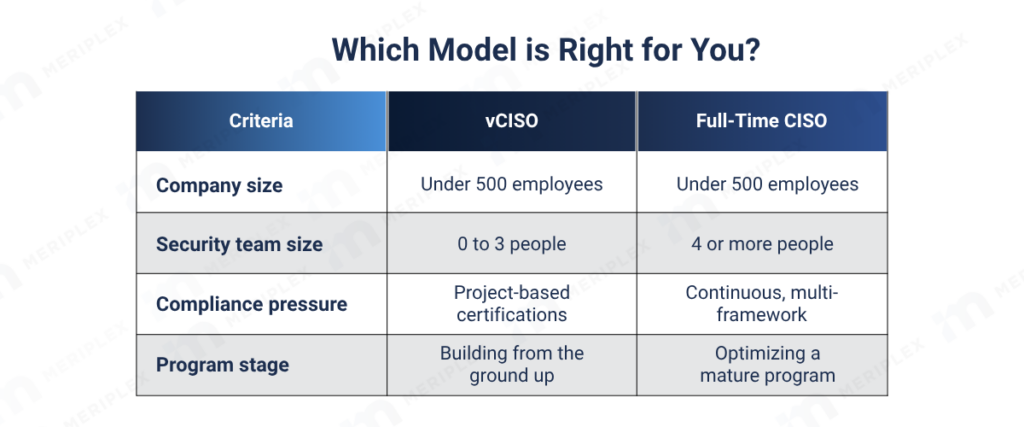
The clearest signal is team size and program stage. If your security team has fewer than four people and your program is still being built, a vCISO covers the strategic leadership you need. If your team is larger, requires daily management, and your program runs continuously across multiple frameworks and business units, a full-time CISO provides the embedded presence that a fractional engagement cannot replicate at that scale.
These questions cut through the cost debate and get to the structural fit:
- How many people are on your internal security team, and do they need daily management?
- Do your compliance obligations require a continuously present, named security officer?
- Can your incident response process tolerate a response window of hours rather than minutes?
- Is your security program in build mode (vCISO advantage) or optimization mode (full-time advantage)?
- Are you preparing for an event, such as an M&A transaction or IPO, where a full-time executive signals governance maturity?
- What is the realistic fully loaded cost of a full-time hire, and what does that budget buy in operational security capabilities if redirected?
Once you have decided to move forward with a vCISO, the next practical question is how to evaluate candidates and providers. The questions to ask when hiring a vCISO covers the evaluation criteria and red flags that separate strong vCISO engagements from weak ones.
For organizations still deciding whether virtual IT leadership makes sense more broadly, the Fractional CIO and vCISO Services guide covers both roles and how they work together in a mid-market context.
The matrix below maps the most common organizational signals to the model they typically point toward.