
When hiring a vCISO, the right questions probe experience, not credentials. Ask about specific industry engagements, how they build and maintain a security roadmap, what their first 90 days look like, and how they handle a live incident. A strong vCISO answers with specifics: framework names, client scenarios, and documented deliverables. Vague answers, over-reliance on certifications, and inability to describe past incident response experience are the clearest disqualifiers.
The vCISO market has a signal problem. Credentials are easy to list. Strategic leadership is not. Two candidates can hold identical certifications and look identical on paper. One has spent years building and running security programs for organizations like yours, the other has spent years producing audit reports and moving on.
The questions below are designed to surface that difference. Before going through them, it helps to be clear on what a vCISO actually owns and what they do not. For a full breakdown of the role, What Does a vCISO Do covers the full scope of responsibilities, from security program governance to board reporting.
If you are still deciding whether a vCISO, a fractional CIO, or both is the right fit, the Fractional CIO vs. Fractional CISO guide breaks down which role owns which responsibilities before you start the hiring process.
Questions About Their Security Program Experience
A vCISO’s most important qualification is not a certification. It is whether they have built a security program before. Building means starting from a gap analysis, translating findings into a prioritized roadmap, driving execution across an organization that has other priorities, and updating the program as the business and threat landscape change. That work is different from auditing a program someone else built.
What to ask
- Walk me through a security program you built from scratch. What was the starting state, and where did the organization end up?
- What framework did you use, and how did you adapt it to the client’s specific risk profile?
- What were the hardest internal objections you had to overcome, and how did you handle them?
- What does a mature security program look like at a company our size, and how long does it typically take to get there?
What the answers should tell you
A strong candidate answers with specifics: a framework (NIST CSF, CIS Controls, ISO 27001), a timeline, a description of the internal resistance they navigated, and a measurable outcome. A weak candidate describes the deliverables they produced (a policy document, an assessment report) without describing the leadership work that made execution happen. Deliverables are outputs. Program leadership is a different skill.
In a first engagement with a mid-market manufacturer, the most revealing question was not about certifications. It was asking the candidate to describe the last time they had to tell a CEO something they did not want to hear about their security posture. The strongest candidates answered immediately, with specifics. The weakest pivoted to process language and never actually answered the question.
Questions About Compliance and Framework Knowledge
Compliance and security are not the same thing, but for most mid-market organizations they are deeply intertwined. A vCISO who cannot run a SOC 2 readiness process, navigate a HIPAA audit, or prepare an organization for CMMC Level 2 certification is not the right fit for a regulated environment.
Healthcare, financial services, government contracting, and retail each have distinct regulatory obligations with specific evidence requirements, timelines, and auditor expectations. Industry proximity is not the same as domain expertise.
What to ask
- What compliance certifications have you led end-to-end, not just supported?
- Walk me through how you prepared an organization for its first SOC 2 Type II audit. What did the evidence collection process look like?
- How do you stay current on regulatory changes, and how quickly do you update client programs when requirements shift?
- Have you worked with CMMC, NY DFS Part 500, or FTC Safeguards Rule? Describe a specific engagement.
- If we have overlapping compliance obligations, such as HIPAA and SOC 2, how do you map controls across frameworks to avoid duplicating work?
What the answers should tell you
Strong candidates describe the compliance process in operational terms: how they structured the evidence collection timeline, how they managed the gap between what auditors ask for and what organizations actually have documented, and what they did when a control failed during testing. For organizations navigating federal compliance specifically, CISA publishes updated guidance on control frameworks and regulatory requirements. Weak candidates name the frameworks they know without describing how they ran a certification process. Naming a framework is not the same as having led an audit.
Questions About Engagement Model and Leadership Reporting
A vCISO who cannot clearly describe what they deliver, how often, and in what format is not ready to run your security program. Vague statements of work create accountability gaps. Before signing anything, you need to know exactly how the engagement is structured, what you receive, and what escalation looks like when priorities shift or a problem surfaces.
What to ask
- How many hours per month are included, and how are those hours allocated across strategic work, meetings, and deliverables?
- What does your monthly reporting look like? Can I see a redacted example of a board-level security report you have delivered?
- How do you handle scope creep if a compliance initiative or incident requires significantly more time than budgeted?
- How do you work alongside an existing MSP or internal IT team without creating overlap or conflict?
- What is your availability outside scheduled hours, and how quickly do you respond to urgent issues?
What the answers should tell you
A strong vCISO can produce a sample deliverable immediately: a board report, a risk register excerpt, a roadmap slide. They describe their reporting cadence without prompting and explain how they separate strategic from operational work. A weak candidate speaks in generalities about ‘staying in close communication’ without being able to describe what that looks like in practice or show you evidence of it.
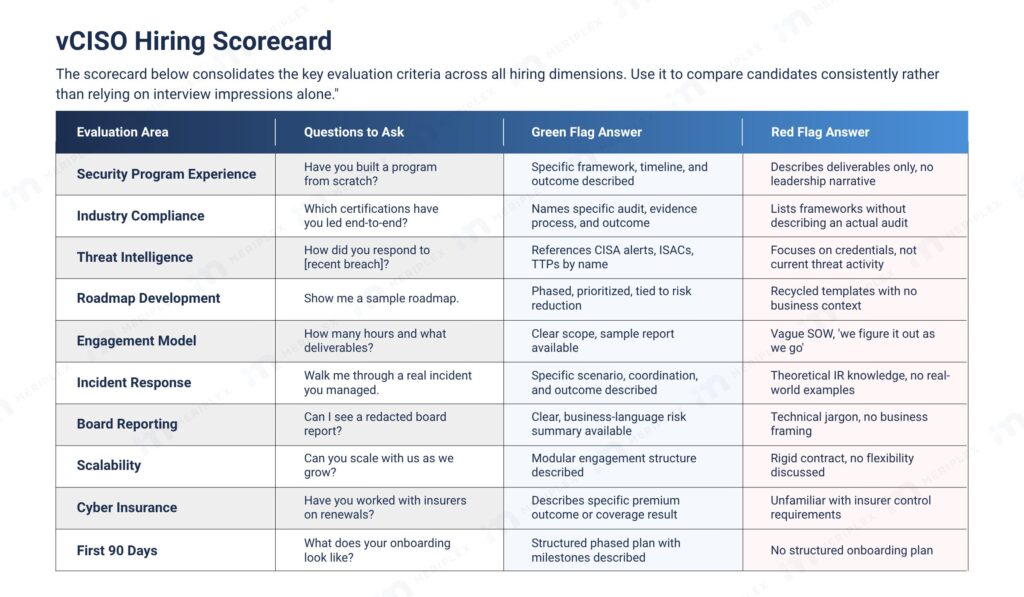
The scorecard below consolidates the key evaluation criteria across all hiring dimensions. Use it to compare candidates consistently rather than relying on interview impressions alone.
Questions About Incident Response and Crisis Readiness
Incident response is where vCISO engagements either justify themselves or expose their limitations. Building an IR plan is one thing. Coordinating a live response under pressure, managing the legal and insurance dimensions simultaneously, and communicating clearly with executive leadership during a crisis is a different capability. Ask about both.
What to ask
- Walk me through a real incident you managed. What happened, what was your specific role, and what would you do differently?
- How do you coordinate between your IR response, legal counsel, and the cyber insurance carrier during an active breach?
- What does your IR documentation look like, and how do you ensure it satisfies insurer requirements?
- How often do you run tabletop exercises, and can you describe one you facilitated?
- What is your on-call availability during an active incident, and how is that structured in the engagement?
What the answers should tell you
The strongest IR candidates describe incidents in operational terms: the initial detection vector, who they called first, how they managed the legal hold question, how the insurance carrier was engaged, and what the post-incident review surfaced. Candidates who have not managed a real incident tend to speak in NIST SP 800-61 process language without the scenario behind it. A candidate can know the framework and have managed a real incident. Ask for the story first, then the process.
Board-Level Questions to Evaluate Cyber Resilience Readiness
A vCISO who cannot communicate effectively at the board level is a security resource, not a security leader. Boards are asking harder questions about cybersecurity than they were five years ago. SEC cybersecurity disclosure rules, increasing D&O liability exposure, and cyber insurance requirements have shifted board expectations significantly. According to Gartner’s 2022 cybersecurity predictions, by 2026 50 percent of C-level executives would have performance requirements related to risk built into their employment contracts, reflecting a broader shift in formal accountability for cyber risk from security leaders to the broader executive team. Your vCISO needs to meet those expectations in the room.
Questions your board should be able to ask your vCISO
- What is our current risk posture relative to our industry peers, and what are the top three threats we face?
- If we experienced a material breach today, what would the financial and operational impact be, and how confident are you in our containment capability?
- Are we meeting our regulatory obligations, and what evidence do we have of that?
- What security investments are we making this quarter, and what risk reduction do we expect in return?
- What would it take for an attacker to reach our most sensitive data, and what controls are preventing that path today?
What this reveals about your candidate
A strong vCISO candidate can answer every one of these questions fluently in business language, without retreating to technical jargon. They understand that board members are not asking about CVEs. They are asking about exposure, liability, and the organization’s ability to recover. A candidate who gets uncomfortable with these questions in an interview will get uncomfortable in the boardroom.
For organizations still building the business case for a vCISO or comparing it to a full-time hire, the Fractional CIO and vCISO Services complete guide covers the financial comparison and organizational fit criteria in detail.
Red Flags: What Bad Answers Look Like
The disqualifiers are often clearer than the green flags. These patterns appear consistently across weak vCISO candidates:
- Credentials without context: Lists certifications (CISSP, CISM, CISA) without being able to describe how they applied that knowledge in a specific engagement
- Deliverable descriptions without leadership narrative: Can describe the outputs they produced but not the internal alignment work required to drive execution
- Vague incident response experience: Speaks in NIST SP 800-61 process language but cannot describe a specific incident they managed
- No sample deliverables: Cannot produce a redacted board report, risk register, or roadmap document from a past engagement
- ‘We will figure it out as we go’: Cannot describe their first 90 days or engagement structure without being prompted
- Unfamiliarity with your sector’s specific regulations: Claims industry experience that does not extend to the specific frameworks your organization faces
- Resistance to board-level communication: Uncomfortable discussing risk in business terms or frames their role as purely technical
How to Evaluate vCISO Proposals Side-by-Side
Most organizations evaluate vCISO proposals on price first and fit second. That order should be reversed. A cheaper engagement that does not produce a functional security program costs more than a well-scoped engagement that does.
What to compare across proposals
• Scope clarity: Does the SOW define specific deliverables, hours, and cadence, or does it describe services in general terms?
• First 90-day plan: Is there a structured onboarding plan with milestones, or is the engagement open-ended?
• Reporting format: Can they show you a sample board report and a sample risk register from a past engagement?
• Incident response terms: What is the on-call commitment, and is it included in the retainer or billed separately?
• Scalability: Can the engagement expand to cover SOC 2 readiness, tabletop exercises, or vendor risk assessments without a full contract renegotiation?
• References: Can they provide a reference from a client in your industry who went through a compliance certification with them?
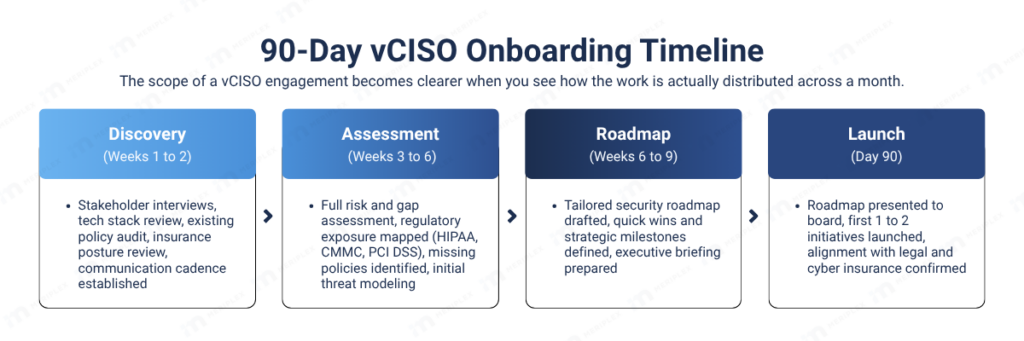
Ask every candidate to walk you through their first 90 days. The structure below reflects what a well-scoped engagement actually looks like. Use it as a benchmark when comparing onboarding plans.
Before your first candidate conversation, work through the vCISO hiring checklist to confirm your internal requirements and evaluation criteria. It covers the scope, deliverables, and governance questions your organization needs to answer before engaging a provider.