
Cybersecurity board reporting is the structured process of translating an organization’s security risk posture, program performance, and financial exposure into information a board of directors can use to exercise governance oversight. An effective cybersecurity board report focuses on risk in business terms rather than technical controls, covers the top threats, their potential cost, and program trends, and closes with a specific decision or resource request.
Your board walked out of last quarter’s security briefing knowing your patch rate was 94% and nothing else that mattered.
That is not a reporting problem. It is a translation problem.
Boards do not need to know what your security team did. They need to know what the organization is exposed to, what it would cost if something went wrong, and whether the program is moving in the right direction. For most organizations, especially those without a dedicated GRC function, nobody has built a clean process for making that translation. The CISO presents data. The board nods. Everyone moves on without the conversation that actually needed to happen.
This guide is for the CISOs, vCISOs, risk leaders, and CFOs who own that translation. It covers what belongs in a board-ready cybersecurity report, which metrics resonate with which executives and why, what a one-page board cybersecurity dashboard looks like in practice, and how to run the board session itself, including the three questions that come up every time.
Why Most Cybersecurity Board Reports Lose the Room
Three mistakes account for most failed board reporting, and they tend to compound each other.
When Meriplex engages with a new client on security governance, the first thing we typically find is a board deck full of operational metrics copied directly from the security team’s internal tracking tools. Patch rates, open ticket counts, firewall events: the kind of data a SOC manager reviews every morning. Nobody made a deliberate decision to put it in front of the board. It migrated there because there was no framework for deciding what belonged instead.
The first mistake is reporting on controls instead of risk. A list of patch completion rates, vulnerability counts, and firewall rule changes is a security operations summary. It tells the board what the team did. It does not tell them what the organization is exposed to, what a bad quarter would cost, or whether the program is improving.
The second is skipping the “so what.” A board member sees that mean time to detect is 4.2 hours. Is that good? Is it below industry median, or is it twice what it should be? Without context, a number is just a number. It communicates nothing the board can act on.
The third is the most damaging: treating the board report as a status update rather than a risk conversation. Boards are not there to approve patch schedules. They are there to ask whether the enterprise is managing cyber risk in a way that protects its strategic objectives. A report that does not invite that question wastes the meeting and, eventually, the board’s trust.
The most common failure in cybersecurity board reporting is presenting controls as if they were risk. A patch rate tells the board what happened. It does not tell them what it would cost if the wrong patch was missed.
What Should Be in a Cybersecurity Board Report?
A cybersecurity board report should contain three layers: the organization’s current risk posture expressed in financial terms, a summary of what changed since the last report including incidents and program improvements, and a specific request for the board’s decision or approval. Technical operational data belongs in a separate management report, not in front of the board.
A board-ready cybersecurity report has three layers: where you stand, what changed, and what you need. Everything else belongs in a management report or an appendix.
Layer 1: Current Risk Posture
Open with a directional read on the organization’s top three to five risks. Not a heat map with forty entries, but a clear statement of the risks that matter most, expressed in business terms.
Each risk should answer three questions: What is the scenario? What would it cost if it materialized? Is it trending better, stable, or worse than last quarter?
The financial exposure estimate is where most organizations stop short, because it requires coordinating across security, finance, and legal. Do it anyway. A range such as “a ransomware event targeting our ERP environment could cost $2M to $6M in downtime, recovery, and regulatory exposure” gives the board something to weigh. (Note: illustrative figures. Your actual exposure range should come from a formal cyber risk quantification, or CRQ, exercise using a methodology such as FAIR, Factor Analysis of Information Risk, tied to your specific environment and industry.) A maturity score gives them nothing to weigh it against.
Layer 2: What Changed This Quarter
Boards track programs, not snapshots. This section covers incidents and near-misses, including what happened, how the team responded, and what changed as a result, meaningful improvements in the security program, and anything in the external environment such as new regulatory requirements or a major breach at a peer company that shifts the risk picture.
Keep it factual and tight. The board does not need a full account of the quarter. They need to know whether the trend line is moving in the right direction and whether anything requires their direct attention.
Layer 3: What You Need
Every board report should close with a specific ask: budget approval, a policy decision, endorsement of a third-party audit, or a change to the reporting structure. “We need $180K to implement privileged access management, or PAM, across our critical systems, which reduces our top-ranked ransomware risk by an estimated 40%” is a request a board can evaluate and approve. (Illustrative. Your numbers should come from a formal risk assessment tied to your control gaps.) “We need more resources” is a conversation that goes nowhere.
Get a Board Report Structure That Fits Your Program
What Should Be in a Cybersecurity Board Report?
The cybersecurity metrics that belong in a board report depend on the audience. The full board needs financial exposure by risk scenario, a compliance status summary, and a risk trend indicator. The audit or risk committee needs program metrics such as mean time to detect, critical vulnerability age, and third-party risk coverage. The CFO needs security spend benchmarks and return on control investment.
Every guide on cybersecurity executive reporting hands you a table of metrics and moves on. The table is necessary but not sufficient. What determines whether a metric lands is whether the person receiving it understands what it means for them, and that varies by audience.
For the Full Board: Business-Oriented Metrics
Financial exposure by top risk scenario. Expressed in dollars, tied to a specific scenario such as ransomware, data breach, or business email compromise, and shown as a range rather than a single number. This is the metric that connects security to how the CFO thinks about the balance sheet. According to IBM’s 2024 Cost of a Data Breach Report, the global average cost of a data breach reached $4.88 million, a figure that tends to focus board attention when it appears alongside your own modeled exposure.
Risk trend, quarter over quarter. A simple three-arrow indicator: improving, stable, or worsening, with one sentence of explanation. Boards track trends. A metric moving in the right direction tells a story. One moving in the wrong direction tells a more important one.
Compliance status summary. One line per applicable framework: NIST CSF 2.0, SOC 2 Type II, HIPAA, PCI-DSS v4.0, and SEC Rule 13a-15 / Regulation S-K Item 106 disclosure requirements. Red, yellow, or green. No explanation needed unless something is amber or red.
Cyber insurance alignment. Does the current coverage match the modeled exposure? Most boards do not know whether their cyber insurance policy actually covers their top risk scenarios, specifically whether it covers business interruption from ransomware, regulatory fines, and third-party liability. Raising it, or flagging a gap, is a material governance conversation that belongs in the room.
For the Audit or Risk Committee: Program Metrics
These audiences typically have more technical context and more time. They can absorb more operational detail, but still want it expressed in terms of program health, not point-in-time activity.
Mean time to detect (MTTD) and mean time to respond (MTTR). How fast does the organization identify an incident, and how fast does it contain one? Attackers who dwell inside an environment for weeks cause exponentially more damage than those caught quickly. According to Mandiant’s M-Trends 2024 Report, the global median attacker dwell time dropped to 10 days, down from 16 days the prior year, reflecting the impact of mature detection capabilities. If your MTTD beats 10 days, say so explicitly. If it does not, that is the conversation.
Critical vulnerability age. What percentage of critical vulnerabilities with a CVSS score of 9.0 or above are more than 30 days unpatched? The NACD’s 2026 Director’s Handbook on Cyber-Risk Oversight targets under 5%. If you are running above that threshold, explain why and when it resolves, not in the report, but in the room.
Third-party risk coverage. What percentage of your Tier 1 and Tier 2 vendors, those with access to sensitive data or critical systems, have current security assessments on file? What percentage have enforceable cybersecurity SLAs in their contracts? According to Verizon’s 2024 Data Breach Investigations Report, third-party involvement was a factor in 15% of all breaches analyzed, more than doubling from the prior year. A board that cannot answer this question is carrying risk it has not measured.
Phishing simulation click rate. Target: under 2%, measured against a rolling 90-day average using a security awareness training platform such as KnowBe4 or Proofpoint Security Awareness Training. If you run simulated phishing campaigns at least quarterly, include the trend line. CIS Controls v8 Control 14, Security Awareness and Skills Training, provides the governance basis for this metric.
For the CFO: Investment-Oriented Metrics
Security spend as a percentage of IT spend. According to the 2024 Security Budget Benchmark Report by IANS Research and Artico Search — a survey of 750+ CISOs — security spending has grown from 8.6% to 13.2% of total IT budgets between 2020 and 2024. The number itself matters less than the trend and the peer comparison.
Cost of incidents this quarter. Direct costs: internal staff hours, external incident response retainer drawdown, any regulatory fine or breach notification expense. This number compounds over time into a compelling argument for prevention investment.
Return on control investment. Connect the control cost to the risk scenario it addresses, show the before-and-after exposure range from your cyber risk quantification model, and let the math make the argument. Most security leaders do not compute this. Most CFOs find it the most persuasive line in the report.
The CFO does not need a security briefing. They need one number: how much risk the organization is carrying, and how much it would cost to reduce it. Return on control investment makes that calculation possible.
What Does a Board Cybersecurity Dashboard Actually Look Like?
A board cybersecurity dashboard is a one-page summary with five elements: an overall risk posture indicator, the top three risks with financial exposure ranges, a compliance snapshot by framework, four to six program health metrics each with a target and trend indicator, and one clearly stated ask for the board’s decision or approval. It is designed to be read in 60 seconds and to start a conversation, not replace one.
The goal of a board cybersecurity dashboard is not to display everything the security team tracks. It is to give the board, in 60 seconds of reading, a clear sense of where the organization stands and whether they need to ask harder questions.
A functional one-page dashboard has five elements:
- Overall risk posture indicator: a single directional signal, improving, stable, or elevated, with one line of explanation.
- Top three risks with financial exposure: risk name, brief scenario description, estimated financial impact range from your risk quantification model, and a trend indicator.
- Compliance snapshot: framework name, current status, and next milestone. Five rows maximum.
- Program health metrics: four to six numbers from the list above, each with a defined target and a trend indicator. MTTD, critical vulnerability age, phishing click rate, and third-party risk coverage are the standard four.
- The ask: one clearly stated decision or resource request for this session, tracked across reports so the board can see their approvals in action.
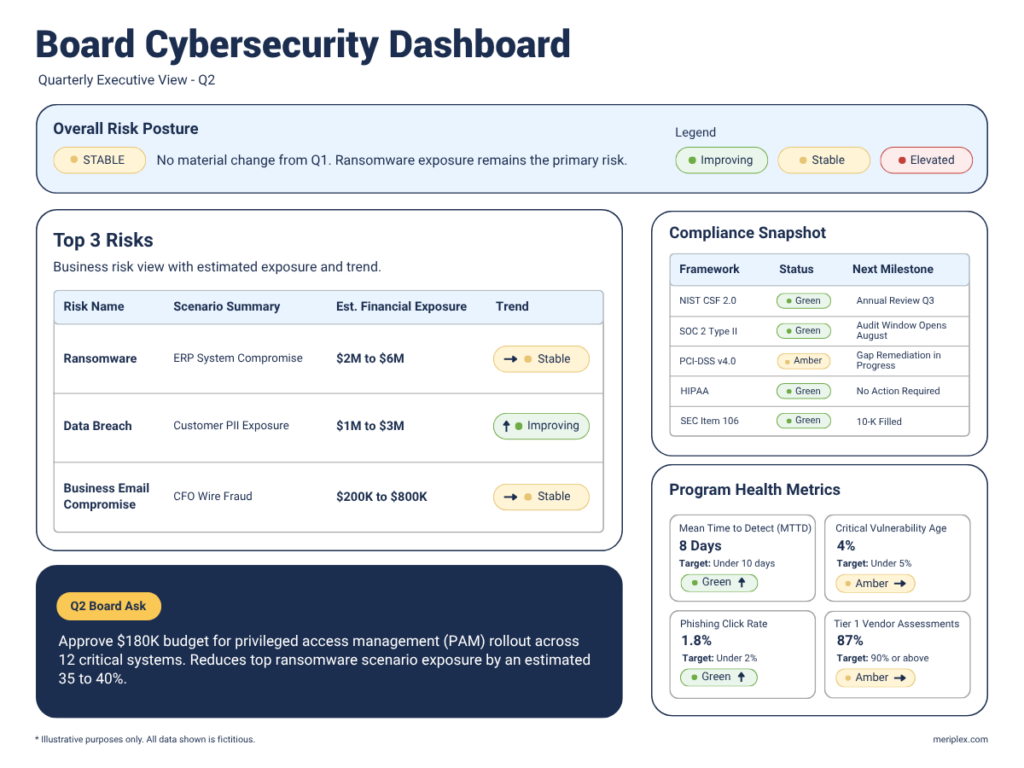
What this dashboard is not: a collection of every output your security tools generate, a sixteen-slide deck of operational detail, or a substitute for the conversation. The dashboard starts the conversation. The board meeting is where it happens.
See What Your Dashboard Should Look Like
When Your Security Program Runs Through a Managed Provider
Almost every guide on cybersecurity board reporting assumes your security program runs entirely in-house. For most mid-market organizations, that assumption is wrong.
If a significant portion of your security operations runs through a managed security services provider (MSSP), your board reporting challenge differs from an organization managing everything internally. You need to report on what your MSSP delivers, not just what your internal team does, and most boards cannot interpret that relationship without help.
Three things belong in your board report if you work with an MSSP:
The shared responsibility model. A clear mapping of who owns which security functions, including detection and response, vulnerability management, endpoint protection, and log management, and where the handoffs are. This matters for incident response accountability, for SOC 2 Type II and ISO 27001:2022 audits, and for the board’s question about whether security gaps are being actively managed or sitting in a gap between provider and client.
MSSP performance metrics. Your provider should supply monthly or quarterly SLA performance data covering alert triage time, mean time to escalate, detection coverage across your monitored assets, and false positive rate. That data belongs in your board reporting cadence. If your managed security service provider does not give you board-reportable metrics, that is the first conversation you need to have with them.
How the managed program maps to your risk posture. The board does not need to know how your SIEM is configured or which correlation rules your provider runs. They need to know your managed detection and response capability covers your highest-risk systems, that it gets tested through tabletop exercises or red team engagements at least annually, and that response times satisfy your cyber insurance policy’s incident notification requirements.
If you are evaluating whether your current managed security provider gives you what you need for governance and reporting, treat that as a distinct question from whether they give you good operational coverage. Both matter. They are not the same question
How to Run the Board Session Without Losing the Room
A well-built report does most of the work before anyone walks in. But the session still has to land.
Budget 15 to 20 minutes for the security segment of a standard board meeting. Open with the overall posture read: two minutes, directional, no detail. Spend the next five minutes on the top risks and any material changes since last quarter. Use the remaining time for the ask and for questions. If you built the report correctly, the questions will be about business decisions, not security operations.
Three questions come up in nearly every board session. Prepare for them specifically:
“How do we compare to others in our industry?” Have a benchmark ready before you walk in. Mandiant M-Trends, Verizon DBIR, and your cyber insurance underwriter all publish sector-specific data on incident frequency, dwell time, and control maturity. If you do not have a current benchmark, “I will bring sector-specific data to the next session” is more credible than an estimate.
“Could that [news breach] happen to us?” This question appears every time a major incident makes headlines. Prepare a two-sentence answer: what the attack vector was, whether it was a phishing credential compromise, an unpatched CVE, a misconfigured cloud storage bucket, or a third-party access abuse, and whether your current controls address it. Boards read the news. They want to know someone in the room is tracking it.
“Are we spending enough?” The CFO asks this, or implies it. Answer by connecting your current spend to your modeled exposure and your Gartner or industry benchmark. Not a yes or no: “here is how our spend compares to the risk we are carrying, and here is what closing the gap would cost and what it would reduce.”
If you have completed a formal security risk assessment, that report is your best source material for all three questions. Boards weight third-party validation heavily. An independent assessment that confirms your risk posture, or surfaces gaps you are actively working through, carries more authority than internal reporting alone.
Aligning Your Report to NIST CSF 2.0 and Other Governance Frameworks
Boards ask, with increasing frequency, whether the organization’s cybersecurity program aligns with a recognized framework. The SEC’s cybersecurity disclosure rules, adopted July 2023 and effective for most registrants in December 2023, require public companies to describe in their annual Form 10-K the processes they use to assess, identify, and manage material cybersecurity risks. Auditors are asking equivalent questions of private companies under state privacy laws and sector-specific regulations. Additionally, under CIRCIA (the Cyber Incident Reporting for Critical Infrastructure Act), organizations in covered sectors face new incident reporting timelines that boards need to understand before an incident occurs.
NIST CSF 2.0, released by NIST in February 2024, is the most widely adopted cybersecurity framework in the US. Reporting against it at the board level does not mean presenting a maturity score for each of the six core functions: Govern, Identify, Protect, Detect, Respond, and Recover. The Govern function, added in version 2.0, is specifically designed to support board-level oversight, covering organizational context, risk management strategy, and supply chain risk. That is the function to lead with when the board asks about framework alignment.
ISO 27001:2022 serves organizations with international operations or those seeking third-party certification of their information security management system. SOC 2 Type II reports, produced against the AICPA Trust Services Criteria and covering a defined audit period of at least six months, are the standard third-party validation mechanism for technology and services companies. CIS Controls v8 provides a practical implementation roadmap that maps directly to NIST CSF and gives boards a controls-level view that auditors can verify.
Regardless of which framework applies, the board-level version of alignment is three things: what the framework requires, how the program measures against it today, and the remediation timeline for anything below target. That fits on half a page. It answers the governance question before it becomes a compliance finding.
For organizations working with a managed security partner, framework alignment is a shared responsibility. Your provider should give you evidence of their own framework compliance, whether that is their SOC 2 Type II report, their ISO 27001:2022 certificate, or their NIST CSF 2.0 self-assessment, and explain clearly how their controls map to yours. If they cannot do that, you have a governance gap, not just an operational one.
NIST CSF 2.0's Govern function was built for the boardroom. It covers organizational context, risk strategy, and supply chain risk: exactly the three areas boards are now required to oversee under SEC disclosure rules.
Related Concepts: A Quick Reference for Board Discussions
When a board member asks a question and the CISO reaches for a term the room does not share, the conversation stops. These are the entities that come up most often in board-level cybersecurity discussions, and what each one means in plain language.
Cyber Risk Quantification (CRQ)
CRQ is the practice of expressing cybersecurity risk in financial terms, typically using a methodology such as FAIR (Factor Analysis of Information Risk). It produces a range of potential loss values for specific scenarios, such as ransomware or data breach, that boards can compare against insurance coverage, risk appetite, and investment decisions. CRQ is what turns a maturity score into a dollar figure.
NIST CSF 2.0 vs. CIS Controls v8
NIST CSF 2.0 is a governance and risk management framework. CIS Controls v8 is an implementation guide with 18 prioritized control groups. Organizations typically use NIST CSF 2.0 to structure their board-level reporting and CIS Controls v8 to define the technical work the security team performs. Your MSSP’s controls should map to one or both.
SEC Cybersecurity Disclosure Rules
Under SEC Rule 13a-15 and Regulation S-K Item 106, effective December 2023 for large accelerated filers, public companies must disclose material cybersecurity incidents on Form 8-K within four business days of determining materiality, and describe their cybersecurity risk management processes annually in their Form 10-K. Boards need a documented process for determining materiality before an incident occurs, not after.
CIRCIA
The Cyber Incident Reporting for Critical Infrastructure Act requires covered entities in 16 critical infrastructure sectors to report significant cyber incidents to CISA within 72 hours and ransomware payments within 24 hours. Organizations in covered sectors should ensure their incident response plan and board notification procedures account for these timelines.
vCISO
A virtual CISO (vCISO) is a fractional security leadership role, typically provided by a managed security services partner, that gives organizations access to CISO-level governance, reporting, and risk management expertise without a full-time hire. For mid-market organizations building a board reporting program for the first time, a vCISO is often the most efficient path to a defensible governance structure.
The Short Version
Boards do not need the full picture of your security program. They need the right picture: the risks that could materially affect the business, expressed in financial terms, with a trend line and a clear ask.
Build the report around risk, not controls. Explain each metric rather than just listing it. Use a one-page dashboard that makes the headline obvious before anyone asks a question. Close every session with a specific decision request. And if your program runs through a managed provider, make that relationship visible and reportable, not invisible.
The boards that get this right do not just satisfy a governance requirement. They become better partners to the security team because they understand what they are actually being asked to oversee.