
In 2025, cyber threats have escalated from an IT headache to a core business risk. Regulators are raising the stakes—the U.S. SEC now requires public companies to disclose their cybersecurity incidents and how the board oversees cyber risks. This pressure is trickling down to private firms as well, as investors and partners expect similar transparency. Boards of directors face greater accountability for cyber oversight; in fact, regulators have signaled that ultimate responsibility for cyber risk rests with the board, even implying board members could be personally liable for major lapses. No wonder modern boards are demanding better cybersecurity reporting that treats cyber like the enterprise risk it truly is, rather than a technical silo.
Beyond compliance, the business consequences of breaches are skyrocketing. The average cost of a U.S. data breach hit an all-time high of $10.2 million in 2025 (global average $4.4M). Add in reputational damage and even potential director liability, and it’s clear why boards are on alert. They now insist on seeing a quantified security posture—hard numbers on risk exposure and mitigation—instead of vague assurances. In short, cybersecurity has shifted from an “IT issue” to a critical enterprise risk. As one industry CEO put it, “Cybersecurity is no longer just a technical problem… it directly impacts revenue growth, customer trust, and even executive job security”. Effective board reporting is how CISOs reassure boards that these risks are understood and under control.
Finally, heightened board interest is about prevention. Directors have seen peers ousted after high-profile breaches, and they’ve read the headlines. They know strong oversight can reduce breach odds and impact. By 2026, enlightened boards view cybersecurity as integral to business continuity and organizational resilience, not a check-the-box exercise. In summary, board reporting on cyber matters more than ever because regulators, investors, and the threats themselves have raised the bar. It’s up to security leaders to meet boards at this new level of scrutiny—and speak in the language of business risk.
What Boards Actually Care About (Not What IT Teams Usually Present)
Boards of directors don’t care how many malware infections you cleaned or how many servers you patched last month—at least not in isolation. What boards want is insider-level clarity on how cybersecurity is reducing business risk. They focus on outcomes like operational risk reduction, business continuity and revenue protection, and clear insight into likelihood vs. impact of top risks. In other words, they care about risk and resilience, not raw technical activity. As a CISO, you might be proud of patching 398 endpoints, but a board member would rather hear that you reduced the likelihood of a major outage by 30%. They expect to see the organization’s top risks with dollarized exposure (“a ransomware attack could cost us $5M in downtime”) and a decisive plan: “Here’s what we need from you (the board) to mitigate these risks.” They also want to understand any regulatory exposures—for instance, are we in compliance with HIPAA, SEC cyber rules, FTC Safeguards, SOX, etc., and what’s being done about gaps?
By contrast, many IT teams mistakenly flood boards with activity reporting instead of risk reporting. Lengthy technical presentations about firewalls, threat feeds, or patch counts will fall flat. One security CEO observed that CISOs often “speak Greek when the rest of the board speaks in dollars and common sense”. Boards don’t want a download of jargon; they want the business meaning. If a presentation dives into detailed vulnerability scan results or configuration tweaks, directors’ eyes glaze over. In fact, overly technical language is counterproductive—board members “don’t like things they don’t understand” and have limited attention spans for security minutiae. The key contrast: IT reports on security activities (e.g.“we deployed a new EDR tool”), whereas boards expect reports on risk and business impact (e.g. “our cyber risk in financial terms has dropped 15% this quarter”).
Insider tip: Always frame your updates around how security initiatives enable the business or protect critical assets. For example, instead of explaining a software vulnerability in tech terms, explain that it posed a supply chain risk that could disrupt customer orders—and that you mitigated it to preserve revenue. Highlight how security efforts support uptime, safeguard customer data, and prevent financial losses. Emphasize likelihood vs. impact in plain language: e.g. “This quarter, the likelihood of a phishing-based breach is down, and even if one occurred, our new backup system limits impact to <24 hours of downtime.” By translating technical metrics into business risk terms, you fulfill the board’s real concern: understanding where the organization stands and what decisions or investments are needed from them to manage cyber risk. In short, boards care about risk reduction, resilience, and clear decision paths—so give them that, not the raw IT drill-down. (It’s telling that in a recent survey, 47% of corporate directors said improving the quality of cybersecurity reporting and metrics is extremely important. They’re practically begging for more risk insight, not more technical data.)
The 7 Metrics Every Board Should See Quarterly
To meet board expectations, organizations should establish a consistent set of cybersecurity metrics reported every quarter. Boards value seeing the same categories each time—it shows trends and progress. Below are seven essential metrics that speak to executive concerns and can serve as a framework for your board reporting. Each metric is tied to business outcomes, not just IT operations:
- Current Threat Landscape Summary: A brief on emerging threats relevant to your industry and business. For example, summarize new ransomware tactics targeting your sector or spikes in attacks observed on peers. This gives context: it answers “What’s out there right now that could hurt us?” By highlighting relevant threat intelligence (e.g. “financial firms are seeing a 30% rise in supply-chain attacks this quarter”), you educate the board on why security efforts this period focused where they did. Keep it high-level and focused on trends, not raw intel feeds.
- Risk Heat Map—Top 5 Enterprise Risks: A heat map or ranked list of the five most critical cyber risks to the enterprise, plotted by likelihood vs. impact. Crucially, quantify these risks in business terms. Instead of saying “legacy system vulnerability,” say “Outage of XYZ system—likely once in 5 years, potential impact $2M in lost sales and recovery costs.” Boards need to grasp both the probability and financial/business impact of each top risk. Visualizing this as a colored heat map (e.g. red = high risk) helps them instantly see where attention is needed. Quantification here is key use estimates of lost revenue, downtime cost, or regulatory fines to make it concrete. (Boards appreciate that you’re speaking their language of enterprise risk.)
- Security Posture Score (with Year-over-Year Progress): Provide a single score or rating that reflects your overall security posture or maturity—for instance, your NIST Cybersecurity Framework (CSF) 2.0 maturity level. Many organizations boil this down to a numeric or letter score (e.g. “3.8 out of 5”, or “Maturity Level: Improving from ‘Defined’ to ‘Managed’”). The exact scoring model can be based on a framework assessment or an external rating. The point is to give the board a simple barometer of “How secure are we?” and show progression over time. For example: “Our security maturity is at 68% of target (up from 55% last year). We moved from a Tier 2 to Tier 3 on NIST CSF, thanks to improvements in incident response.” Boards love to see this improvement and benchmarking. (In fact, nearly 73% of companies now disclose alignment to an external framework like NIST CSF or ISO 27001 in their governance reports—a huge increase from just a few years ago, because it gives boards and stakeholders confidence that a structured approach is in place.)
- Incident Overview—Last 90 Days: A summary of cyber incidents or major attempts in the past quarter. This should cover: how many significant attack attempts were detected and blocked, any incidents that occurred (with brief business impact description), and key lessons learned or improvements made as a result. For example: “We blocked 3 million port scans and thwarted 2 targeted phishing attempts on executives. We had one minor incident – a malware infection contained with no data loss—which taught us to enhance MFA on a certain system.” This metric assures the board that threats are being actively managed and that the organization is learning continuously. Be sure to emphasize if no successful breaches occurred, and if one did, what corrective action was taken.
- Compliance & Regulatory Status: Update on the state of compliance with key regulations (HIPAA, PCI DSS, GDPR, FTC Safeguards, SOC 2, etc.) or industry cybersecurity requirements. Include any upcoming audits or assessments (e.g. “HIPAA audit in Q3” or “SOC 2 Type II renewal next month”) and the status of preparations. Highlight any gaps identified and remediation timelines: for instance, “We are 90% through closing gaps from last year’s audit, remaining issues (like log retention policy) will be resolved by year-end.” Boards take regulatory compliance seriously – they need assurance that there are no looming compliance violations or surprises. This section also ties into overall risk: non-compliance can mean fines or legal penalties, so it’s part of the enterprise risk picture.
- Investment vs. Exposure: This is essentially a business alignment metric – it shows the security budget and resources versus the financial risk exposure. One way to present this is a chart comparing “Cyber Risk Exposure ($) vs. Security Investment ($)” for the organization. For example, “Our estimated annual cyber risk (expected loss) is $X million, and we are investing $Y million in security, compared to industry peers who invest ~$Z million”. This helps boards evaluate if spending is commensurate with risk. It can also show ROI: e.g., “Last quarter we spent $250K on new email filters which reduced expected phishing loss by $1M – a 4x return in risk reduction.” Boards appreciate seeing how security spend is reducing the company’s exposure in financial terms. You can even include peer benchmarking (if available) to show how your security program stacks up in investment and effectiveness. (Boards love to know, “Are we above or below average in our industry on security?”)
- Roadmap & Required Decisions: A forward-looking metric set that outlines the cybersecurity project roadmap and explicitly calls out any items that need board approval or input. Break it down into: “Initiatives in progress (already funded)” versus “Proposed initiatives (requiring board funding/approval)”. For each major item, give a brief status or ROI expectation. For example: “Multi-Factor Authentication (MFA) rollout – 80% complete, will cover all users by next quarter” and “Proposed network segmentation project – requires $500K investment, expected to cut potential breach blast radius by 50%, ROI in 2 years.” This part of the dashboard ensures the board is aware of what’s coming and what decisions or support you need from them. It essentially provides a clear decision path: where you need approval, where you need their championing, and what the expected benefit is. Boards don’t like guesswork – they want to know how they can help. By laying out a quarterly cybersecurity roadmap with milestones and required actions, you invite the board to participate in risk mitigation actively.
By covering these seven areas consistently every quarter, you address what boards actually care about: the external threat context, the organization’s top risks and risk trend, current security performance/maturity, incident track record, compliance health, alignment of costs to risk, and future plans with business rationale. This comprehensive yet business-focused dashboard becomes a powerful tool. In fact, many top CISOs organize their board reports in just this way, because it provides a narrative that is easy to follow and hits all the major points an executive team or board needs to govern cybersecurity.
Tip: Keep these metrics straightforward and not overly technical. Use visuals (charts, heat maps) where possible. As one guide on board reporting notes, the right high-level KPIs help executives clearly understand cyber risk and support security investments, whereas overly technical metrics can confuse and derail discussions . Aim for metrics that are accurate, trend-able, and easily explained to non-tech leaders . The result will be a dashboard the board looks forward to reviewing each quarter – a far cry from the dense, IT-centric reports of the past.
Strengthen Your Cyber Resilience
The Reporting Frameworks That Signal Maturity (and Impress Boards)
One way to instantly boost board confidence in your cybersecurity program is to map your reporting to well-known frameworks. Seasoned board members recognize names like NIST, ISO, and COBIT – aligning to these shows that your security program follows established best practices (not ad hoc whims). In 2026, using frameworks is seen as a hallmark of a mature, well-governed security program. In fact, nearly 3 out of 4 companies now align their cybersecurity reporting to an external framework such as NIST CSF 2.0, ISO 27001, or similar, up from just 4% in 2019. This huge shift is because mapping cybersecurity into these frameworks gives boards confidence: it demonstrates a structured approach and makes it easier for them to understand where you stand.
Here are a few frameworks that, when referenced in board reports, tend to impress boards and signal program maturity:
- NIST Cybersecurity Framework (CSF) 2.0: NIST CSF is now considered a foundational framework for cybersecurity. It breaks security into core functions (Identify, Protect, Detect, Respond, Recover—with a new “Govern” function added in CSF 2.0) and provides a common language to describe your security maturity. Mapping your activities and metrics to NIST CSF shows the board how each area of cybersecurity is being managed. More importantly, using NIST lets you measure and report your cybersecurity posture effectively. For example, you might report, “Overall, we’re at 70% implementation of NIST CSF outcomes, with Identify and Protect stronger, and Detect/Respond needing improvement.” Boards like this because NIST CSF is widely respected and non-technical – it’s practically designed to translate tech details into business outcomes. If your organization isn’t already leveraging NIST CSF 2.0, consider adopting it as the backbone of your board reporting.
- HITRUST CSF (for Healthcare): In healthcare and other regulated industries, HITRUST is a common framework that blends numerous regulations and standards (HIPAA, NIST, ISO 27001, PCI, etc.) into one comprehensive model. Achieving HITRUST certification or even aligning with it signals a high level of rigor. For boards of healthcare companies, hearing that your security program maps to HITRUST means you’re covering all bases from privacy to security controls. It basically says, “We take compliance and security seriously enough to follow an industry gold standard.” If your board is concerned about HIPAA or patient data security, referencing HITRUST framework maturity can be very reassuring.
- COBIT (Control Objectives for Information and Related Technologies): COBIT is an IT governance framework from ISACA that focuses on aligning IT and security with business goals and managing risk. It’s not purely a cybersecurity framework; it’s broader, emphasizing governance, process, and control objectives. Including COBIT principles in your reporting (like showing how cyber risk management is integrated into enterprise governance) can impress board members who are familiar with it. COBIT basically ensures that you have the right governance structure – roles, policies, and processes – around IT and security. Mentioning COBIT can signal that your approach to cyber risk is holistic and tied into overall corporate governance and compliance. It answers the board’s question: “Do we have the governance part of cybersecurity handled?” (COBIT’s emphasis on meeting stakeholder needs and covering the enterprise end-to-end aligns well with board oversight priorities.)
- CIS Controls: The CIS Critical Security Controls (formerly known as SANS Top 20, now 18 controls) are a practical, technical framework of top cybersecurity practices. While the board won’t care about the nitty-gritty of each control, showing that your program adheres to CIS Controls demonstrates you are following industry-recognized best practices to secure the environment (like having inventory of devices, continuous vulnerability management, access control, etc.). You might report something like, “We have implemented 16 of the 18 CIS Critical Controls to at least an 80% level – up from 14 last year – improving our baseline security hygiene.” Boards appreciate this because CIS Controls are often mapped to reduced incident rates; it’s concrete evidence you’re doing the things that matter. If your board is not very technical, you can describe CIS Controls as “a checklist of the top things all companies should do for cybersecurity—and we’re nearly complete.”
- ISO/IEC 27001 (and 27701): ISO 27001 is the international standard for Information Security Management Systems (and 27701 for Privacy Information Management). Being ISO 27001 certified or aligned is a strong signal of a mature security program. Board members, especially those in global companies or outside the U.S., recognize ISO 27001 as a mark of quality. Including in your report that “We maintain ISO 27001 certification” or “Our security controls are annually audited against ISO 27001 standards” gives immediate credibility. It says an external auditor has verified your program meets a high bar. Even if not certified, you can use ISO 27001 as a reporting structure (it has 14 domains like Access Control, Incident Management, etc.). That way, a board sees that all key domains of security are covered in your program. ISO 27701, focusing on privacy, is increasingly relevant with data protection laws – so if privacy risk is a board concern, aligning with 27701 can be a bonus.
In summary, tying your cybersecurity metrics and initiatives to these frameworks signals to the board that your program is structured, benchmarked, and following best practices. It provides an external point of reference for your claims about security posture. For example, instead of just saying “we’re doing well in security,” you can say “we have achieved a Level 4 maturity in NIST CSF and are 90% compliant with CIS Controls.” This concreteness builds trust. It’s no coincidence that many boards now explicitly ask management which framework the company uses to measure cybersecurity – and as noted, 73% of companies disclose using one. It’s become a governance expectation.
One caution: Don’t overwhelm the board with alphabet soup. Pick one or two primary frameworks to report against (commonly NIST for overall program maturity, plus maybe a compliance-related one like ISO or HITRUST if relevant). The goal is to use frameworks as a communication tool. When you do, you’ll find board members nodding in approval, since you’re speaking the structured risk language they associate with mature programs. As AuditBoard’s CISO guide notes, NIST CSF in particular provides a common language for communicating cybersecurity to executives and boards. Leverage that common language to your advantage – it sets you apart as a strategic, business-aligned security leader.
How to Quantify Cyber Risk in a Way Boards Understand
One of the biggest shifts in board reporting is moving from subjective red/yellow/green gauges to hard numbers and dollar values. Boards don’t want to hear “We’re a yellow on cyber risk” without context – they want to know “How much could we lose in a worst-case breach, and what’s the probability?” In other words, translate cyber risk into the same financial terms used for other enterprise risks. By quantifying cyber risk, you essentially turn cybersecurity from a nebulous technical issue into a classic risk-reward business discussion.
Here are key ways to quantify cyber risk for the board:
- Loss Event Calculations: Present scenarios of potential cyber incidents and estimate their financial impact. For example, calculate the cost of a major data breach: consider forensic response costs, customer notification, legal fees, regulatory fines, downtime, lost business, etc. You might say, “A breach of our customer database (worst-case 1M records) would cost approximately $5.5M – including $3M in incident response and $2.5M in lost sales from reputational damage.” Breaking down the costs shows the board you’ve done due diligence to quantify impact. It’s much more powerful than simply saying “A breach would be bad.” Some organizations use established models like FAIR (Factor Analysis of Information Risk) for this, which quantifies risk as a function of loss event frequency and loss magnitude. The FAIR model specifically helps translate technical scenarios into dollar figures by running data through Monte Carlo simulations to get distributions of possible loss. The benefit? You can now discuss cyber risk in the Board’s language of dollars and cents, not just heat maps.
- Expected Annual Loss (EAL/ALE): Borrowing a concept from operational risk, calculate the “expected annual loss” from cyber incidents. This is essentially probability * times * impact summed across scenarios. For instance, if you estimate a 20% chance of a $5M ransomware incident in a year, that’s an expected loss of $1M per year from ransomware. Do this for major threat categories (data breach, ransomware outage, business email fraud, etc.) and you can tell the board, “Our analysis indicates an expected annual loss of ~$2.3M from cyber threats.” This number can be tracked over time (hopefully going down as controls improve). It can also be compared to investments: e.g. “We invest $1M/year in security which mitigates an estimated $3M/year in risk – a 3:1 benefit-cost ratio.” Boards love this kind of ROI-centric view. It frames cybersecurity as risk management with clear value, rather than a cost center. In fact, risk quantification methods are all about making such comparisons possible – one PwC report noted that quantifying cyber risks helps get more “bang for the buck” by directing resources to the greatest risks.
- Scenario Modeling (Ransomware, Downtime, Breach, etc.): Use a few credible what-if scenarios to illustrate potential losses and how controls reduce them. For example: Scenario 1: 2-day ransomware-caused production outage during peak season – impact $8M in lost revenue + recovery costs. Probability ~15% over 5 years. Then show what you’ve done to mitigate it: “Implementing offline backups and incident response plan reduces the expected impact by 60%.” Do the same for a data breach scenario, and maybe a third-party supplier hack scenario. By walking the board through these story-like models, you make the abstract threat real in business terms. Boards can then discuss whether the residual risk is acceptable or if more investment is warranted. This approach also helps answer the inevitable “How bad could it be?” question with concrete analysis instead of speculation.
- Cost-to-Mitigate vs. Cost-of-Incident: Whenever you’re proposing a security investment to the board, present the cost of control versus the risk reduction (or cost avoidance) it achieves. For instance, “Deploying an enhanced email filter will cost $200K, but is expected to prevent ~$1M per year in phishing-related losses.” Or “Not implementing this might lead to a $5M breach, whereas implementing costs $500K—effectively a 10:1 return.” This kind of calculation frames cybersecurity projects in familiar financial terms. It shifts the conversation to ROI, just like any other business project. Board members (especially CFOs on the board) will respond very well to this. It demonstrates that you’re prioritizing and spending wisely. It also pre-empts the question “Why do we need to spend this on security?” by answering it in dollars. Many organizations now use Cyber Risk Quantification (CRQ) tools to generate these analyses quickly. According to one study, the metrics most important for board reporting are exactly that: the likelihood of various cyber events coupled with their potential severities in financial terms. In other words, translate a technical risk into “X% chance of $Y impact” and then show how spending Z dollars will reduce Y or lower X.
- Productivity Impact & Downtime Calculations: Not all cyber impacts are direct costs; some are hits to productivity or uptime. Quantify those too. For example, you can estimate how much revenue per hour an outage of a certain system would cost, or how much employee productivity is lost per day if email is down (and thus how valuable it is to prevent that). If you rolled out a new security tool that sometimes blocks legitimate activity, quantify the productivity trade-off: “MFA causes a 30-second delay for 500 employees daily – that’s ~4 hours of productivity lost per week, but it prevents far larger losses from account breaches.” When boards see that you’ve balanced security and productivity in economic terms, it builds trust. It shows you’re managing cyber risk in a business-savvy way.
Overall, quantification shifts cybersecurity from a fuzzy technical discussion to a concrete risk management discussion. It helps the board see cybersecurity alongside other enterprise risks (market risk, credit risk, operational risk) on an apples-to-apples basis – often in annual loss expectancy dollars or similar metrics. This not only helps in getting buy-in for security initiatives, but it also changes the perception: security is no longer just a cost center, it’s a function that prevents measurable losses (thus preserving revenue and profit). As a bonus, speaking in numbers tends to boost a CISO’s credibility in the boardroom. Directors hear a lot of qualitative talk; when you bring real data and financial analysis, you stand out as a leader who’s on top of the business.
For example, practitioners of the FAIR model have noted that by quantifying risk in financial terms, they can “make the most effective use of their time in the boardroom” because they can challenge and defend decisions in dollar terms. The board can argue if assumptions are too high or low, but at least now you’re having the right conversation (about risk appetite and trade-offs) rather than talking past each other. Aim to provide the board with 1-2 key quantified risk metrics (like expected loss and worst-case loss scenarios) in your regular reports. Over time, you’ll find the board starts thinking about cybersecurity the same way they think about other business risks – and that is exactly where you want to be.
Get Executive-Level Cyber Leadership
The Biggest Mistakes Companies Make in Board Reporting
Even well-intentioned security leaders sometimes miss the mark when reporting to boards. Let’s cover some of the biggest mistakes (the “what not to do”) that can undermine your message. By avoiding these, you build trust and credibility with executives:
- Overloading with Technical Detail: Perhaps the number one mistake is drowning the board in jargon, acronyms, and low-level metrics. If your slides look like a Splunk dashboard or a network diagram, you’re doing it wrong. As one CISO put it, “If they are too technical, they will lose their audience”. Board members aren’t cybersecurity experts, nor should they have to be. They care about outcomes, not the nuts and bolts. Resist the urge to explain how your new AI-based firewall works; instead explain what risk it reduces. Using overly technical language not only confuses directors but can erode their confidence in you (if they can’t understand you, they might conclude you don’t understand the business). Translate everything to plain English and business impact. For example, rather than “SQL injection vulnerability on our web app,” say “a weakness in our website that could have exposed customer data, which we fixed to prevent potential fines.” Keep it succinct and visual when possible – a simple chart or analogy beats a text wall of tech-speak every time. Remember, board members “have short attention spans” for security talk, so make every word count.
- No Clear Ties to Business Risks: Another common pitfall is presenting security efforts in a vacuum, without linking them to what the business cares about. Boards don’t inherently care about patch management or IDS alerts – they care if those things mean the company could not ship product or could lose customer trust. If your report doesn’t explicitly connect a cyber issue to a business impact, that’s a miss. For instance, don’t just report “We had 3 critical vulnerabilities unpatched for over 30 days.” Add context: “Those vulnerabilities were on systems that handle billing; if exploited, they could have caused billing errors or data exposure.” Board members like context and relevance. One CISO advises that threat discussions should always tie back to business impact – focusing on how a threat could “hinder business growth or introduce unacceptable levels of operational risk”. In practice, this means frame your entire report around the company’s strategic objectives and key processes. If you mention a risk or an incident, add a clause about which business service or goal it affects. By doing so, you speak the board’s language of business risk. (It also shows you “get it” – you understand the company’s mission and how security supports it.)
- Focusing on Activity Instead of Risk (Tools Instead of Outcomes): Many security reports to boards read like a technical status update: “We deployed X tool, patched Y systems, blocked Z attacks.” That’s activity reporting. The mistake here is failing to elevate the conversation to risk and results. Boards assume you’re doing a lot of activity – they want to know if it’s the right activity and how it reduces risk. Don’t list the dozen tools you have and their configurations; instead report on how well the company is protected and where it’s exposed. For example, a poor metric: “Spam filter blocked 50,000 emails.” A better metric: “Our phishing click rate dropped from 8% to 2% after awareness training, reducing our social engineering risk significantly.” Avoid the trap of relying solely on raw operational metrics or vendor-provided “risk scores” without context. As one expert noted, out-of-the-box risk scores often “lack the nuance and context required to make them actionable”. They don’t distinguish what truly matters to your business. Tailor your reporting to your company’s crown jewels and critical processes. Discuss those risks and how you’re managing them. A telltale sign of this mistake is a security dashboard full of IT-centric KPIs (number of vulnerabilities, compliance checklist percentages) that doesn’t convey what business risk is actually high or low. Always ask: would a non-IT person reading this know what to do or worry about? If not, refocus on the risk narrative.
- Using Fear Tactics or FUD: Painting a doom-and-gloom picture with scary statistics and hypothetical disasters can backfire. Yes, you need to inform the board of serious risks, but fear-based reporting (all “the sky is falling!” with no positive news or plan) will either overwhelm them or diminish your credibility. Boards don’t respond well to feeling strong-armed by fear. One seasoned advisor warns, “Don’t be the prophecy of doom, and be very careful when using fear, uncertainty, and doubt (FUD) as a weapon – it can come back to bite you.”. Instead, maintain a factual, calm tone. Present the risks, but also present your strategy to mitigate them. If you show them a nightmare scenario, pair it with what you’re doing to prevent or respond to it. The goal is to educate without panic. If something genuinely keeps you up at night, it’s fine to convey urgency – but do so professionally: “We are highly concerned about ransomware risk, which could halt operations for days; that’s why accelerating our backup system upgrade is critical this quarter.” That approach shares the concern but also the solution. Fear-based reporting with no solution can cause board members to lose confidence in the security team (“Are they just trying to scare us into giving budget? Do they even have a handle on this?”). So avoid melodrama; be candid but solution-oriented.
- Not Stating What You Need from the Board: Often, CISOs will brief the board on a problem but fail to explicitly ask for a decision or support. Remember, part of the board’s role is to help remove obstacles and allocate resources. If you don’t tell them what you need, that’s a missed opportunity (and frankly they might get frustrated if every report is just informational with no action for them). Make sure every board report has a “What we need from you” moment—even if it’s just concurrence on strategy. It could be, “We recommend increasing the cyber insurance coverage; we seek board concurrence on pursuing a higher policy limit.” Or “We need the board’s support to enforce new security training requirements for all employees, which may require a cultural push from the top.” If you present a challenge (say, talent shortage or a tricky legacy system risk), be ready with one or two asks the board can consider (“we may need additional budget next year to replace that legacy system—flagging now for your awareness”). Boards don’t like ambiguity on whether they should act. By clearly stating what decisions or support you need, you also demonstrate leadership – you’re not just reporting problems, you’re guiding them on solutions.
- Lack of ROI and Business Value Context: This is the flip side of fear-based reporting – only talking about cost and problems, and never about value and opportunity. Boards ultimately want to know the ROI of cybersecurity spend. If you never talk in those terms, you’re missing a chance to shape the narrative. Don’t just say “We need $1M for X” without also saying “This $1M investment will likely save us $3M in avoided losses and enable the business to pursue Y opportunity safely.” Translate security into business value whenever possible. For example, if security has enabled a new digital product to go live (because you built secure architecture), mention that. Or if your improvements in uptime or recovery could translate to better customer satisfaction or revenue protection, highlight it. One former CISO noted that security leaders can win board support by showing that security is “a revenue driver instead of a cost center”, e.g. how being secure sped up sales or passed customer security reviews, etc.. Even metrics like faster completion of customer security questionnaires or fewer delays in deal sign-offs due to security concerns can illustrate this point. The mistake is to talk about security only as insurance or defense, and not as something that also facilitates trust, brand protection, and even market advantage. Fix that by bringing at least one data point about how security investments are benefiting the company’s bottom line or competitive position.
- Death by Slides (Overwhelming Information): Finally, an oft-seen mistake is presenting a 50-slide deck crammed with text, or a dashboard with 100 metrics in microscopic font. Overwhelming the board with too much data is counterproductive. They will either tune out or cherry-pick something unimportant. Boards appreciate clarity and brevity. It’s far better to have a concise deck (say 10-15 slides, or whatever your board allocates time for) that tells a clear story, than to provide an encyclopedia. If you have backup data, put it in an appendix – available if they ask. Prioritize the key points in the main report. Also, use visuals wisely: a single well-designed chart or heat map can often convey what would take a page of text. The mistake is thinking “more = better” in an effort to be transparent. In reality, focus = better. Highlight what matters most. You might say, “In the interest of time, we’re focusing on the top 5 risks and key metrics; additional details are in the appendix or can be provided on request.” This shows respect for their time and an understanding of strategic focus. As one expert quipped, boards often have to review hundreds of pages of material across all topics – help them out by being succinct. They will thank you for it, and you’ll get your message across more effectively. An overwhelmed board is not an informed board.
Avoiding these mistakes will set you apart as a savvy communicator. Boards will come to see you as someone who “gets it” – who understands that it’s not about the technology per se, but about managing risk to the business. Over time, this builds trust: they’ll be more likely to support your initiatives, heed your advice, and even advocate for cybersecurity at the board level. In contrast, if a CISO consistently does the things above (too technical, no business link, no ask, fear-mongering, etc.), boards may start questioning if they have the right person for the job. Communication is as important as technical competence at that level. So take these lessons to heart – they can transform your board reporting from a stumbling block into a career-strengthening skill.
Talk to a Security Expert
Example of a Board-Level Cybersecurity Dashboard
Let’s paint a picture of what an ideal board-level cybersecurity dashboard looks like. Imagine a one-page or one-screen dashboard that a board member can glance at and grasp the company’s security posture and key issues within minutes. It’s high-level, focused, and visual – no tiny text or technical gibberish. Here are the typical elements such a dashboard would include, based on best practices and what boards have responded well to:
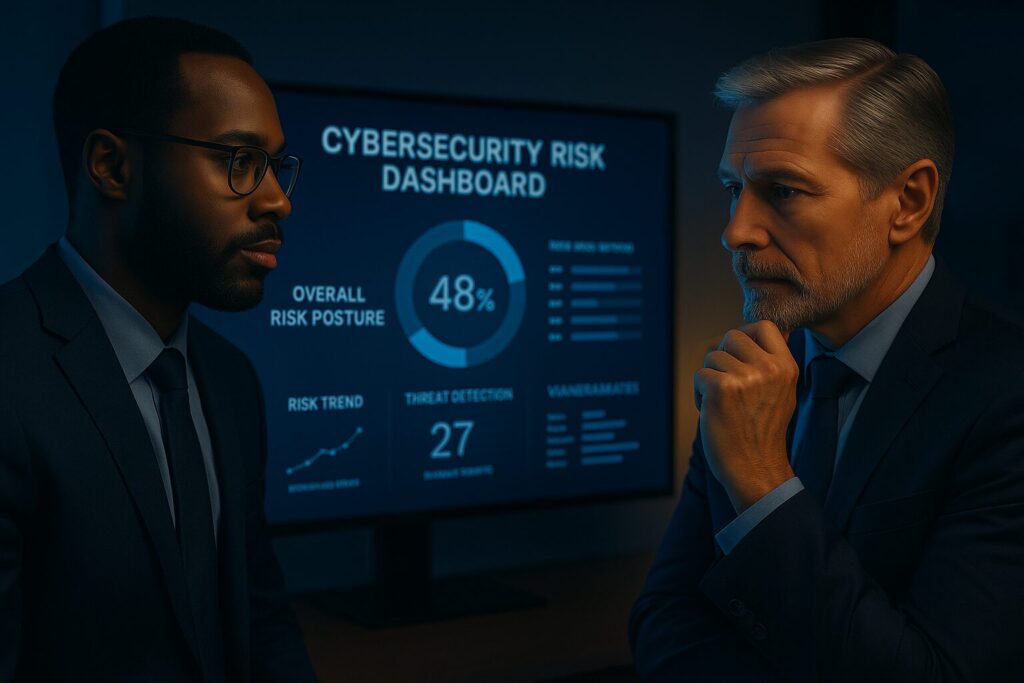
- Overall Security Posture Score: Front and center, have a gauge or score (as mentioned earlier, could be something like a percentage, letter grade, or numeric out of 100/1000) that summarizes the organization’s security health. This could be an internal composite score or an external rating (like a security rating from a service). For instance, “Security Posture: B+ (Good)”. Accompany it with a short trend indicator (“up from B last quarter”). This gives the board an immediate sense of “Are we in decent shape or not?” much like a credit score. Some dashboards use the Bitsight-style rating (250-900 scale)—e.g., score 750 with a green dial, indicating a low likelihood of breach (companies with higher ratings are far less likely to be breached). The key is one big indicator that integrates many factors into a simple grade.
- Maturity Level vs. Industry Benchmark: A visual (like a bar or spider chart) showing your security maturity or capabilities relative to industry peers or standards. For example, if you use NIST CSF, this might show your maturity in each function (Identify/Protect/Detect/Respond/Recover) versus the industry average. Or a bar showing “Our overall maturity: 3.5/5, Industry: 3.2/5” – so the board sees we’re slightly above average, or below if that’s the case. If you have data from surveys or third parties, include it: e.g., “Peer Benchmark: we spend 7% of IT budget on security vs. peer avg 5%, and our breach rate in last 3 years is lower than industry average.” Boards love benchmarks – it provides external validation. This section basically says “How do we stack up?” which is often a board question. If no benchmark is available, at least show year-over-year improvement as a form of benchmarking against ourselves.
- Top Vulnerabilities & Remediation Status: This could be a brief table or chart listing the top, say, 3-5 high-risk vulnerabilities or security gaps that the organization is currently addressing. For example: “Legacy ERP system – missing patches (80% remediated, will be 100% by Dec).” Or “Lack of MFA on VPN – project 60% done, completing next quarter.” Each should note the potential impact if not fixed (“legacy ERP could allow data breach”) to reinforce importance. The idea is to be transparent about the biggest known weaknesses and show progress on fixing them. Boards appreciate knowing where the holes are (they know no program is 100% perfect) and that there’s a plan. A simple red/yellow/green status on each issue can indicate if it’s on track. For instance, if something is behind schedule or newly discovered, flag it in red with a note (“New critical issue: zero-day vulnerability in core system, expedited patching by next week”). This part of the dashboard addresses, “What are our most serious technical risks and what’s being done?”
- Incidents Attempted vs. Blocked: Some visualization of the threat activity the company faces and how effective defenses were. This could be a bar chart: “In Q4, we saw 500,000 intrusion attempts; 499,990 were blocked by our controls, 10 got through leading to minor incidents.” Or a pie chart of “Incidents: 90% phishing attempts (all mitigated), 10% malware (1 device infected, remediated).” The point is to show volume of attacks vs. successful compromises. If you have metrics like Mean Time to Detect/Respond (MTTD/MTTR), you can include those as well, since they indicate efficiency of your security ops. For example: “Average detection time: 4 hours; containment time: 1 day; improving trend.” These metrics answer “Are our defenses holding up against the onslaught? And how quickly do we react?” If there were notable incidents, you might put a one-liner: “Notable incident: Ransomware attempt on May 5 – detected and blocked, no impact.” This reassures the board that threats are active but being handled. Over time, tracking attempted vs blocked helps show if things are getting quieter or more intense (e.g., a spike might prompt discussion, but you can also show it’s under control).
- Patch Compliance & MFA Adoption: Boards often ask about basic hygiene, because they hear in the news that breaches happen due to unpatched systems or weak authentication. A dashboard element might be a simple stat: “Critical systems patch compliance: 95% (target: 100% within 30 days of release) .” This tells them if you’re keeping up with patches. If that number is not 100%, you might color it yellow but note improvement. You could also show an average patching time/cadence grade if you have one, since research shows delays in patching correlate with higher breach risk . Likewise, MFA (Multi-Factor Authentication) coverage could be displayed: e.g., “MFA enabled on 88% of employee accounts (goal: 100% by Q4).” These are straightforward metrics that even non-tech board members understand: keeping systems updated and using strong authentication are widely known best practices. By including them, you proactively answer questions and demonstrate good cyber hygiene.
- Security Training & Human Risk: Perhaps a gauge or progress bar on the workforce’s security awareness. For example: “Security Awareness Training Completion: 98% this year” or “Phishing Simulation Click Rate: 2% (down from 5% last year)” . This shows the board how well the “human firewall” is performing. Many breaches trace back to human error, so boards are keen to know if employees are being trained. A compelling stat is to show improvement, like reduction in phishing susceptibility or number of people who fell for tests vs previous. If there are specific programs (like exec training, or new hire training within 1 week of start), you can note those highlights. It’s one more piece of the risk puzzle – technology alone isn’t enough, and this demonstrates you have the people side in hand as well.
- Third-Party Vendor Risk Overview: Often a dashboard will include something about key third-party risk, since boards know that partners and suppliers can be a source of breaches. You might list the number of critical vendors and their risk status (perhaps using something like average vendor security rating as Bitsight does ). For example: “Top 10 critical suppliers – 2 high risk, 7 medium, 1 low (high risks being worked with to improve by Q1).” If a particular vendor had an issue or assessment, mention it: “Conducted assessment of new cloud provider – findings addressed, now compliant with standards.” This portion answers the question, “Are we monitoring our ecosystem for weaknesses that could affect us?” and aligns with board concerns about supply chain attacks.
- Progress on Annual Roadmap: A small section or visual tracking where you are in executing the cybersecurity initiatives planned for the year (as approved by the board or budgeted). This ties back to the roadmap metric discussed earlier. Perhaps a timeline or checklist: “2026 Cyber Roadmap: Q1 goals (done), Q2 goals (in progress),…” with a highlight of any major deliverables. For example: “Security Operations Center build-out – completed; DR drill – completed; IAM project – 50% (delayed due to vendor issue, new target Q3).” This reminds the board of the strategic improvements underway and gives a sense of momentum. It closes the loop from when they approved the plan/funding to seeing the execution status. If something is at risk of delay or needing extra help, it will show up here and you can proactively explain it. Boards absolutely appreciate proactive updates on project status – it builds confidence that management is on top of it. It also subtly reinforces asks: if something needed more budget or a policy change, you’d flag it here (“need approval for additional headcount to complete X”). But in a dashboard form, keep it simple and visual (maybe green checkmarks for done, amber for in-progress, red for at-risk).
- To sum up, a board-level cybersecurity dashboard should give a holistic, high-level view of the security posture: how we’re doing overall, what the biggest risks are, how effective our defenses are, where we stand on key initiatives, and what’s coming next. It should be intuitive and free of technical clutter. Think of it this way: if you left that one-page dashboard behind after a board meeting, could a board member refer to it later and explain to someone else in two minutes “our company’s cyber risk situation”? If yes, you’ve nailed it.
- In practice, many companies iterate on their dashboards with board feedback. Pay attention to what questions board members keep asking and consider adding a metric or tweaking the display to answer those on the dashboard itself. For example, if a board member always asks “How do we know if we’re better or worse than others?” – that’s your cue to add an industry benchmark element. If they ask “Are we sure our cloud providers are secure?”, maybe add a line about third-party risk ratings. The dashboard is not static; it’s a communication tool that should evolve to remain relevant and useful.
- Remember: clarity and logic are paramount. One piece of advice from experts is to ensure metrics tell a coherent story, organized in a framework that tracks to the narrative you want (such as using those seven metric categories we outlined) . Metrics alone can be misinterpreted; metrics grouped into a clear framework (like “Protect, Detect, Respond” or “People, Process, Technology” or however you structure it) will make sense. The board should be able to follow: Threats → Risks → Posture → Incidents → Actions → Next Steps in a flow. A well-crafted dashboard lets them do exactly that at a glance, and it becomes a trusty reference every quarter.
What Boards Are Going to Ask in 2026 (Prepare Your Answers)
Effective board reporting isn’t just a one-way monologue—it’s about anticipating and answering the questions board members are likely to ask. Looking ahead, here are some of the top questions you can expect boards to be asking in 2026, and why they matter. Use this as a checklist to prepare your answers (and even incorporate the answers into your presentation preemptively):
- “Are we SOC 2 / HIPAA audit-ready?”—With regulatory scrutiny increasing, boards will zero in on compliance readiness. If you operate in a regulated space (healthcare, finance, etc.), they want assurance that if an auditor walked in or a certification (like SOC 2) is due, you’d pass with flying colors. Be ready to summarize your compliance status: any audits in the past year, results, and how you’ve closed any findings. If you have an upcoming audit, communicate confidence and preparation steps. Essentially, boards are asking: Are there any compliance landmines we should worry about? By 2026, even companies not strictly required to have SOC 2 are doing it to build trust, and boards see value in these attestations. So have a crisp answer like, “Yes, our HIPAA self-assessment shows 95% control adherence, and we’re on track to renew our SOC 2 Type II with no exceptions. We’ve engaged an external firm to double-check readiness, and I’ll report results next quarter.”
- “What’s our cyber insurance status? Do we have enough coverage – and have we ever had to use it?” – Cyber insurance has become a hot topic in the boardroom, especially as premiums rise and underwriters get stricter. Boards will ask if you have a cyber insurance policy, what it covers, and importantly, can we still get renewed given the threat landscape? Be prepared to discuss the coverage limits vs. your risk exposure (e.g., “We carry $10M in cyber liability coverage, which would cover our plausible worst-case incident.”). Also mention any steps you’ve taken to optimize insurance (insurers now want evidence of controls – if you’ve improved something to get better rates or meet requirements, tell the board) . If you ever filed a claim or considered it (for example, to cover a breach cost), they may ask how that went. In 2026, some boards might even ask if insurance is worth it or if certain incidents wouldn’t be covered. It’s wise to have evaluated this – for instance, knowing that certain things (like state-sponsored attacks or acts of war) might be excluded. An answer could be: “We renewed our cyber insurance last month with a $1M increase in coverage. Underwriters were pleased with our MFA and incident response plans, which helped keep our premium increase moderate. We believe our coverage is sufficient for the major scenarios; it covers both incident response costs and business interruption. We have not had to file any claims to date, and hopefully never will, but we conduct annual reviews to ensure it aligns with our risk profile.”
- “What’s the business impact of our top cyber risk – and what are we doing about it?” – This question goes to the heart of quantification. Boards are increasingly asking management to articulate the worst-case business impact of cyber scenarios. If earlier in your presentation you noted a “top risk is a production plant ransomware attack,” you should be ready when a director asks, “If that happened, how would it hit our revenue or operations, specifically?” Make sure you have that scenario modeled (as discussed in section 5). It’s best to answer in their terms: “Our top risk scenario (ransomware on plant operations) could halt production for 48 hours, which would cost approximately $2M in lost output and expediting fees. It’d also delay some customer deliveries, potentially affecting about 5% of quarterly sales if not recovered quickly. We have multiple mitigations: regular backups, an incident response retainer, and a plant recovery plan – which collectively should reduce downtime to under 24 hours, capping the potential impact to maybe $500K. Plus, insurance would cover some losses.” An answer like that shows you’ve thought it through end-to-end. In 2026, boards expect this level of business impact analysis, not just IT impact (“the servers would be down”).
- “What decisions or support do you need from us today?” – This is a question you want them to ask (if you haven’t already spelled it out). Often the board, after hearing your report, will ask: “How can we help? Are there any roadblocks?” Be very clear and direct on your asks. Whether it’s budget approval, policy enforcement support, or just air cover for tough organizational changes, use this opportunity. For example: “We seek the board’s approval to increase the cybersecurity budget by 8% ($500K) next year, primarily to fund expanded cloud security and third-party risk management. This will significantly lower our risk in those areas. Additionally, we ask for the board’s visible support in mandating annual security training for all employees – a message from the top would ensure participation.” Don’t be shy here – the worst answer to that question is “Oh, nothing really.” Boards want to be useful; giving them a role also gets them more invested in the program’s success.
- “How prepared are we for a 48-hour disruption? What about a ‘black swan’ event?” – Business resilience is a board-level topic that goes beyond cyber, but cyber ties into it. A “48-hour disruption” question is essentially asking about your disaster recovery and business continuity Boards in 2026 know that whether it’s a cyberattack, cloud outage, or even an AI gone rogue, downtime can happen. They want to know: can we keep running (or recover fast) if critical tech goes down for a couple of days? You should be ready to discuss results of any BCP/DR tests or tabletop exercises. In fact, 58% of companies now report doing cyber simulations or DR tests as part of board oversight , so expect the board to ask if you’ve done them. A strong answer: “We have a tested business continuity plan. In our last simulation in May, we recovered our core customer-facing systems within 36 hours after a simulated cyber incident. Critical data is backed up offline; we’ve identified manual workarounds for essential processes for up to 72 hours. The test revealed a few gaps (for instance, communication protocols on day 2) which we have since fixed. So yes, we can handle a 48-hour disruption in most scenarios, and we’re aiming to reduce even that window. We also involve cross-functional teams (ops, PR, legal) in these drills so the whole company is prepared.” Mention if you’ve invested in resilience (e.g., geo-redundant systems, etc.). Boards will take comfort in knowing resilience is front of mind, because investors and customers will ask them those questions too.
- “Are we monitoring third-party risk – and what about our supply chain’s cybersecurity?” – After events like SolarWinds and other supply chain hacks, boards are acutely aware that your company can be secure but still get compromised through a vendor or partner. They will ask about your third-party risk management: how you vet new vendors, how you monitor existing ones, and what your contingency plans are if a key vendor gets hit. Be prepared with specifics: “We assess all critical vendors annually for cyber risks. We use a questionnaire and external risk rating service. Currently, out of 50 critical suppliers, 3 have elevated risk ratings; we’re working with them (or considering alternatives if needed). We also include contractual requirements for security (like breach notification within 24 hours) in new vendor agreements. And yes, our incident response plan includes third-party incidents – for example, if our cloud provider is down, we have a migration playbook to alternate providers.” Also, if any vendor has had a known issue recently (maybe something in the news), proactively mention how it affected or didn’t affect you. This shows you’re not just inwardly focused but scanning the ecosystem. Considering 78% of employees admit to using AI tools or cloud apps without approval by 2025 (shadow IT), which could introduce third-party risk, boards may also ask about that. So you might add, “We also periodically scan for unauthorized cloud apps in use, to catch any shadow IT that bypasses our vendor assessments.” Essentially, reassure them that the extended enterprise (vendors, partners, shadow tools) is on your radar.
- “Where are we exposed to AI-driven threats?” – By 2026, AI is both an opportunity and a threat. Boards are hearing about AI systems being both attackers (deepfakes, automated hacking) and targets (AI models being poisoned or exploited). They’re likely to ask something along the lines of: “Do we have any risks related to AI – either in how we use AI or how attackers might use AI against us?” This is a relatively new question and a savvy one. You should be ready to discuss two angles: (1) Malicious AI threats – e.g., “Attackers are using generative AI to craft more convincing phishing (we’ve noticed an uptick in deepfake emails or audio). We’ve trained our team to be vigilant and are exploring AI-based detection tools.” In fact, deepfake attacks have become the second most common type of cyber incident in some reports , so acknowledge that trend and how you’re countering it. And (2) Risks from our use of AI – e.g., if your company deploys AI models or relies on AI, are those models secure? Also, are employees inadvertently leaking data into large AI models (like pasting confidential info into ChatGPT)? Boards will ask if you have policies and controls around that (since 58% of employees admitted to inputting sensitive info into AI tools ). So a comprehensive answer might be: “Yes, we’re addressing AI-related risks. On the threat side, we’re aware of AI-driven phishing and deepfakes – for example, we saw a deepfake voice message attempt last quarter impersonating our CEO, which we caught via our verification procedures. We’re training employees about these new tactics and using email filters with AI to detect impersonation. On our side, we have guidelines for employees on use of generative AI: they are not to input sensitive data into public AI tools, and we’re testing an in-house secure AI assistant for internal use. We’re also evaluating the security of the AI models we use in our products – ensuring they can’t be manipulated or reveal sensitive training data. Additionally, oversight of AI risk has been integrated into our risk governance (our Audit Committee reviews AI risk as part of cyber risk oversight).” This shows you’re forward-looking. Boards in 2026 will be impressed if you bring up AI proactively, as it’s a big theme (some boards are even adding AI experts or committees ). By preparing for this question, you demonstrate thought leadership in emerging risks.
By preparing concise, thoughtful answers to these questions, you signal to the board that you’re not just reacting – you’re ahead of the curve. In fact, you can weave some answers into your main presentation to preempt the questions entirely. That often wins kudos, as one of the directors might say, “Thank you for addressing that; it was going to be my next question!” It shows you understand their oversight role and concerns. Also, consider providing a short Q&A document in the appendix of your board report addressing these common queries—it can be a handy reference.
In essence, think like a board member. They are concerned with compliance, major financial exposures, strategic disruptions, external scrutiny, and emerging threats. If you address these areas, you’ll answer most of their burning questions before they even ask. And for the questions that do come – welcome them. A board engaged enough to ask tough questions is a good thing. It means they care, and it gives you a chance to shine by delivering well-considered answers. (Pro tip: never get defensive about tough questions – use them to advance the discussion and show you have options and recommendations. And if you don’t know an answer, say you’ll get back with that information soon – then do so. Credibility is king.)
Sample Quarterly Cybersecurity Board Report Timeline
To make all of this practical, let’s outline a sample timeline for producing a quarterly cybersecurity board report. Having a defined process ensures you’re not scrambling at the last minute and that your report is comprehensive and vetted. Here’s how you might structure the work over a typical 4-week period leading up to a board meeting:
Week 1: Data Gathering and Incident Review – In the first week of the quarter (or roughly a month before the board meeting), start pulling together all the raw data and inputs you’ll need. This includes security tool dashboards, incident logs, vulnerability scan results, compliance checklists, etc. Have your Security Operations Center (SOC) or IT security team deliver a summary of incidents from the past 90 days (number of alerts, notable events, incident response reports). Gather updates from various control owners: e.g., ask IT for the latest patch management stats, ask HR/training for the latest phishing test results, ask compliance for any audit findings, etc. Essentially, this week is about due diligence – making sure you have all facts and figures at hand. It’s also a good time to meet with any business units for any concerns (maybe the CFO about any security-related losses or the CIO about any upcoming system changes that impact security). You might also refresh your threat intel on current relevant threats to include. By end of Week 1, you should have a pile of information – likely more than will go into the report, but that’s okay.
Week 2: Risk Analysis and Metric Preparation – In the second week, turn that data into insights. This is when you update your risk heat maps, calculate your risk metrics (like expected loss, etc.), and identify the top themes for this quarter. For example, maybe this quarter phishing attempts spiked – note that as a theme. Or perhaps a new regulation was passed – incorporate that. Perform any needed analysis: e.g., run your risk quantification model to update financial risk figures, recalc your security posture score if it’s based on an internal assessment, and so on. If you have a risk committee internally, it might meet around this time to discuss cyber risks—use that to refine what’s important for the board. At this stage, also draft the key messages: what do you want to highlight to the board? Maybe “We improved X, but Y is a growing concern.” Identify 2-3 key messages or stories that the data supports. Also, prepare visualizations now: update that dashboard graphic, charts for incident trends, etc. Don’t wait to do graphics last – they often take time to tweak. By end of Week 2, you should have the core of your report analysis done and perhaps a rough outline of the deck or report structure with placeholders for each section’s main point.
Week 3: Drafting the Board Deck/Report & Internal Review – Week 3 is when you actually write the narrative and build the slides. Start filling in your outline with text – remember to keep it concise and executive-level. Include the data points from Week 2’s analysis in a digestible form (maybe in bullet points or short paragraphs). Design the slides or document pages with the visuals prepared. Essentially, produce a draft board report. Once you have a draft, conduct an internal review. Share it with key stakeholders for feedback: perhaps the CIO, CFO, or CEO if they are closely involved. Definitely review it with any immediate higher-ups you have (so no one is caught off guard by what’s being reported). Also, double-check numbers for accuracy – you don’t want to present wrong figures to the board (that can dent credibility). Use this time to also practice or think through the verbal presentation if you’ll be the one speaking. What questions might come up (refer back to section 8’s list) and ensure the answers are either in the report or in your back-pocket notes. Incorporate any internal feedback – e.g., maybe Legal wants a tweak on how a compliance issue is phrased, or the CFO suggests clarifying a cost figure. By mid-to-late Week 3, you should have a refined version of the report.
Week 4: Finalize and Executive Briefing – As you approach the board meeting date (usually in week 4 or so), finalize the report. Do a last proofread for clarity and typos. Ensure the format is clean and consistent. Finalize your talking points for each slide – maybe even write speaker notes or talking bullets for yourself. If time permits, do a short run-through presentation in front of a friendly audience (could be the CIO or an internal exec committee) to get comfortable with flow and timing. Importantly, brief your CEO and any other execs who will be in the board meeting on your section. Often, the CISO or security leader might only have a slot in the agenda, but the CEO and possibly Audit Committee Chair should know ahead what you’ll say, in case questions come to them. A quick pre-brief with the CEO: “Here’s the gist of what I’ll report and the one ask I have from the board” can do wonders to avoid surprises. They might give you tips (“Actually, emphasize this more, the board is very concerned about that”) or just be aligned. If you have a Board Audit/Risk Committee meeting before the full board, you might present there first – adjust your timeline accordingly to have material ready for that. In the final couple of days, ensure copies of the deck are distributed as per board procedures (some boards want materials a few days in advance). Then it’s showtime: deliver the presentation confidently, engage in the discussion, and note any follow-up items.
Post-Meeting Follow-ups (Bonus step): After the board meeting (let’s call it Week 4.5), document any questions that were asked and any requests the board had. For example, maybe they asked for a deeper dive on third-party risk next time, or they approved a budget increase—note all that. Send any promised follow-up information. Also, debrief with your team—what went well, what could be improved next time. This continuous improvement will make the next cycle even smoother.
By following a timeline like this each quarter, you create a repeatable process that takes the stress out of board reporting. You’re not rushing the night before to pull data (we’ve all been there – it’s not fun). Instead, you have a mini project plan that ensures thoroughness and polish. It also signals to the board that you are organized and proactive. Boards love process clarity: if they see that you have a disciplined reporting process (even sharing that timeline with them in a governance doc could be positive), it reinforces that cybersecurity is being managed systematically. Google’s search algorithms might not directly rank your process, but in an SGE context, laying out steps in a timeline (like above) even adds some SEO value through structure.
One more benefit: a structured timeline helps you align with enterprise reporting cadences. Many companies do quarterly business reviews – if you time your cyber reporting steps right, you can feed into those or draw from them (e.g., if the CIO is presenting IT updates to the board, coordinate so your data is consistent). It also helps ensure you meet any new regulatory expectations for timely reporting. For example, with the SEC’s rules requiring prompt reporting of material cyber incidents, having a regular cadence and a prepared team means if something happens, you can quickly integrate it into your board communications or even call a special meeting. Regulators are increasingly asking to see evidence that boards discuss cybersecurity frequently – your quarterly timeline is that evidence.
Finally, don’t underestimate the power of no surprises. A timeline that includes briefing the CEO and key execs beforehand ensures that when you present, everyone is on the same page. This unified front in front of the board is important. It shouldn’t look like security is off in a corner; it should look integrated with the business (because you briefed and incorporated feedback from business leadership).
By operationalizing board reporting into a defined, quarterly process, you make it a routine part of business governance. Over time, the board will come to expect and rely on your reports as a regular insight into the company’s health, just like financial reports. That’s where you want to be – cybersecurity firmly embedded into corporate governance cadence. And selfishly, it makes your life easier too. When the question “are we ready for the board meeting?” comes, you’ll have a confident answer: “Yes – we followed our process and the deck is ready to go.” As one expert aptly said, “Board meetings are not a great place for surprises”. A solid process ensures there aren’t any.
Conclusion
With this extensive playbook on board reporting for cybersecurity—from understanding why it matters, to knowing what to present (and what not to do), to leveraging frameworks, quantification, and even external expertise – you are well-equipped to turn cybersecurity into a boardroom success story. The goal is to inform and engage your executives with the right insights, inspire their confidence, and obtain their support for keeping the organization secure. Mastering board reporting is not just about pleasing the board; it drives alignment and resources for your security program, turning cybersecurity into a true business enabler. Good luck, and remember: speak the language of the board, back it up with data, and always tie it back to business outcomes. Do that, and you’ll not only survive your board presentations—you’ll shine in them.